Elizabeth George - Just One Evil Act
Здесь есть возможность читать онлайн «Elizabeth George - Just One Evil Act» весь текст электронной книги совершенно бесплатно (целиком полную версию без сокращений). В некоторых случаях можно слушать аудио, скачать через торрент в формате fb2 и присутствует краткое содержание. Год выпуска: 2013, ISBN: 2013, Издательство: Dutton, Жанр: Детектив, на английском языке. Описание произведения, (предисловие) а так же отзывы посетителей доступны на портале библиотеки ЛибКат.
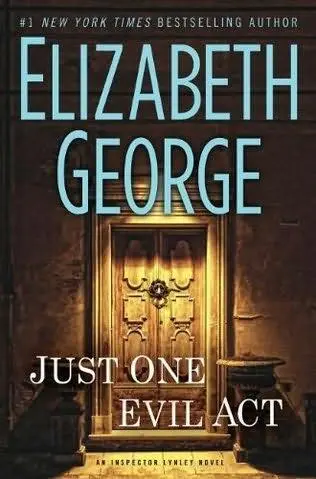
- Название:Just One Evil Act
- Автор:
- Издательство:Dutton
- Жанр:
- Год:2013
- ISBN:978-0-698-13828-5
- Рейтинг книги:5 / 5. Голосов: 1
-
Избранное:Добавить в избранное
- Отзывы:
-
Ваша оценка:
Just One Evil Act: краткое содержание, описание и аннотация
Предлагаем к чтению аннотацию, описание, краткое содержание или предисловие (зависит от того, что написал сам автор книги «Just One Evil Act»). Если вы не нашли необходимую информацию о книге — напишите в комментариях, мы постараемся отыскать её.
bestselling author Elizabeth George offers the latest in her Inspector Lynley series: a gripping child-in-danger story featuring fan favorite Barbara Havers. Detective Sergeant Barbara Havers is at a loss: The daughter of her friend Taymullah Azhar has been taken by her mother, and Barbara can't really help—Azhar had never married Angelina, and his name isn't on Hadiyyah's, their daughter's, birth certificate. He has no legal claim. Azhar and Barbara hire a private detective, but the trail goes cold.
Azhar is just beginning to accept his soul-crushing loss when Angelina reappears with shocking news: Hadiyyah is missing, kidnapped from an Italian marketplace. The Italian police are investigating, and the Yard won't get involved, until Barbara takes matters into her own hands. As she attempts to navigate the complicated waters of doing anything for the case against her superior's orders, her partner, Inspector Thomas Lynley, is dispatched to Italy as the liaison between the Italian police and Hadiyyah's distraught parents.
In time, both Barbara and Lynley discover that the case is far more complex than just a kidnapping, revealing secrets about Angelina; her new lover, Lorenzo; and even Azhar—secrets Barbara may not be willing to accept. With both her job and the life of a little girl on the line, Barbara must decide what matters most and how far she's willing to go to protect it.
Just One Evil Act — читать онлайн бесплатно полную книгу (весь текст) целиком
Ниже представлен текст книги, разбитый по страницам. Система сохранения места последней прочитанной страницы, позволяет с удобством читать онлайн бесплатно книгу «Just One Evil Act», без необходимости каждый раз заново искать на чём Вы остановились. Поставьте закладку, и сможете в любой момент перейти на страницу, на которой закончили чтение.
Интервал:
Закладка:
“You don’t listen to me . I have no symptoms. It was flu or a bad meal or a twenty-four-hour whatever. I’m fine now. I’m going home. You’re the one being ridiculous about this.”
Lorenzo’s face darkened but that was the extent of his reaction. “ Le donne incinte ,” Lynley murmured to him. Pregnant women needed to be humoured. Things would return to normal again—at least in this matter—when Angelina was safely delivered of their child. As to the rest of their life together . . . He knew this depended on the outcome of Hadiyyah’s disappearance.
“If we can speak for a moment?” he said to them. “Perhaps inside?” He indicated the doors of the hospital. There was a lobby within.
They agreed to this, and they established themselves in such a way that the light was good on all of their faces, rendering them readable to Lynley as he imparted the information. A car had been found in the Apuan Alps, he said, at the scene of an accident that had apparently occurred a few days earlier, although they wouldn’t know the exact time until a forensic pathologist examined a man’s body that had been near the vehicle. He hastened to add that no child’s body had been at the accident site, but because the car in question matched the description of a car seen parked in a lay-by with a man and a young girl near it, the vehicle was being taken off for study. They would be looking for a child’s fingerprints as well as any other evidence of her presence.
Angelina nodded numbly. She said, “ Capisco, capisco ,” and then, “I understand. You must need . . .” She didn’t seem able to continue.
Lynley said, “I’m afraid we do. Her toothbrush, her hairbrush, anything to give us a DNA sample. The police will want to dust for her fingerprints, perhaps in her bedroom, so comparisons can be made.”
“Of course.” She looked at Azhar and then away, out of the window where Italian cypresses shielded the car park from view and a fountain bubbled on a square of gravel with benches on all four of its sides. “What do you think?” she said to Lynley. “What do they think . . . the police?”
“They’ll be checking into everything about the man whose body was there.”
“Do they know . . . Can they tell . . . ?”
“He had identification with him,” Lynley said. And here was the important part, their reactions when he said the name. “Roberto Squali,” he told them. “Is that name familiar to any of you?”
But there was nothing. Just three blank faces and an exchange of looks between Lorenzo and Angelina as they asked each other nonverbally if this was a person either of them knew. As for Azhar, he repeated the name. But it seemed more an effort to commit it to memory than an attempt to appear in the dark about who this man was.
Whatever came next, it would be from police work on the part of the Italian force, Lynley reckoned. Either that or from Barbara’s uncovering something in London.
They would all have to wait.
29 April
LUCCA
TUSCANY
F orse quarantotto ore .” Over the telephone Dr. Cinzia Ruocco gave Salvatore Lo Bianco the information in her usual manner when speaking to a male: on the border between rude and angry. She didn’t like men, and who could blame her? She looked like a young Sophia Loren, and because of this she’d suffered men’s lusting after her body for a good twenty-five of her thirty-eight years. Whenever Salvatore saw her, he lusted after her as well. He liked to think he was good at keeping his thoughts off his face, but the medical examiner had antennae attuned to the slightest mental image that might pop up in the head of any male who gazed upon her bounteous physical virtues. This was one of the reasons she preferred to do things by phone. Again, who could blame her?
Forty-eight hours, Salvatore thought. Where had Roberto Squali been heading, then, forty-eight hours ago when his car had flown off the road and his life had ended? Was he drunk? he asked Cinzia Ruocco. He was not, she replied. Not drunk and, barring toxicology reports which would be weeks in coming, not impaired in any way. Except, she added, in the way of all men who think ownership of a fast sports car makes them more masculine than owning something sensible. She wouldn’t be surprised to learn this fool had possession of a motorcycle as well. Something huge, she said, to take the place of what—she was happy to report—he didn’t have in great size between his legs.
“ Sì, sì ,” Salvatore said. He knew Cinzia lived with a man, but he had to wonder how the fellow put up with her general disdain for males of all species. He rang off and considered a map he’d posted on the wall of his office. There was so much in the Apuan Alps. It would take a century to work out where the dead man had been heading, if, indeed, where he’d been heading was relevant to the case.
Salvatore had come up with a photo of Squali in better days, which was any day prior to the day on which they’d found his body. He was a handsome man, and with the picture in his possession, it was a small matter for Salvatore to reboot the tourist photographs he’d loaded onto his laptop and to verify that it was indeed Squali standing there in the crowd behind Hadiyyah, holding the card with a yellow happy face on it. Seeing this, Salvatore considered his next options.
They had everything to do with Piero Fanucci. Il Pubblico Ministero was not going to be pleased when Salvatore revealed to him that he might be wrong about his prime suspect. In the past two days, Fanucci had invested a great deal into Carlo Casparia’s ostensible guilt, allowing more and more details of the drug addict’s “confession” to be leaked to the press. He’d even given an interview about the investigation to Prima Voce . This interview had ended up on the tabloid’s front page as well as its website, which meant it would soon enough be translated by the British media, members of which group had started to show up in Lucca. They’d made short work of figuring out that the café down the street from the questura was the best spot to pick up gossip about the case, and like their Italian counterparts, they were dogged when it came to buttonholing police officials for direct questioning.
Because of this latter fact, when it came down to it, there was really no decision to make about whether to tell il Pubblico Ministero about the discovery of Roberto Squali, Salvatore realised. Should he not tell him, a reporter would, or—what was worse—Piero would read about it in Prima Voce . There would be hell for Salvatore to pay if that occurred. So there was nothing for it but to pay a call upon Fanucci.
Salvatore gave the magistrato every one of the details he’d so far withheld: the red convertible, the previous sighting of a man and a girl heading into the woods, the American tourist’s photos of a man in possession of a card that—so it appeared—he seemed to have given to the missing girl, and now the accident site with that same man’s dead body forty-eight hours in the out-of-doors.
Fanucci listened to Salvatore’s recitation from the other side of his vast walnut desk, twirling a pen in his fingers and keeping his eyes fixed upon Salvatore’s lips. At the conclusion of Salvatore’s remarks, il Pubblico Ministero abruptly shoved his chair back, surged to his feet, and walked to his bookcases. Salvatore steeled himself for Fanucci’s rage, possibly to include the hurling of legal volumes in his direction.
What came, however, was something else.
“ Così . . . ,” Fanucci murmured. “ Così, Topo . . .”
Salvatore waited for more. He did not have to wait long.
Читать дальшеИнтервал:
Закладка:
Похожие книги на «Just One Evil Act»
Представляем Вашему вниманию похожие книги на «Just One Evil Act» списком для выбора. Мы отобрали схожую по названию и смыслу литературу в надежде предоставить читателям больше вариантов отыскать новые, интересные, ещё непрочитанные произведения.









Обсуждение, отзывы о книге «Just One Evil Act» и просто собственные мнения читателей. Оставьте ваши комментарии, напишите, что Вы думаете о произведении, его смысле или главных героях. Укажите что конкретно понравилось, а что нет, и почему Вы так считаете.