Elizabeth George - Just One Evil Act
Здесь есть возможность читать онлайн «Elizabeth George - Just One Evil Act» весь текст электронной книги совершенно бесплатно (целиком полную версию без сокращений). В некоторых случаях можно слушать аудио, скачать через торрент в формате fb2 и присутствует краткое содержание. Год выпуска: 2013, ISBN: 2013, Издательство: Dutton, Жанр: Детектив, на английском языке. Описание произведения, (предисловие) а так же отзывы посетителей доступны на портале библиотеки ЛибКат.
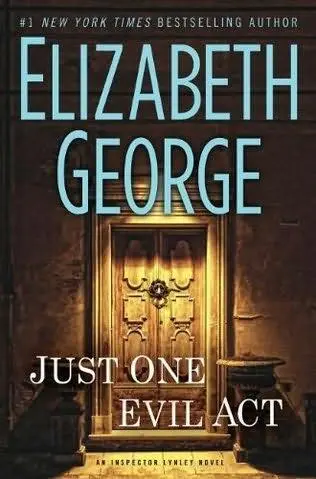
- Название:Just One Evil Act
- Автор:
- Издательство:Dutton
- Жанр:
- Год:2013
- ISBN:978-0-698-13828-5
- Рейтинг книги:5 / 5. Голосов: 1
-
Избранное:Добавить в избранное
- Отзывы:
-
Ваша оценка:
Just One Evil Act: краткое содержание, описание и аннотация
Предлагаем к чтению аннотацию, описание, краткое содержание или предисловие (зависит от того, что написал сам автор книги «Just One Evil Act»). Если вы не нашли необходимую информацию о книге — напишите в комментариях, мы постараемся отыскать её.
bestselling author Elizabeth George offers the latest in her Inspector Lynley series: a gripping child-in-danger story featuring fan favorite Barbara Havers. Detective Sergeant Barbara Havers is at a loss: The daughter of her friend Taymullah Azhar has been taken by her mother, and Barbara can't really help—Azhar had never married Angelina, and his name isn't on Hadiyyah's, their daughter's, birth certificate. He has no legal claim. Azhar and Barbara hire a private detective, but the trail goes cold.
Azhar is just beginning to accept his soul-crushing loss when Angelina reappears with shocking news: Hadiyyah is missing, kidnapped from an Italian marketplace. The Italian police are investigating, and the Yard won't get involved, until Barbara takes matters into her own hands. As she attempts to navigate the complicated waters of doing anything for the case against her superior's orders, her partner, Inspector Thomas Lynley, is dispatched to Italy as the liaison between the Italian police and Hadiyyah's distraught parents.
In time, both Barbara and Lynley discover that the case is far more complex than just a kidnapping, revealing secrets about Angelina; her new lover, Lorenzo; and even Azhar—secrets Barbara may not be willing to accept. With both her job and the life of a little girl on the line, Barbara must decide what matters most and how far she's willing to go to protect it.
Just One Evil Act — читать онлайн бесплатно полную книгу (весь текст) целиком
Ниже представлен текст книги, разбитый по страницам. Система сохранения места последней прочитанной страницы, позволяет с удобством читать онлайн бесплатно книгу «Just One Evil Act», без необходимости каждый раз заново искать на чём Вы остановились. Поставьте закладку, и сможете в любой момент перейти на страницу, на которой закончили чтение.
Интервал:
Закладка:
She was sitting on the stone floor of the place, her knees drawn up to her chin and her thin arms holding her legs in place. She was tucked into the deepest cool shadows, and as Sister Domenica Giustina entered the grotto, she saw the child shrink away.
“ Vieni, Carina ,” she said softly to the child, extending her hand. “ Vieni con me .”
The girl looked up, her face like a haunted thing. She began to speak, but the words she used were not in Italian, so Sister Domenica Giustina understood from them only a few words. “I want my mummy,” Carina said. “I want my dad. I was s’posed to see him and where is he and I want him and I don’t want to be here anymore and I’mscaredandIwantmydadnownownow!”
Dad was the word Sister Domenica Giustina caught among the rush of language. She said, “ Tuo padre, Carina? ”
“IwanttogohomeandIwantmydad.”
“ Padre, sì? ” Sister Domenica Giustina clarified. “ Vorresti vedere tuo padre? ”
“ Voglio andare a casa ,” the little girl said, her voice growing stronger. “ Voglio andare da mio padre, chiaro? ”
“Ah, sì ?” Sister Domenica Giustina said. “ Capisco, ma prima devi venire qui .”
She held out her hand once more. If the child wanted to go to her father’s home, as she said, there were steps to be taken and those steps could not begin in the Grotta dei Venti .
The child looked at the hand extended to her. Her face wore an expression of doubt. Sister Domenica Giustina smiled softly to encourage her. “ Non avere paura ,” she told her, for there was indeed no reason to have fear.
Slowly, then, Carina got to her feet. She put her hand in Sister Domenica Giustina’s. Together, they left the cool confines of the grotto. Together, they climbed the stairs out of the sunken garden and began to approach the great shuttered villa.
“ Ti dobbiamo preparare ,” Sister Domenica Giustina murmured to the little girl. For she could not meet with her father unprepared. She had to be ready: sweet and clean and pure. She explained this to the child as she urged her forward, past the villa’s wide and empty loggia, past the sweeping steps that led up to this, round the corner of the building itself, and in the direction of the vast cellars of the place.
It was on the approach to the steps leading down to the cellars that Carina’s footsteps began to falter. She began to pull back in obvious reluctance. She began to speak words that Sister Domenica Giustina could not hope to understand.
“Mydadsnottherehe’snotinthecellaryousaidmydadyousaidyouwouldtakemetomydadIwon’tgoIwon’tIwon’tit’sdarkinthereitsmells I’mafraid!”
Sister Domenica Giustina said, “ No, no, no. Non devi . . .” But the child did not understand. She tried to pull away with all the strength she had, but with surpassing strength Sister Domenica Giustina pulled back. “ Vieni ,” she said. “ Devi venire .”
Down one step, down two, down three. An enormous effort and she had the child within the damp, dank darkness of the cellar.
But there the little girl began to scream. And the only way to silence her was to drag her far, far inside the rooms of the cellar until she could not be heard by the world outside the forbidding walls of that terrible place.
LUCCA
TUSCANY
Salvatore knew that the possibility of Roberto Squali’s having arranged the kidnapping of the English child on his own was remote. Although his past clearly identified him as a player on the field of illegal activities, there had for years been no hint of scandal or law-breaking on his part. The logical conclusion was that although the child had been with him, she had not come to his attention as a kidnap victim via his own inspiration. The business card of Michelangelo Di Massimo within Squali’s portafoglio suggested that there was a substantial link among the private detective, Squali, and the crime, and Salvatore was intent upon finding it.
This did not take long for the simple reason that Roberto Squali had done nothing at all to hide the link, so sure had he apparently been of the potential success of the scheme. The records of his telefonino revealed calls made to him by Michelangelo Di Massimo. The records of his bank account showed a significant deposit made into his account—in cash—on the very day of the girl’s disappearance. This deposit far exceeded anything that Roberto Squali had put into his account at any other time. Salvatore was not a betting man, but he found himself willing to wager that an amount identical to Squali’s deposit had left the account of Michelangelo Di Massimo on the very same day. Salvatore made the necessary arrangements to have those banking records sent to him via the Internet. Then he ordered the Pisan detective to be brought to the questura . There would be no polite visit by the police to Di Massimo’s office or to the salon of his hairdresser or to any other place the man might have established himself. Salvatore wanted Di Massimo intimidated, and he knew how best to effect that reaction.
He rang DI Lynley in advance of Di Massimo’s arrival. He also rang Piero Fanucci to bring him up to the minute on what he’d discovered and on which direction he was now headed with the case. On the part of Lynley, the conversation was brief: If the chief inspector didn’t mind, the British detective would like to be present for the questioning of this man. On the part of Fanucci, the conversation was quite mad: They had their kidnapper or at least their mastermind in the person of Carlo Casparia, and Salvatore’s instructions had been and still were to find the connection that existed between this Roberto Squali and him . If he couldn’t manage that much . . . Did Fanucci need to see to it that someone else was assigned to this case, or was Topo going to come to his senses and resist the inclination to follow every wild hare that happened to hop by him?
“For the love of God, Piero” got Salvatore nowhere. So he agreed—as useless as he knew the endeavour would be—to see in what manner he could prove a conspiracy among three men when two of them did not even know of the existence of the third.
When Lynley arrived at the questura , Salvatore told him of his visit to the home of the Medici family in Via del Fosso. On a map of the province, he showed him the position of the convent as indicated by the parents of Domenica Medici, caretaker of the place. This could be something or it could be nothing, he explained to the Englishman. But the fact that Squali had been headed in the direction of this place where his cousin lived at least suggested her involvement. Once they had hammered down Di Massimo’s part in what had occurred that day in the mercato , the convent was their next logical move.
Di Massimo’s arrival caused a stir outside among the paparazzi and the reporters who were hanging about the questura on the scent of a new angle to the story. When he saw them, the Pisan detective covered his head—which, considering the appearance of his yellow hair, didn’t seem like a bad idea—but a covered head indicated an unwillingness to be photographed, which naturally provoked the paparazzi into a frenzy of photographing him on the off chance that he was someone of interest.
Inside the questura , Di Massimo garnered an equal amount of attention. He wore his motorcycle leathers and wraparound sunglasses so dark that his eyes were hidden. His demands for an avvocato were vociferous and angry. Per favore was not part of what he said.
Salvatore and DI Lynley met him in an interview room. Four uniformed policemen lined along the wall to emphasise the seriousness of the situation. A tape recorder and a video camera were set up to document the proceedings. These began with polite offers of food and drink and a request for the name of Di Massimo’s lawyer so that the man or woman could be sent for immediately to attend upon the needs of the suspect.
Читать дальшеИнтервал:
Закладка:
Похожие книги на «Just One Evil Act»
Представляем Вашему вниманию похожие книги на «Just One Evil Act» списком для выбора. Мы отобрали схожую по названию и смыслу литературу в надежде предоставить читателям больше вариантов отыскать новые, интересные, ещё непрочитанные произведения.












Обсуждение, отзывы о книге «Just One Evil Act» и просто собственные мнения читателей. Оставьте ваши комментарии, напишите, что Вы думаете о произведении, его смысле или главных героях. Укажите что конкретно понравилось, а что нет, и почему Вы так считаете.