Margaret Atwood - Cat's eye
Здесь есть возможность читать онлайн «Margaret Atwood - Cat's eye» весь текст электронной книги совершенно бесплатно (целиком полную версию без сокращений). В некоторых случаях можно слушать аудио, скачать через торрент в формате fb2 и присутствует краткое содержание. Жанр: Старинная литература, на английском языке. Описание произведения, (предисловие) а так же отзывы посетителей доступны на портале библиотеки ЛибКат.
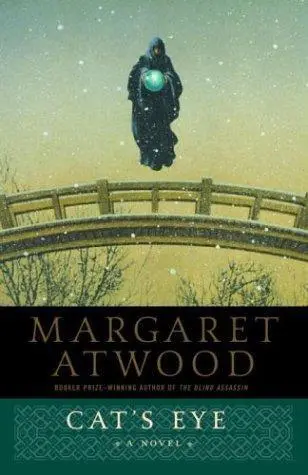
- Название:Cat's eye
- Автор:
- Жанр:
- Год:неизвестен
- ISBN:нет данных
- Рейтинг книги:5 / 5. Голосов: 1
-
Избранное:Добавить в избранное
- Отзывы:
-
Ваша оценка:
Cat's eye: краткое содержание, описание и аннотация
Предлагаем к чтению аннотацию, описание, краткое содержание или предисловие (зависит от того, что написал сам автор книги «Cat's eye»). Если вы не нашли необходимую информацию о книге — напишите в комментариях, мы постараемся отыскать её.
Cat's eye — читать онлайн бесплатно полную книгу (весь текст) целиком
Ниже представлен текст книги, разбитый по страницам. Система сохранения места последней прочитанной страницы, позволяет с удобством читать онлайн бесплатно книгу «Cat's eye», без необходимости каждый раз заново искать на чём Вы остановились. Поставьте закладку, и сможете в любой момент перейти на страницу, на которой закончили чтение.
Интервал:
Закладка:
There are indeed three photos. One is of my head, shot a little from beneath so it looks as if I have a double chin. The other two are of paintings. One is of Mrs. Smeath, bare-naked, flying heavily through the air. The church spire with the onion on it is in the distance. Mr. Smeath is stuck to her back like an asparagus beetle, grinning like a maniac; both of them have shiny brown insect wings, done to scale and meticulously painted. Erbug, The Annunciation, it’s called. The other is of Mrs. Smeath by herself, with a sickle-moon paring knife and a skinless potato, unclad from the waist up and the thighs down. This is from the Empire Bloomers series. The newspaper photos don’t do these paintings justice, because there’s no color. They look too much like snapshots. I know that in real life the bloomers on Mrs. Smeath are an intense indigo blue that took me weeks to get right, a blue that appears to radiate a dark and stifling light.
I scan the first paragraph: “Eminent artist Elaine Risley returns to hometown Toronto this week for a long overdue retrospective.” Eminent, the mausoleum word. I might as well climb onto the marble slab right now and pull the bedsheet over my head. There are the usual misquotations, nor does my blue jogging suit escape comment. “Elaine Risley, looking anything but formidable in a powder-blue jogging suit that’s seen better days, nevertheless can come out with a few pungent and deliberately provocative comments on women today.”
I suck in some coffee, skip to the last paragraph: the inevitable eclectic, the obligatory post-feminist, a however and a despite. Good old Toronto bet hedging and qualification. A blistering attack would be preferable, some flying fur, a little fire and brimstone. That way I would know I’m still alive. I think savagely of the opening. Perhaps I should be deliberately provocative, perhaps I should confirm their deepest suspicions. I could strap on some of Jon’s axmurder special effects, the burnt face with its one peeled bloodshot eye, the plastic blood-squirting arm. Or slip my feet into the hollow casts of feet and lurch in like something from a mad scientist movie.
I won’t do these things, but thinking about them is soothing. It distances the entire thing, reduces it to a farce or prank, in which I have no involvement aside from mockery.
Cordelia will see this piece in the paper, and maybe she will laugh. Even though she’s not in the phone book, she must still be around here somewhere. It would be like her to have changed her name. Or maybe she’s married; maybe she’s married more than once. Women are hard to keep track of, most of them. They slip into other names, and sink without a trace.
At any rate she’ll see this. She’ll know it’s Mrs. Smeath, she’ll get a kick out of that. She’ll know it’s me, and she’ll come. She’ll come in the door and she’ll see herself, titled, framed, and dated, hanging on the wall. She will be unmistakable: the long line of jaw, the slightly crooked lip. She appears to be in a room, alone; a room with walls of a pastel green.
This is the only picture I ever did of Cordelia, Cordelia by herself. Half a Face, it’s called: an odd title, because Cordelia’s entire face is visible. But behind her, hanging on the wall, like emblems in the Renaissance, or those heads of animals, moose or bear, you used to find in northern bars, is another face, covered with a white cloth. The effect is of a theatrical mask. Perhaps. I had trouble with this picture. It was hard for me to fix Cordelia in one time, at one age. I wanted her about thirteen, looking out with that defiant, almost belligerent stare of hers. So?
But the eyes sabotaged me. They aren’t strong eyes; the look they give the face is tentative, hesitant, reproachful. Frightened.
Cordelia is afraid of me, in this picture.
I am afraid of Cordelia.
I’m not afraid of seeing Cordelia. I’m afraid of being Cordelia. Because in some way we changed places, and I’ve forgotten when.
Chapter 42
A fter the summer I’m in Grade Ten. Although I’m still shorter, still younger, I have grown. Specifically, I’ve grown breasts. I have periods now, like normal girls; I too am among the knowing, I too can sit out volleyball games and go to the nurse’s for aspirin and waddle along the halls with a pad like a flattened rabbit tail wadded between my legs, sopping with liver-colored blood. There are satisfactions in this. I shave my legs, not because there’s much to shave but because it makes me feel good. I sit in the bathtub, scraping away at my calves, which I wish were thicker, bulgier, like the calves of cheerleaders, while my brother mutters outside.
“Mirror, mirror on the wall, who is the most beautiful of all?” he says.
“Go away,” I say tranquilly. I now have that privilege.
In school I am silent and watchful. I do my homework. Cordelia plucks her eyebrows into two thin lines, thinner than mine, and paints her nails Fire and Ice. She loses things, such as combs and also her French homework. She laughs raucously in the halls. She comes up with new, complicated swearwords: excrement of the ungulate, she says, meaning bullshit, and great flaming blue-eyed bald-headed Jesus. She takes up smoking and gets caught doing it in the girls’ washroom. It must be hard for the teachers, looking, to figure out why we are friends, what we’re doing together. Today on the way home it snows. Big soft caressing flakes fall onto our skin like cold moths; the air fills with feathers. Cordelia and I are elated, we racket along the sidewalk through the twilight while the cars drift past us, hushed and slowed by the snow. We sing:
Remember the name
Of Lydia Pinkham,
Whose remedies for women brought her FAME!
This is a singing commercial from the radio. We don’t know what Lydia Pinkham’s remedies are, but anything that says “for women” on it has to do with monthly blood or some equally unspeakable female thing, and so we think it’s funny. Also we sing:
Leprosy,
Night and day you torture me,
There goes my eyeball
Into my highball….
Or else:
Part of your heart,
That’s what I’m eating now,
Too bad we bad to part….
We sing these, and other parodies of popular songs, all of which we think are very witty. We run and slide, in our rubber boots with the tops turned down, and make snowballs which we throw at lampposts, at fire hydrants, bravely at passing cars, and as close as we dare at people walking on the sidewalk, women most of them, with shopping bags or dogs. We have to set our school books down to make the snowballs. Our aim is poor and we don’t hit much of anything, though we hit a woman in a fur coat, from behind, by mistake. She turns and scowls at us and we run away, around a corner and up a side street, laughing so much with terror and embarrassment we can hardly stand up. Cordelia throws herself backward onto a snow-covered lawn. “The evil eye!” she shrieks. For some reason I don’t like the sight of her lying there in the snow, arms spread out.
“Get up,” I say. “You’ll catch pneumonia.”
“So?” says Cordelia. But she gets up.
The streetlights come on, though it isn’t yet dark. We reach the place where the cemetery begins, on the other side of the street.
“Remember Grace Smeath?” Cordelia says.
I say yes. I do remember her, but not clearly, not continuously. I remember her from the time I first knew her, and later, sitting in the apple orchard with a crown of flowers on her head; and much later, when she was in Grade Eight and about to go off to high school. I don’t even know what high school she went to. I remember her freckles, her little smile, her coarse horsehair braids.
Читать дальшеИнтервал:
Закладка:
Похожие книги на «Cat's eye»
Представляем Вашему вниманию похожие книги на «Cat's eye» списком для выбора. Мы отобрали схожую по названию и смыслу литературу в надежде предоставить читателям больше вариантов отыскать новые, интересные, ещё непрочитанные произведения.





Обсуждение, отзывы о книге «Cat's eye» и просто собственные мнения читателей. Оставьте ваши комментарии, напишите, что Вы думаете о произведении, его смысле или главных героях. Укажите что конкретно понравилось, а что нет, и почему Вы так считаете.