Richard Patterson - Conviction
Здесь есть возможность читать онлайн «Richard Patterson - Conviction» весь текст электронной книги совершенно бесплатно (целиком полную версию без сокращений). В некоторых случаях можно слушать аудио, скачать через торрент в формате fb2 и присутствует краткое содержание. Жанр: Старинная литература, на английском языке. Описание произведения, (предисловие) а так же отзывы посетителей доступны на портале библиотеки ЛибКат.
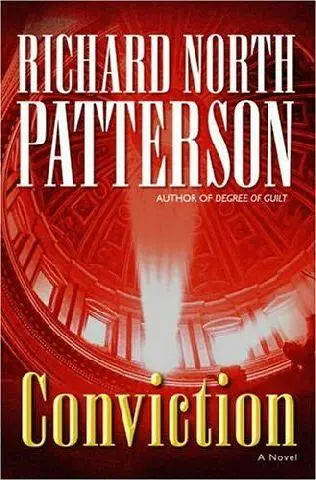
- Название:Conviction
- Автор:
- Жанр:
- Год:неизвестен
- ISBN:нет данных
- Рейтинг книги:3 / 5. Голосов: 1
-
Избранное:Добавить в избранное
- Отзывы:
-
Ваша оценка:
Conviction: краткое содержание, описание и аннотация
Предлагаем к чтению аннотацию, описание, краткое содержание или предисловие (зависит от того, что написал сам автор книги «Conviction»). Если вы не нашли необходимую информацию о книге — напишите в комментариях, мы постараемся отыскать её.
Conviction — читать онлайн бесплатно полную книгу (весь текст) целиком
Ниже представлен текст книги, разбитый по страницам. Система сохранения места последней прочитанной страницы, позволяет с удобством читать онлайн бесплатно книгу «Conviction», без необходимости каждый раз заново искать на чём Вы остановились. Поставьте закладку, и сможете в любой момент перейти на страницу, на которой закончили чтение.
Интервал:
Закладка:
"I remember it." Frowning, Caroline became still, a reflective figure framed by the only personal mementos on her credenza—a photograph of her daughter, Brett, another taken with President Kilcannon in the Rose Garden on the day of her surprising nomination. "The freestanding innocence question is a bit dicey," the Chief allowed. "I'd prefer the Court not grapple with it now. Is Justice Fini's communiqué in the nature of a polemic, or does it come with a concrete plan of action?"
"It comes with a countermemo." Written, Callista did not add, by a bow-tied and overprivileged little reactionary from Virginia Law School, quite possibly America's whitest male. "Justice Fini wants you to put the Price case on the discuss list."
Though Caroline smiled resignedly, Callista could imagine her perplexity. The Chief Justice's "discuss list," circulated before each conference among the justices, specified the petitions she deemed worthy of consideration. While the vast majority of petitions never made the list—and, therefore, were dead—any associate justice could request that a petition be added to the list. When that justice was Anthony Fini, what followed was often contentious: not only did Fini give no quarter but he was that rarest of justices on a decorous Court, a vigorous lobbyist for his positions. And never more so than in opposing strictures on the death penalty, for which he was an unabashed proponent—Rennell Price, whoever he was, had become less a person than a potential milestone in the law.
After a moment, Caroline Masters stirred herself from thought. "Prepare another memo," she directed briskly. "Hit all the issues raised by Justice Fini, and all the reasons not to take this case. I don't think it would be in the interest of the law or, in candor, this Court."
"How so?"
The Chief Justice considered her, then offered a rare elaboration of her thoughts. "Capital punishment," she answered, "distorts the law, imports the corruptions of politics into whether a prisoner lives or dies, and corrodes relations among the justices. Eventually, death penalty cases present so many fundamental questions that they can color one justice's view of another as a human being. I don't want that to happen to my colleagues."
Or to me, Callista could sense the Chief thinking. Caroline Masters was no doubt aware of the subterranean bitterness swirling among the justices—the rumor, for example, that after the latest approval of an execution in Mississippi, Justice Fini had referred to the Chief Justice's dissenting ally Justice Huddleston as a "hand-wringing mediocrity," and that the venerable Huddleston had labeled Fini "the only justice in memory who'd have deferred to the commandant of Auschwitz." The Chief Justice surely did not want another death row inmate to put her Court, or these emotions, in play.
"Do you want me to circulate my memo?" Callista asked.
"Only after I read it," Caroline Masters answered. "With all respect, Callista, I might want to take a hand in this myself."
FOUR
TWO FRIDAYS LATER, THE NINE JUSTICES OF THE UNITED STATES Supreme Court gathered in the Chief Justice's conference room.
To Caroline Masters, the room combined the clubby aura of an inner sanctum with a distinct sense of history—wood paneling, a fireplace, a rich red carpet, oil portraits of Chief Justices Marshall and Jay in scarlet robes, shelves filled with books preserving the Court's prior rulings. At other such conferences, the Court had unanimously voted to bar segregation in Brown v. Board of Education and, two decades later, divided bitterly over Roe v. Wade. The two rulings, so different in conception and consequence, were ever on Caroline's mind; if she could manage to build consensus—and this task was not easy—this Court would not exacerbate the acrid cultural and social schisms which existed in contemporary America, and which made the ongoing battle over federal judicial nominations as incendiary as had been her own.
Certainly, the timeless rituals of these conferences were crafted to preserve decorum. Each began with the justices shaking hands before they sat at a long table inlaid with green leather and illuminated by a crystal chandelier. Their places, too, were preordained: Caroline sat at one end of the table in a leather chair bearing a brass nameplate which said simply "The Chief Justice"; the opposite end was reserved for the senior associate justice, Walter Huddleston. The next most senior justices—Anthony Fini, McGeorge Glynn, Thomas Raymond—sat to Caroline's right, while the four who were most junior—John Ware, Bryson Kelly, Miriam Rothbard, and Dennis Millar—faced them across the table. The Court's newest member, Justice Millar, was stationed nearest the door, so as to pass messages or requests for additional documents to the messenger waiting outside. On the surface, Caroline thought dryly, everyone knew his place.
But the far less neutral way in which they defined their places made Caroline edgy. In the most contentious cases she, Huddleston, and Rothbard battled with Fini, Kelly, and Ware for the votes of the centrists—Glynn, Raymond, and Millar. So that today, when Justice Fini grinned and shook her hand, she thought of former Justice Byrnes's remark that the handshake reminded him of the referee's instructions before a prize fight: "Shake hands, go to your corner, and come out fighting."
Still, as the conference wended its way through the discuss list, their exchanges remained sufficiently muted that Caroline dared to hope contention might take a holiday. When they arrived at the Price case, she said with deceptive ease, "This one's yours, Tony."
Immediately she sensed a heightened alertness among the others, underscored by Justice Huddleston's quizzical frown toward his nemesis, Anthony Fini: challenges to a memo from the cert pool were unusual, and the sharpness of Fini's language, an incitement to controversy, was matched by the lawyerly thoroughness of Caroline's response. And if Fini carried Kelly and Ware—a near certainty—all he needed for the Court to grant the State of California's petition was the vote of a single centrist.
"To begin with," Fini said crisply, "this case involves a horrendous crime—"
"They're all horrendous," Huddleston murmured with a rumble of disdain.
Fini paused, to signal his annoyance, then continued as though Huddleston had not spoken. "—in a case which, to me, is wrongly decided and bristles with contempt for AEDPA. Not to mention whole paragraphs of result-oriented jurisprudence contrived by its progenitors, Judges Sanders and Montgomery."
You just can't resist going after Montgomery, Caroline thought.
"Among the more glaring problems," Justice Fini continued, "the majority concludes that the Atkins bar on executing the supposedly retarded applies retroactively to habeas corpus petitioners like Price; that it owed no deference to the California Supreme Court; that a dubious jailhouse confession establishes innocence under AEDPA; and that, regardless of AEDPA, Price had the right on a second habeas corpus petition to demonstrate freestanding innocence. In short," Fini concluded with disdain, "they tried every intellectual gyration necessary to bar an execution. To countenance such a shabby result is to beg for more—especially from jurists like this creative duo."
"Creative?" Kelly asked rhetorically. "You mean lawless."
Caroline chose to ignore this second breach of manners, another justice speaking out of turn. "Tony," she said to Fini, "do you have anything else?"
"No," Fini answered briskly. "Save that I vote to grant the State's petition."
Three votes to go, Caroline thought. "As Chief," she began, "and given that I'm responsible for the pool memo, I should respond.
"We all know the history between this Court and my former circuit. But it is essential not to personalize this matter." Her tone, though even, contained a touch of acid. "After all, I'm sure none of us believes that our Court's principal purpose is the moral instruction of Blair Montgomery."
Читать дальшеИнтервал:
Закладка:
Похожие книги на «Conviction»
Представляем Вашему вниманию похожие книги на «Conviction» списком для выбора. Мы отобрали схожую по названию и смыслу литературу в надежде предоставить читателям больше вариантов отыскать новые, интересные, ещё непрочитанные произведения.











Обсуждение, отзывы о книге «Conviction» и просто собственные мнения читателей. Оставьте ваши комментарии, напишите, что Вы думаете о произведении, его смысле или главных героях. Укажите что конкретно понравилось, а что нет, и почему Вы так считаете.