Richard Patterson - Conviction
Здесь есть возможность читать онлайн «Richard Patterson - Conviction» весь текст электронной книги совершенно бесплатно (целиком полную версию без сокращений). В некоторых случаях можно слушать аудио, скачать через торрент в формате fb2 и присутствует краткое содержание. Жанр: Старинная литература, на английском языке. Описание произведения, (предисловие) а так же отзывы посетителей доступны на портале библиотеки ЛибКат.
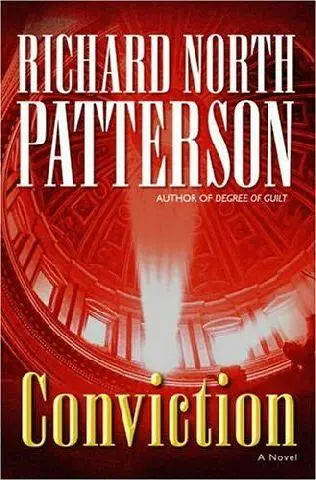
- Название:Conviction
- Автор:
- Жанр:
- Год:неизвестен
- ISBN:нет данных
- Рейтинг книги:3 / 5. Голосов: 1
-
Избранное:Добавить в избранное
- Отзывы:
-
Ваша оценка:
Conviction: краткое содержание, описание и аннотация
Предлагаем к чтению аннотацию, описание, краткое содержание или предисловие (зависит от того, что написал сам автор книги «Conviction»). Если вы не нашли необходимую информацию о книге — напишите в комментариях, мы постараемся отыскать её.
Conviction — читать онлайн бесплатно полную книгу (весь текст) целиком
Ниже представлен текст книги, разбитый по страницам. Система сохранения места последней прочитанной страницы, позволяет с удобством читать онлайн бесплатно книгу «Conviction», без необходимости каждый раз заново искать на чём Вы остановились. Поставьте закладку, и сможете в любой момент перейти на страницу, на которой закончили чтение.
Интервал:
Закладка:
Rennell nodded—whether out of instinct or merely to avoid speaking, Chris could not tell.
"Ever go to a game, Rennell?"
Rennell folded his hands. Softly, he answered, "Daddy never took me to no games."
Yeah, Chris thought, too busy with that space heater—fun for the entire family. He felt more foolish than before.
"What they like?" Rennell asked.
"Fun," Chris answered with a smile. "There's all kinds of food."
Rennell seemed to ponder this. "Food here's all the same. Sometimes, Grandma, she take me out for barbecue." He hesitated. "Before all this happen."
Chris tilted his head. "Did Payton go, too?"
"Sometimes." Rennell gave a reminiscent smile. "Sometimes she just take me. Special times, she say."
How much, Chris wondered, had Eula Price understood about his early childhood? Perhaps more than she had wished to, and far less than he had needed. But then what could she have done—there was so much damage to repair, so few resources. And therapists like Tony Lane did not set up shop in the Bayview.
"When I get out," Rennell said, "maybe you take me to a game. With Terri and Carlo and all."
Chris nodded. "They'd like that."
Rennell shook his head in wonder at the thought. "When you think I'm gettin' out?"
Chris hesitated. "Maybe June," he answered. "July, at the latest." One way or the other.
"July," Rennell repeated. "Sunny then. They still be playin' baseball?"
"Yeah. For sure." Chris mustered a smile. "If the Giants go to the championship, they'll still be playing in October."
Rennell hesitated, a frown of worry creasing his smooth forehead. "Where you think I be livin'?"
"I'm not sure yet."
Rennell bit his lip. "See, I was hopin' I could stay with you."
Chris had no answer. "Terri and Carlo love you," he said at last.
To his surprise, Rennell's eyes filled with tears. And then he half-stood, reaching across the table, and leaned his head against Chris's shoulder.
Feeling Rennell's hair and skin against his neck, Chris thought of Carlo, much younger, and then Kit. "They love you," he repeated softly.
SIX
PRESIDENT KERRY FRANCIS KILCANNON WAS NEARING THE END of a very long day and plainly had no patience for internecine warfare. "Why is this my problem?" he inquired of his Chief of Staff.
They sat in the Oval Office, two friends who were markedly different in temperament and appearance. At forty-four, Kerry bore the unmistakable stamp of Ireland, the country of his forebears—a slight but sinewy frame, thick ginger hair, a thin face at once angular and boyish, blue-green eyes which reflected the quicksilver of his moods—sometimes cold, at other times remote and almost absent, and at still others deeply empathic or glinting with amusement or outright laughter. Clayton Slade was the first African American to serve as Chief of Staff, and everything about him seemed earthbound—from his sturdy build and shrewd brown eyes to his plainness of speech and blunt determination to save his romantic and intuitive friend from his own worst impulses. With affection and amusement, Kerry had once remarked to Clayton, "Together, we make a passably good President. But don't start believing you could do the job without me."
Now Clayton smiled at his friend's annoyance. "Because your Solicitor General called me, back-dooring your Attorney General—"
"So tell them to work it out," Kerry snapped. "I'm the President, not a mediator. Or a judge."
"True," Clayton answered imperturbably. "People have to elect you. Next year you'll be asking them to do it again—this time, hopefully, by more than a few thousand votes. Given that you've already inflamed the pro-lifers and the gun lobby, you might want to embrace at least one of our nation's deeply rooted values."
"What?" Kerry inquired. "Executing people?"
Left unsaid were the complexity of Kerry's own feelings. After Kerry's older brother, Senator James Kilcannon, had been assassinated while running for President, Kerry—as a matter of private conscience—had asked the prosecution not to seek the assassin's execution. Yet Senator Kilcannon's death, which had propelled Kerry toward the presidency, haunted him still. "It's what Americans believe in," Clayton responded with the same air of calm. "During the last election you claimed to believe in it, too." Clayton took a brief sip of his diet cola, adding pointedly, "If you hadn't, Mr. President, you wouldn't be President."
"Oh, I know." Kerry emitted a sigh of resignation. "What's this contretemps about?"
"AEDPA. You voted for it, as you'll recall—"
"I try not to, actually."
"Anyhow, the Supreme Court's about to hear a death penalty case involving a prisoner named Rennell Price. You may have seen Bob Herbert's columns in the Times."
Reflective, the President rested an elbow on one arm of the wing chair, propping his face in the palm of his hand. "It's coming back to me," he said. "From the evidence, it sounded like he might well be innocent, and another man guilty."
"So his lawyers claim. But that's not the crux of our problem." Clayton finished his cola. "The Ninth Circuit issued an opinion that can be read to soften AEDPA. Your Attorney General and the head of his Criminal Division want the Solicitor General to support sharply restricting the rights of habeas corpus petitioners—like Price—to prove their innocence. Your new Solicitor General is balking."
Clayton watched the President consider this: the S.G., Avram Gold, had been his personal lawyer, and for a number of reasons, the President was in his debt. "What's Avi want?" he asked.
"Avi Gold," Clayton said with a touch of weariness, "is a civil libertarian. He hates the death penalty. He hates this statute, always has. So he wants us to stay out."
"Is that such a bad idea? What if Price is innocent?"
"Nobody will go blaming you," Clayton answered. "But if Avi Gold had his way, all you'd carry is the faculty room at Harvard.
"We've got capital punishment because that's what most Americans want, by roughly three to one. The people who don't want it—civil rights groups and social liberals—have got no one to vote for but us. But if Caroline Masters and her Court do something funky with the death penalty, the Republicans will come after you like hell won't have it."
Kerry smiled quizzically. "Is that what the Attorney General wants us to say?"
Silent, Clayton fought to repress his exasperation. With an intimacy and candor the President permitted him alone, he said softly, "Don't be perverse, Kerry. I understand what you wrestled with after Jamie was killed. But the difference between your presidency and that of some Republican is way too important to put at risk. Not to mention how you'd feel about losing."
"I appreciate the sentiment," Kerry answered with equal quiet. "That's why I voted for AEDPA, after all."
The President's ambivalence was unmistakable. "I guess you've decided to hear Avi out," Clayton said.
"Both of them—Avi and the A.G. Toward the end of lunch tomorrow."
"Isn't that your time with Lara and the baby?"
"Uh-huh." Kerry smiled again. "I'm making whoever loses change his diapers."
* * *
Though named after Kerry Kilcannon's older brother, at seven months of age James Joseph Kilcannon already had his father's blue-green eyes and inquisitive expression. But Jamie's raven hair and pale skin were Lara's.
Pausing in the doorway, Clayton found them sitting on a carpet in the middle of the Oval Office. They made a lovely picture, as numerous photographers had captured: the young First Lady whose beauty, derived from her Latina mother, had—combined with talent and a fierce will to succeed—helped make her a celebrated television journalist; the infant discovering the world on his hands and knees; the President to whom this child, their first, was an endless source of wonder and delight. Shadowed by the grimness of his childhood, Kerry thought of Jamie as a miracle, for whose happiness and wholeness Kerry would have sacrificed anything but Lara. Jamie, knowing none of this, simply found his father very silly.
Читать дальшеИнтервал:
Закладка:
Похожие книги на «Conviction»
Представляем Вашему вниманию похожие книги на «Conviction» списком для выбора. Мы отобрали схожую по названию и смыслу литературу в надежде предоставить читателям больше вариантов отыскать новые, интересные, ещё непрочитанные произведения.








Обсуждение, отзывы о книге «Conviction» и просто собственные мнения читателей. Оставьте ваши комментарии, напишите, что Вы думаете о произведении, его смысле или главных героях. Укажите что конкретно понравилось, а что нет, и почему Вы так считаете.