Richard Patterson - Conviction
Здесь есть возможность читать онлайн «Richard Patterson - Conviction» весь текст электронной книги совершенно бесплатно (целиком полную версию без сокращений). В некоторых случаях можно слушать аудио, скачать через торрент в формате fb2 и присутствует краткое содержание. Жанр: Старинная литература, на английском языке. Описание произведения, (предисловие) а так же отзывы посетителей доступны на портале библиотеки ЛибКат.
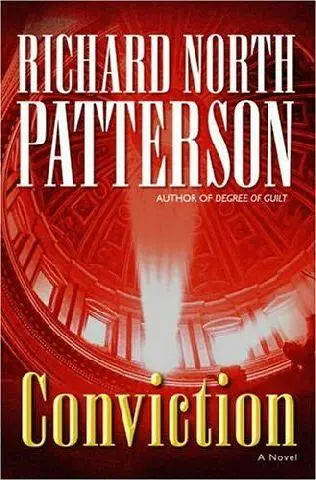
- Название:Conviction
- Автор:
- Жанр:
- Год:неизвестен
- ISBN:нет данных
- Рейтинг книги:3 / 5. Голосов: 1
-
Избранное:Добавить в избранное
- Отзывы:
-
Ваша оценка:
Conviction: краткое содержание, описание и аннотация
Предлагаем к чтению аннотацию, описание, краткое содержание или предисловие (зависит от того, что написал сам автор книги «Conviction»). Если вы не нашли необходимую информацию о книге — напишите в комментариях, мы постараемся отыскать её.
Conviction — читать онлайн бесплатно полную книгу (весь текст) целиком
Ниже представлен текст книги, разбитый по страницам. Система сохранения места последней прочитанной страницы, позволяет с удобством читать онлайн бесплатно книгу «Conviction», без необходимости каждый раз заново искать на чём Вы остановились. Поставьте закладку, и сможете в любой момент перейти на страницу, на которой закончили чтение.
Интервал:
Закладка:
"Facts," Pell corrected for Bond's benefit, "found true by a jury, confirmed three times by the California Supreme Court, and therefore entitled to a presumption of correctness under AEDPA. We can't pretend these facts don't exist, Your Honor. And even if we could, I'm entitled to ask an expert witness to assume certain facts for the purpose of eliciting his professional opinion."
Bond folded his hands. "Mr. Pell is well within his rights," he told Terri. "The witness may assume, for the purposes of answering, that the facts to which Mr. Fleet testified at trial are true."
Terri searched for a retort. "Then I hope Mr. Pell will give Mr. Fleet limited immunity, and allow this court to hear his testimony. That way we won't have to 'assume' his dubious credibility."
"You'll have time to argue that," Bond answered with a wave of the hand. "Go ahead, Mr. Pell."
Pell turned on Lane. "Are you familiar with Mr. Fleet's trial testimony?"
"Of course."
"Assume for the moment all that's true." Pell placed his hands on his hips, projecting an attitude of skepticism. "Would you still contend, Dr. Lane, that this series of deliberate actions by Rennell Price—starting with fetching Fleet and ending with Mr. Price disposing of Thuy Sen's body—betrays a 'failure of adaptive skills'?"
"That's difficult to say," Lane responded after a moment. "Even assuming that any of that happened, a great deal would depend on whether Rennell was acting under Payton's directions—"
"According to Fleet," Pell interrupted, "they were acting as coequals."
"Then it would be the only time." Lane rested both arms on the witness chair. "That's one of many reasons I don't believe it."
"You can't make the rules here," Pell said sharply. "Assuming the truth of these facts—as did the jury—do they undermine the assertion that Rennell Price is retarded?"
Caught in Pell's construct, Lane paused. "Taken out of their context, and taken as gospel, they might. If the larger context weren't Rennell's lifetime incapacities."
"Let's look at that," Pell persisted. "At the trial, Rennell listened to Tasha Bramwell lie to exculpate him and Payton. You suggest that it's another sign of retardation. Couldn't it also be the behavior of a man who knew perfectly well that he was guilty, and that Bramwell was his last chance of getting off?"
"If Rennell weren't retarded."
Pell shook his head in a theatrical show of wonder. "Assuming the truth of Mr. Fleet's account, was it 'retarded' for Rennell to insist to Inspector Monk that he didn't force Thuy Sen to give him oral sex? Or was it the rational response of a guilty man who knew that confession meant conviction and, perhaps, death?"
Terri saw Kim Sen, seated in the first row, staring fixedly at Tony Lane.
"Even assuming the 'truth' of Mr. Fleet's statements," Lane answered, "that's impossible to know."
"Really? I thought you suggested that Rennell's mother was too retarded to fabricate a lie about his parentage."
Lane hesitated. "I believe that, yes."
"And that a frequent hallmark of retardation is false confessions."
"That's also true."
"And yet you also implied that Rennell's insistence on his innocence was evidence of his innocence. Couldn't it—just as plausibly—be evidence of a man smart enough to lie?"
Bond scrutinized Lane's demeanor with a jeweler's eye. "This entire exercise," Lane protested, "has become untethered from reality. In my considered opinion, Rennell Price not only is too retarded to lie well but didn't truly comprehend the circumstances of his interrogation. Your questions wholly ignore the Rennell Price who exists in real life."
"And who, in your view, suffers from a 'failure of adaptive skills.' Yet you cited his record in prison as evidence of nonviolence."
"True."
Pell smiled. "But many death row inmates exhibit exemplary behavior. Isn't all this more evidence of Rennell's superior adaptive skills?"
"No. Although it does refute your argument that he's antisocial." Beneath the firmness of Lane's voice lay anger at Pell's studied incomprehension. "Outside of the exercise yard, death row was the first secure environment Rennell Price had ever known. You'd go mad there, Mr. Pell. So would I. But for Rennell, solitary confinement in a six-by-six cell became an opportunity to sleep without fear. That he was pathetically grateful for this refuge is a measure of his tragedy, and his impairment . . ."
"Yes," Terri whispered in approval. "It's true."
But her husband was watching Gardner Bond. "That's why you need Rennell to testify," he said.
ELEVEN
THE EXPERT PSYCHOLOGIST FOR THE STATE OF CALIFORNIA, DR. Davis Kuhl, was a slender, dark-haired man in his early forties, with watchful, dark eyes, a prominent nose, and a dispassionate manner which lent weight to his opinions. "My conclusion," he told Larry Pell from the witness stand, "is that the evidence does not support a finding that Rennell Price is mentally retarded."
Terri watched him, pen poised over her legal pad. "In reaching that conclusion," Pell asked, "what methods did you employ?"
Kuhl placed his hands together, fingertips touching. "Extensive testing, obviously. But the essence of my approach is what I call forensic behavioral analysis: to re-create the defendant's behavior in his normal life and—minute by minute—in the commitment of the crime."
"Assumes guilt," Terri scribbled. "Opinion depends on Fleet—"
"There's a somewhat tired joke," Kuhl continued, "about how to tell if defendants are lying. The punch line is 'Because their lips are moving.' " Absently, he began rubbing his fingertips together. "I don't accept that, of course. But their actions can be far more telling than anything they say—or, for this case, anything that Payton Price said when he had nothing more to lose."
"Or Fleet," Carlo whispered to Terri. "When he had everything to gain."
"Kuhl's very selective," she answered dryly.
With a satisfied expression, Pell inquired, "I'd like you to begin with your examination of Rennell Price. What conclusions did you reach with respect to fetal alcohol syndrome or organic brain damage?"
Kuhl shook his head. "Fetal alcohol syndrome tends to affect impulse control, and I found no sign of impulsivity in my dealings with Rennell. Or in his life history as set forth by his own lawyers." Kuhl faced the defense table, as though to underscore his evenhandedness. "Claims of fetal alcohol syndrome and organic brain damage have become commonplace among petitioners in habeas corpus cases. Chaotic and abusive backgrounds, such as those existing in Rennell's family of origin, lend a superficial plausibility to such a claim. But the clearest manifestations of fetal alcohol syndrome are physical features—like a high palate or abnormal eye placement—wholly absent in this man, whose appearance is quite normal. Nor do the MRI and CAT scans we administered reveal any trauma to the brain."
Kuhl's mien of academic neutrality, Terri perceived, was well-chosen for an expert whose role was to preserve the State's right of execution. With a look of approval, Gardner Bond had taken out a fountain pen, making notes of his own.
Pell, too, seemed pleased. "As I understand it, you also find Rennell Price's numeric IQ to be well above the standard for retardation."
"Seventy-eight, to be precise." Giving Terri a deferential nod, he added, "But whether you believe his IQ is seventy-two or seventy-eight, neither score supports his claim to be retarded. Indeed, taken together, they contradict that claim." Cocking his head toward Bond, Kuhl adopted the manner of an expert clearing up confusion. "Dr. Lane himself noted that the improvement in IQ score evinces Rennell Price's ability to learn. Add the fact that he also says—correctly—that IQ is affected by deficits in education, and Rennell's actual intelligence may be higher than either score suggests."
Читать дальшеИнтервал:
Закладка:
Похожие книги на «Conviction»
Представляем Вашему вниманию похожие книги на «Conviction» списком для выбора. Мы отобрали схожую по названию и смыслу литературу в надежде предоставить читателям больше вариантов отыскать новые, интересные, ещё непрочитанные произведения.










Обсуждение, отзывы о книге «Conviction» и просто собственные мнения читателей. Оставьте ваши комментарии, напишите, что Вы думаете о произведении, его смысле или главных героях. Укажите что конкретно понравилось, а что нет, и почему Вы так считаете.