Richard Patterson - Conviction
Здесь есть возможность читать онлайн «Richard Patterson - Conviction» весь текст электронной книги совершенно бесплатно (целиком полную версию без сокращений). В некоторых случаях можно слушать аудио, скачать через торрент в формате fb2 и присутствует краткое содержание. Жанр: Старинная литература, на английском языке. Описание произведения, (предисловие) а так же отзывы посетителей доступны на портале библиотеки ЛибКат.
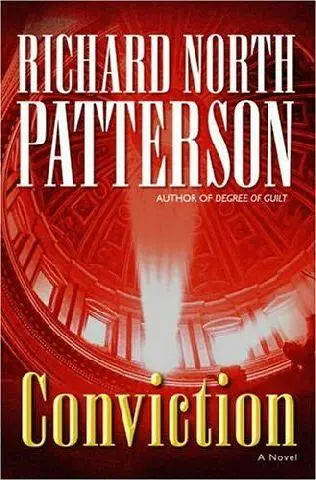
- Название:Conviction
- Автор:
- Жанр:
- Год:неизвестен
- ISBN:нет данных
- Рейтинг книги:3 / 5. Голосов: 1
-
Избранное:Добавить в избранное
- Отзывы:
-
Ваша оценка:
Conviction: краткое содержание, описание и аннотация
Предлагаем к чтению аннотацию, описание, краткое содержание или предисловие (зависит от того, что написал сам автор книги «Conviction»). Если вы не нашли необходимую информацию о книге — напишите в комментариях, мы постараемся отыскать её.
Conviction — читать онлайн бесплатно полную книгу (весь текст) целиком
Ниже представлен текст книги, разбитый по страницам. Система сохранения места последней прочитанной страницы, позволяет с удобством читать онлайн бесплатно книгу «Conviction», без необходимости каждый раз заново искать на чём Вы остановились. Поставьте закладку, и сможете в любой момент перейти на страницу, на которой закончили чтение.
Интервал:
Закладка:
"Yes."
"In which case," she said to Bond, "I'd like Dr. Lane to set forth the reasons that the accusation of murdering Thuy Sen is in conflict with Rennell's entire life."
Trapped by the presence of the media, Bond gave a grudging nod. "Go ahead."
Quickly, Terri asked Lane, "What factors in Rennell's past suggest that he is not disposed to the crime for which he was sentenced to death?"
"It's more an absence of any factors suggesting that he is." Pausing, Lane summoned the list that he and Terri had rehearsed. "Unlike Eddie Fleet—who has a rich legal history of physically abusing women—Rennell has no such history. Unlike Eddie Fleet, Rennell has no history of violence whatsoever. Either before his imprisonment or after. Unlike what we believe is true about Eddie Fleet, Rennell Price has no history of sexual misconduct—"
"Including with children?"
"Yes," Lane said firmly. "In fact, we can find no evidence that Rennell Price ever had sexual relations—consensual or forcible—with anyone. In this sense, as well, it seems that Rennell is innocent."
Pell folded his arms, a portrait of frustration. "As I comprehend it," Lane continued, "the purpose of this proceeding is to determine whether we can—or should—execute Rennell Price on the basis of the legal system's understanding of him fifteen years ago." Turning to Pell, he finished softly, "Our obligation is to understand him now. You're correct, Mr. Pell, that I wasn't present at the murder of Thuy Sen. But based on my understanding of him, neither was Rennell. And even if he were 'present,' in a more profound sense he wasn't. To execute him would be a crime."
"Thank you," Terri said and sat, satisfied that she and Anthony Lane had accomplished everything they could.
TEN
WHEN THE HEARING RESUMED THE NEXT MORNING, THUY SEN'S father, mother, and sister—at the request, Terri was certain, of Larry Pell—were seated in the front row with Ellen Sutter, a prominent advocate of victims' rights whose four-year-old son had been murdered by a pedophile. Bond's persistent glances toward Sutter and the Sens made Terri uneasy.
She forced herself to concentrate on Pell. Standing a respectful distance from Anthony Lane, Pell inquired, "How many times, Dr. Lane, have you testified with respect to the mental condition of a man charged with—or convicted of—a crime which carried the penalty of death?"
Lane squinted at the ceiling, seeming to conduct a mental count. "Upwards of thirty."
"In how many of those cases did you testify for the prosecution?"
"None."
"Is there a reason?"
Lane regarded him with a neutral look, neither hostile nor ingratiating. "Too many prosecutors view the mental condition of a defendant simply as an impediment to execution. That's not my orientation."
"How would you define your orientation?"
"To form my opinions as objectively as possible."
In the front row, Terri saw Meng Sen fold his arms, signaling his disapproval. Sitting between her husband and her daughter, Chou Sen clasped Kim's hand. But Thuy Sen's sister looked waxen and far away. "Is it objective," Pell demanded, "never to testify for the State?"
"That's not the issue, Mr. Pell. It's objective to refuse to testify for a defendant whose mental condition—in my professional opinion—does not support his claims. Which I've done."
"In how many cases?"
"Ten, at least."
Pell paused, seeming to make his own mathematical calculation. "In other words, Dr. Lane, in roughly three-quarters of the cases brought to you by defense lawyers, you believed that the defendant was mentally unfit to execute."
Lane curled one hand in the fingers of another. "That sounds about right," he answered. "But the death row population is far more troubled than the average run of citizens. And the lawyers I've worked with know better than to bring me a bogus claim."
"But what makes a bogus claim," Pell countered, "is subjective. Do you have a moral position on the death penalty?"
Bond glanced at Terri, expecting an objection. But she did not move or change expression. "Yes," Lane answered. "I'm opposed to it."
"In all cases?"
"Yes."
"Even with respect to serial killers?"
"Yes."
Pell skipped a beat. "Or child molesters?"
"Yes." Lane leaned forward. "I don't believe that we, as humans, are equipped to understand, or to judge, why people commit crimes that society rightly considers despicable. Or, in any given case, if they did. Therefore, I'm uneasy with capital punishment, especially when one alternative is life without parole in a maximum-security prison. But these are my personal beliefs.
"What you're asking by insinuation is whether those beliefs affect my testimony in this case." Pausing, Lane said emphatically. "They do not. Capital punishment is the law. I have an obligation to this Court—and every court—to testify within the legal standards which govern whether we execute a chosen individual. When I took the oath yesterday, I left my personal opinions behind."
"Good answer," Carlo murmured. But in Terri's judgment, Larry Pell had done precisely what he intended—to drain Lane's depiction of Rennell of its force, and to bring its credibility into question. She found Bond's silence worrisome.
"All right," Pell said to Lane abruptly, "you assert that Rennell Price has an IQ of seventy-two, while admitting that the accepted professional measure of retardation is seventy—at the high end. Is it also true that Rennell's IQ could actually be seventy-seven?"
"Or sixty-seven. The standard range of error is plus or minus five." Lane glanced at the judge. "As I said, IQ is a social measure rather than merely a numerical one. You have to look at Rennell's adaptive skills and state of functioning."
"What level of adaptive skills does it take to force a child into oral copulation?"
With the same air of equanimity, Lane answered, "Performance skills are irrelevant to sex crimes. A retarded man may be as capable of pedophilia as Eddie Fleet. I don't quite grasp the import of your question."
Pell crossed his arms. "Then let me try this, Doctor. You say that Rennell's IQ is a 'social measure.' Isn't it quite possible that Rennell's allegedly low adaptive skills are a result of the substandard schooling, chaotic family life, abuse, truancy, and all the other social barriers you described for Ms. Paget?"
"They all contribute."
"And all of these factors also affect thousands of environmentally challenged criminals with IQs well over seventy, correct?"
Lane hesitated. "Of course. But—"
"So can't we set these factors aside?" Pell interrupted. "At least as a gauge of retardation—or, for that matter, moral responsibility. Let's return to Rennell's IQ. Would it surprise you to learn that our expert psychologist scored it at seventy-eight?"
"Not at all," Lane answered with unruffled authority. "To me, that says three important things. First, that Rennell was as cooperative as I found him to be. Second, that he was not malingering for the sake of scoring low. And third, that like anyone with any capacity to learn, practice made him better." Lane's tone became sardonic. "Six points better, to be precise. But those defendants who are 'mongoloids,' or who visibly drool, don't end up on death row. That's reserved for the more gifted of our retarded population."
Unfazed, Pell stepped closer. "You also believe that Rennell suffered from fetal alcohol syndrome. Isn't that difficult to diagnose?"
"It can be."
"Is it also difficult to measure its impact on intelligence?"
"With precision, yes—"
"So we keep returning to that damnable number," Pell cut in with a fleeting smile. "But let's change the subject to Rennell's role in the crime for which the jury found him guilty."
Terri stood at once. "Objection," she called out. "Mr. Pell is asking Dr. Lane to assume the truth of facts which are very much in doubt—asserted fifteen years ago by a self-serving witness, Eddie Fleet. Who now refuses to repeat them."
Читать дальшеИнтервал:
Закладка:
Похожие книги на «Conviction»
Представляем Вашему вниманию похожие книги на «Conviction» списком для выбора. Мы отобрали схожую по названию и смыслу литературу в надежде предоставить читателям больше вариантов отыскать новые, интересные, ещё непрочитанные произведения.











Обсуждение, отзывы о книге «Conviction» и просто собственные мнения читателей. Оставьте ваши комментарии, напишите, что Вы думаете о произведении, его смысле или главных героях. Укажите что конкретно понравилось, а что нет, и почему Вы так считаете.