Connie Willis - All Clear
Здесь есть возможность читать онлайн «Connie Willis - All Clear» весь текст электронной книги совершенно бесплатно (целиком полную версию без сокращений). В некоторых случаях можно слушать аудио, скачать через торрент в формате fb2 и присутствует краткое содержание. Жанр: Старинная литература, на английском языке. Описание произведения, (предисловие) а так же отзывы посетителей доступны на портале библиотеки ЛибКат.
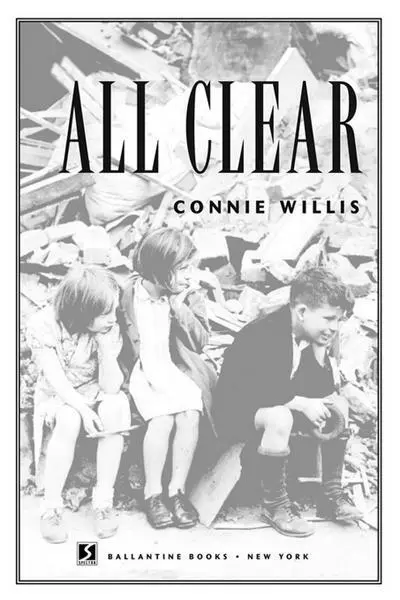
- Название:All Clear
- Автор:
- Жанр:
- Год:неизвестен
- ISBN:нет данных
- Рейтинг книги:5 / 5. Голосов: 1
-
Избранное:Добавить в избранное
- Отзывы:
-
Ваша оценка:
All Clear: краткое содержание, описание и аннотация
Предлагаем к чтению аннотацию, описание, краткое содержание или предисловие (зависит от того, что написал сам автор книги «All Clear»). Если вы не нашли необходимую информацию о книге — напишите в комментариях, мы постараемся отыскать её.
All Clear — читать онлайн бесплатно полную книгу (весь текст) целиком
Ниже представлен текст книги, разбитый по страницам. Система сохранения места последней прочитанной страницы, позволяет с удобством читать онлайн бесплатно книгу «All Clear», без необходимости каждый раз заново искать на чём Вы остановились. Поставьте закладку, и сможете в любой момент перейти на страницу, на которой закончили чтение.
Интервал:
Закладка:
“I knew a girl who vanished without a trace,” the woman next to her said.
So do I, he thought. And it was clear he wasn’t going to find out whether these women had known Polly just by eavesdropping. He approached them, notebook in hand. “What was her name?” the woman was saying. “It began with an S. You remember, Lowry, she was hit by an HE. Totally vaporized—”
“I’m sorry to interrupt, ladies,” he said. “I’m Calvin Knight. I’m here to do a story on the opening of the exhibition, and I was wondering if I might interview you.
You all did war work during World War Two, is that right? Were you all in London?”
“She was,” the white-haired one with the lace collar said, pointing at the one who’d spoken of the girl vanishing without a trace, “and these two”—she pointed at the crone and the one with the photographs—“were WAACs.”
“Women’s Auxiliary Army Corps,” the crone said. “We were radio operators.”
“And what did you do?” he asked the lace-collared one.
“Well,” she said, dimpling, “until just a few years ago I couldn’t tell you. I was in Intelligence.”
“She was a spy,” the crone said. “But I had an even more exciting job. I drove a mortuary van.”
“During the Blitz?”
“No, I’m younger than this lot. I was still at school in Surrey during the Blitz. I didn’t join up till July of ’forty-four.”
Which was too late. Polly would already have been driving an ambulance near Croydon by then. And her deadline would already have passed. “Were the two of you in London during the Blitz?” he asked the WAACs.
“No, we were stationed at Bagshot Park,” the first one said, and the second handed him the snapshot he’d supposed was of her grandchildren. It wasn’t. It was a black-and-white photograph of two slim, pretty girls in uniform, one fair, one dark, perched, laughing, on a tank. “I’m the blonde,” she said, “and that’s Louise.” She pointed at the curly-haired girl perched next to her in the picture and then at her friend.
“That’s you?” he said, staring at the snapshot. The faded, stout old woman in front of him bore no resemblance at all to the vivid, laughing girl in the photograph.
“Yes,” Louise said, coming round to look at it. “I was a brunette in those days.”
He had assumed he’d recognize Merope if he saw her, even though he hadn’t seen her in eight years and she’d be far older than she’d been then, but now that he saw this snapshot …
There was no resemblance at all between the curly-haired girl in the photo and the dumpy, faded woman in front of him. Too much time had gone by.
Too much time. Merope could be here, right now, in this lobby, perhaps only a few feet away, and he simply hadn’t recognized her. And if she recognized him, would she come up to him and say, “Where were you? Why didn’t you come?”
would she come up to him and say, “Where were you? Why didn’t you come?”
He was still staring blindly at the snapshot. “Are you all right?” Louise asked him.
“He’s stunned by how little we’ve changed,” her friend said, and the women all laughed good-naturedly.
“She’s quite right. Neither of you’s changed a bit,” he said, recovering himself. He handed the snapshot back to them and asked the four their names, “so I can quote you in the article.”
Thankfully, none of them was named Merope—or Eileen O’Reilly, which had been her cover name. But he couldn’t ask every woman here her name. He remembered the woman with the name tags and went looking to see if she’d managed to pass them out, but he couldn’t find her.
No, there she was, over by the ticket desk, conferring with the woman he’d seen earlier out in the car park. She was probably asking for a microphone.
She’d need it. The noise had risen to a din, and several women had their hands cupped to their ears in an effort to hear, though when he attempted to ask one of them who was wearing an ARP armband whether she’d been in London during the Blitz, she said, “I beg your pardon, I couldn’t hear you. I’m deaf in that ear.”
And in the other one as well. When he shouted, “Were you in London during the Blitz?” she said, “List? What list?”
He bellowed at her for a bit longer till he got her maiden name out of her—Violet Rumford—then moved on through the crowd, eavesdropping on their conversations, attempting to catch their names, but a large number seemed to be calling one another by nicknames—“Stodders” and “B-1” and “Foxtrot”—and the rest by their last names.
The name-badge woman had apparently given up on attempting to get either a microphone or the entire group’s attention and was moving among the crowd, passing them out. Good.
He worked his way over to her. “Print your name on the badge and fix this gold star in the corner,” she was saying, handing the women badges and pens, “and then go through that door.”
But not until I’ve had a chance to read your names, he thought.
“Which names should we put?” a woman in a pink feathered hat asked. “Our name now or our name during the war?”
“Both,” the organizer said. “And write the name of the service you were with below it.”
Thank you, he thought, and followed in her wake, reading the women’s names as they printed them. Pauline, Deborah, Jean. Netterton, Herley, York. No Eileen, no O’Reilly, though the woman in charge evidently hadn’t given all of the women the same instructions. Several had printed only one name, and only a few had listed the service they’d been in. ARP, WAAF, WVS.
They were beginning to drift out of the lobby into the museum. He needed to purchase his ticket, but there were still several ladies who hadn’t put their tags on yet.
Walters, Redding …
The third woman’s hand shook with palsy when she wrote her name, and when she pinned it to her breast, he couldn’t decipher it, though the first letter might be an O. He’d have to corner her once they got inside and find out.
The fourth woman, a tiny creature who looked like she might break in two, still hadn’t finished printing her name, though he didn’t see how she could possibly be Merope, whom he remembered as being taller. But he’d grown since then, and people had still shrunk with age in this era, hadn’t they? “Did she say we were supposed to put what unit we were in?” the woman asked.
“Yes,” Walters and the one with the unreadable name tag said in unison and then laughed, and Unreadable Name Tag said, “Walters? Is that you?”
Walters gaped at her. “Oh, my goodness!” she cried. “I can’t believe this!” She flung her arms around her. “Geddes!”
Geddes. Good. It had been a G, not an O.
“We were stationed at Eastleigh together,” Geddes was telling Redding. “We were Atta Girls.”
“Air Transport Auxiliary,” Walters explained. “We ferried new planes to their airfields for the RAF.” And if they’d been stationed at Eastleigh, they hadn’t been anywhere near London and couldn’t have known Polly.
“What did you do in the war?” Walters was asking Redding.
“Nothing so romantic, I’m afraid,” she said. “I was a land girl. I spent the war shoveling pig muck in Shropshire.”
Which eliminated her too. That left the tiny woman who’d finally finished printing her name and pinned her badge on. “Mrs. Donald Davenport,” it read, and below it, “Lt. Cynthia Camberley.”
He let out a breath he hadn’t realized he’d been holding. Merope wasn’t here.
Thank God. But he still had no idea where Polly had been, and he still hadn’t found anyone who might know. And Camberley, who hadn’t said if she’d been in London during the Blitz, was already going in with the others. He started after her, remembered he hadn’t bought a ticket, and raced over to the desk, but by the time he got it and went in, they’d vanished.
Читать дальшеИнтервал:
Закладка:
Похожие книги на «All Clear»
Представляем Вашему вниманию похожие книги на «All Clear» списком для выбора. Мы отобрали схожую по названию и смыслу литературу в надежде предоставить читателям больше вариантов отыскать новые, интересные, ещё непрочитанные произведения.








Обсуждение, отзывы о книге «All Clear» и просто собственные мнения читателей. Оставьте ваши комментарии, напишите, что Вы думаете о произведении, его смысле или главных героях. Укажите что конкретно понравилось, а что нет, и почему Вы так считаете.