Connie Willis - All Clear
Здесь есть возможность читать онлайн «Connie Willis - All Clear» весь текст электронной книги совершенно бесплатно (целиком полную версию без сокращений). В некоторых случаях можно слушать аудио, скачать через торрент в формате fb2 и присутствует краткое содержание. Жанр: Старинная литература, на английском языке. Описание произведения, (предисловие) а так же отзывы посетителей доступны на портале библиотеки ЛибКат.
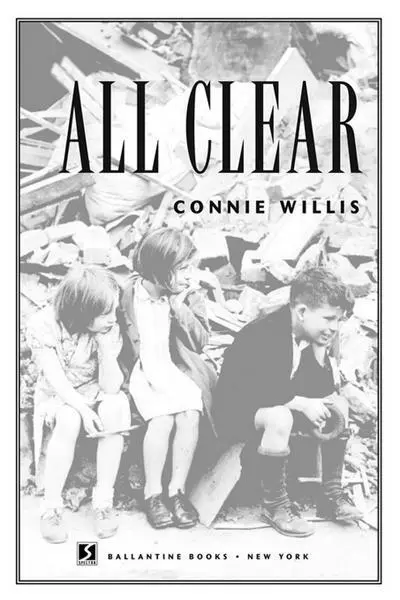
- Название:All Clear
- Автор:
- Жанр:
- Год:неизвестен
- ISBN:нет данных
- Рейтинг книги:5 / 5. Голосов: 1
-
Избранное:Добавить в избранное
- Отзывы:
-
Ваша оценка:
All Clear: краткое содержание, описание и аннотация
Предлагаем к чтению аннотацию, описание, краткое содержание или предисловие (зависит от того, что написал сам автор книги «All Clear»). Если вы не нашли необходимую информацию о книге — напишите в комментариях, мы постараемся отыскать её.
All Clear — читать онлайн бесплатно полную книгу (весь текст) целиком
Ниже представлен текст книги, разбитый по страницам. Система сохранения места последней прочитанной страницы, позволяет с удобством читать онлайн бесплатно книгу «All Clear», без необходимости каждый раз заново искать на чём Вы остановились. Поставьте закладку, и сможете в любой момент перейти на страницу, на которой закончили чтение.
Интервал:
Закладка:
Cess opened the door and leaned in. He was dressed in his officer’s uniform. “Why aren’t you ready?”
“I thought we were leaving tomorrow morning.”
“No,” Cess said. “Lady Bracknell wants us to leave now.” Which made no sense—Portsmouth was only a few hours away, but Ernest didn’t object. The sooner they got there the better, and if they stopped for the night along the way, he’d have even more opportunities to ask about Atherton.
“Give me twenty minutes,” he said.
“Ten. You don’t know where our map got to, do you?”
“I thought you said Bracknell gave one to you.”
“No, a map of this area.”
“Prism had it, I think,” Ernest lied, and as soon as Cess had gone off to look for it, he dug the map out of the pile on his desk, stuck it in his pocket, and bolted down to the mess to hide it in the silverware drawer. Then he ran to throw his razor and soap into a bag, answer Cess’s “Are you certain you didn’t have it after Prism?” and take the bag and his officer’s uniform back to the office. He put it on and began typing madly again.
He managed to finish another message—“Schoolgirl Mary P. Cardle won the war-saving stamp competition at St. Sebastian School last week. Fourteen-year-old Mary, known to her friends as Polly, earned the money to buy the stamps by running errands. Said headmaster Dunworthy Townsend, ‘Let’s hope we can all do as much for the war effort as Mary has.’ ”—before Cess reappeared with the map, saying, “You won’t believe where I found this,” and demanding to know why Ernest still wasn’t ready.
Ernest stuffed the articles into an envelope, sealed it, and hurried out to where Cess had already started up the Rolls. He pulled out onto the road before Ernest even had his door shut. “We need to run these articles by the Call office,” Ernest said, showing the envelope to Cess.
“We’ll have to do it on the way back.”
“But Croydon’s right on the way.”
Cess shook his head. “We have to go up to Gravesend and then back down to Dover and Folkestone first.”
“What?” If Cess had lied about Portsmouth, he’d kill him. “Why?”
“We need to write down the names of all the roads and all the villages we go through,” Cess said.
“Why? Can’t Bracknell get those off the map?”
“Yes, but not the landmarks. And the distances have to be right, in case a member of the German High Command happened to spend a holiday hiking through Kent
“Yes, but not the landmarks. And the distances have to be right, in case a member of the German High Command happened to spend a holiday hiking through Kent before the war.”
“The German High …? What exactly are we picking up?”
“A German prisoner of war,” Cess said. “We’re picking him up at his prison camp and driving him to London. He’s ill, and the Red Cross has arranged to have him sent home to Germany. But first we’re driving him to Dover through the staging area in Kent so he can see our invasion preparations firsthand.”
“A few rubber tanks, wooden planes, and a sewer-pipe oil refinery? Those were meant to fool a reconnaissance plane from twenty thousand feet up, not a—”
“No, we’re going to show him the real thing,” Cess said, “ships, aeroplanes, everything. He’s only going to think he’s in Kent. That’s why we have to drive to Gravesend this afternoon. We’ve got to map out a false route so the colonel can accidentally overhear us talking about where we are.”
It was a clever plan. With signposts down all over England, the colonel would only have their word for where they were, and if they could convince him he was in Kent and he went home and told the German High Command, it could help convince them the Allied attack would come at Calais.
But it played hell with his plan to find Atherton. He could hardly ask a soldier where Denys was with the colonel listening. He’d have to get away from him and Cess.
“You said we’ll be gone two days,” he said. “Where are we spending the night? At an Army camp or in Portsmouth?”
“Neither. We’re bringing him straight to London.”
“But I thought you said we wouldn’t be back in time for Chasuble’s date?”
“Chasuble said that. He’s convinced something will go wrong and we’ll blow the gaffe,” Cess said. “No, we’re not to stop for anything, except to go to the loo.
And we’re not to let the colonel out of our sight for a moment. Lady Bracknell wants both of us with him at all times.”
When peace breaks out again (as it will, do you know) and the lights come on again, we shall look back on these days and remember gratefully the things that brought us cheer and gave us heart even in the glummest hours.
—NEWSPAPER ADVERTISEMENT,
1941
Imperial War Museum, London—7 May 1995
BY FIVE TILL TEN, THE GROUP HE WAS WAITING FOR STILL hadn’t arrived at the museum, and it was pouring rain. The American couple had given up trying to set him up with their daughter and gone off to find “someplace dry” and have “a decent cup of coffee, if there is such a thing in this country, Calvin,” which was a blessing, but there was no sign of any other visitors.
What if they all went to the exhibit at St. Paul’s instead? he thought. Or what if this isn’t the right day? What if the exhibit doesn’t begin till tomorrow? Or began yesterday?
At one minute till, an elderly museum guard appeared, unlocked the doors, and let him come inside the lobby to wait. “Today is the first day of the ‘Living Through the Blitz’ exhibition, isn’t it?” he asked the guard.
“Yes, sir.”
“And it’s a special Free Day for civilians who were involved in war work?”
“Yes, sir,” the guard said warily, as if he suspected him of attempting to pass himself off as one of those survivors. “You purchase your exhibition ticket over there.”
He nodded stiffly toward the still-unoccupied ticket desk. “Admission to the museum and the permanent collections is free. The museum will be open shortly. Till then you’re welcome to go into the gift shop.” The guard pointed to where it stood just past the ticket desk.
“Thank you. I’ll just look round the lobby,” he said, pointing up at the high ceiling, where a Spitfire and a V-1 and a V-2 rocket all hung suspended. As soon as the guard had gone, he went back over to the window to see if anyone was coming.
No one was. He read the Upcoming Lecture and Events poster. “June 18—‘So Few: The Battle of Britain,’ ” it said. “June 29—‘Unsung Heroes of World War II.
A slide presentation of civilians who gave their lives to win the war, from American bandleader Glenn Miller to decoding genius Dilly Knox and Shakespearean actor Sir Godfrey Kingsman.’ ”
The car park was still nearly deserted. He looked at the clock behind the ticket desk. Ten past. They’re all at St. Paul’s, he thought, and wondered if he should give up and go there, but it would take him at least half an hour to get there by tube, and in the process he might miss them both places. He decided to give it ten more minutes.
At a quarter past they all arrived at once. Two large vans pulled up and began disgorging a score of elderly women. They were too far away for him to be able to see their faces clearly, and as they started for the steps, they opened out umbrellas and ducked under them, so he couldn’t see them till they were nearly at the top of the steps.
And what if one of them was Merope? He hadn’t thought of that possibility till this moment, he’d been so intent on finding someone who’d known Polly, who would have a clue to where she’d gone after she left Mrs. Rickett’s. If she’d left Mrs. Rickett’s. If she and Merope hadn’t been killed as well that night.
Читать дальшеИнтервал:
Закладка:
Похожие книги на «All Clear»
Представляем Вашему вниманию похожие книги на «All Clear» списком для выбора. Мы отобрали схожую по названию и смыслу литературу в надежде предоставить читателям больше вариантов отыскать новые, интересные, ещё непрочитанные произведения.




Обсуждение, отзывы о книге «All Clear» и просто собственные мнения читателей. Оставьте ваши комментарии, напишите, что Вы думаете о произведении, его смысле или главных героях. Укажите что конкретно понравилось, а что нет, и почему Вы так считаете.