Jack Whyte - The Lance Thrower
Здесь есть возможность читать онлайн «Jack Whyte - The Lance Thrower» весь текст электронной книги совершенно бесплатно (целиком полную версию без сокращений). В некоторых случаях можно слушать аудио, скачать через торрент в формате fb2 и присутствует краткое содержание. Жанр: Старинная литература, на английском языке. Описание произведения, (предисловие) а так же отзывы посетителей доступны на портале библиотеки ЛибКат.
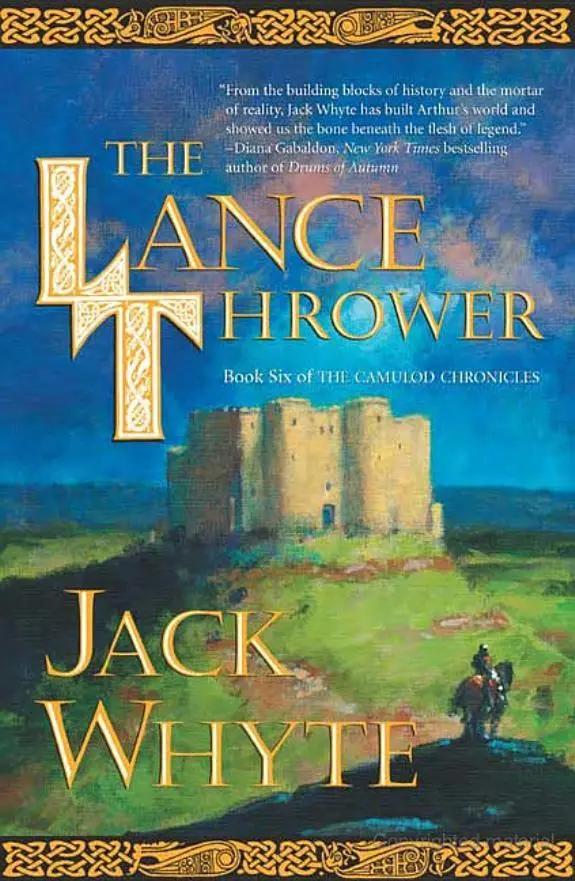
- Название:The Lance Thrower
- Автор:
- Жанр:
- Год:неизвестен
- ISBN:нет данных
- Рейтинг книги:5 / 5. Голосов: 1
-
Избранное:Добавить в избранное
- Отзывы:
-
Ваша оценка:
The Lance Thrower: краткое содержание, описание и аннотация
Предлагаем к чтению аннотацию, описание, краткое содержание или предисловие (зависит от того, что написал сам автор книги «The Lance Thrower»). Если вы не нашли необходимую информацию о книге — напишите в комментариях, мы постараемся отыскать её.
Clothar is a young man of promise. He has been sent from the wreckage of Gaul to one of the few schools remaining, where logic and rhetoric are taught along with battle techniques that will allow him to survive in the cruel new world where the veneer of civilization is held together by barbarism. He is sent by his mentor on a journey to aid another young man: Arthur Pendragon. He is a man who wants to replace barbarism with law, and keep those who work only for destruction at bay. He is seen, as the last great hope for all that is good.
Clothar is drawn to this man, and together they build a dream too perfect to last--and, with a special woman, they share a love that will nearly destroy them all...
The name of Clothar may be unknown to modern readers, for tales change in the telling through centuries. But any reader will surely know this heroic young man as well as they know the man who became his king. Hundreds of years later, chronicles call Clothar, the Lance Thrower, by a much more common name.
That of Lancelot.
The Lance Thrower — читать онлайн бесплатно полную книгу (весь текст) целиком
Ниже представлен текст книги, разбитый по страницам. Система сохранения места последней прочитанной страницы, позволяет с удобством читать онлайн бесплатно книгу «The Lance Thrower», без необходимости каждый раз заново искать на чём Вы остановились. Поставьте закладку, и сможете в любой момент перейти на страницу, на которой закончили чтение.
Интервал:
Закладка:
In the exhilaration of knowing some men had escaped, we decided to follow them and try to find them and join up with them if we could, and Ursus turned his back on me, his hands on his hips, to stare back up at the slope we had descended.
“Well,” he said, “we should have brought the horses down and picked an easier route. No one was chasing us , after all. Now we have to climb back up that whoreson.”
Mounted again, we took one last look around the killing ground and then made our way slowly down the swooping slope by a more circuitous route until we could enter the wooded ravine, but we left it again almost immediately to make our way downhill more easily in the open, following the path of the stream and watching for the signs that would indicate where the survivors had left the protection of the deep gully. We did not find any until the hillside had faded gently into a wooded valley where the stream joined a wider brook, but when we found the spot where the horses had finally clambered out of the riverbed to head across the valley bottom toward a denser growth of forest on the far side, the tracks were clean and easy to identify as belonging to fourteen riders, which was a far larger number than either of us had expected. I looked at Ursus immediately, but before I could make any comment he shrugged his shoulders.
“Makes no sense to me, either, so don’t even ask me. Some of them must have made their way down the same way we did. Either that or they cut around behind somehow and managed to keep out of the way of the bowmen coming down from above until they found another way to reach the bottom of the slope. It’s not important how they did it. What’s important is that they escaped and now they’re out there, somewhere ahead of us.”
It took us until late in the afternoon to track them down, even though we knew they must be close by in one large, wooded area because we had found their tracks, then lost them again on stony ground, but could find no trace of them anywhere beyond that, once the ground softened again and the soil was deep enough to show tracks. We made a complete circuit of the tract of woodland, large as it was, and by the end of it, when we arrived back at the point where we had started, we knew beyond any doubt that our quarry must still be within the tract somewhere, because the only way they could have traveled on without us finding their trail would have been to sprout wings and fly out.
As it transpired, we must have ridden by the entrance to their hiding place three or four times without even suspecting it was there, because it lay in the densest part of the forest, shrouded by ancient clumps of gnarled, moss-covered trees covering the base of a hill that was crowned with a solid mass of thick, seemingly impenetrable brush. Behind that screen of growth, however, and not easily found unless you knew it was there, lay the single narrow, twisting entrance to a small, steep-sided valley—a rift, little more than a wide vertical split in the hillside—that had no exit. The men hiding in there were being very unobtrusive, knowing that they were deep in hostile territory, hostages to treachery, and evidently expecting, for the best of reasons, that they might be the object of a massive hunt.
We found them on what might have been our fifth pass by the entrance to their hiding place, but it is far more accurate to say that they showed themselves to us. They had seen us pass by once before, and not recognizing us but knowing that we had not seen them, they had allowed us to pass unmolested. The next time we returned, however, they took notice of us.
There was a wide, grassy expanse—a natural meadow with isolated copses of beech and chestnut trees—fronting the mass of older, smaller trees that veiled their hiding place from us, and Ursus and I were searching it thoroughly when we returned that time, quartering it slowly with our eyes to the ground, looking for signs that someone—anyone—had passed that way recently. Ursus was on my left, a good hundred paces from me at the farthest reach of my sweep, which took me within a very short distance of the edge of the clearing. At the opposite end of one sweep, however, when I was farthest away from the forest’s edge and closest to Ursus, I caught a flicker of movement from the corner of my eye and looked up to see a horseman emerge from the woods on my right and come toward me. He was heavily armored, his face hidden by the closed flaps of a heavy, crested helmet, and he carried a spear and a brightly colored shield, blazoned in yellow and crossed by the black diagonal bar that marked him clearly as one of Theuderic’s men.
And then, being almost sixteen, I committed the error of a sixteen-year-old for the first and only time. I whooped in welcome and kicked my horse forward to meet him as I saw two more mounted spearmen come out of the trees at his back. I heard Ursus shout something from behind me, but I assumed it was a shout of welcome like my own and paid it no attention, bent on exchanging greetings with the newcomers.
Only as I began to draw close to the man ahead of me did I begin to suspect that all was not as it should be, because instead of approaching me directly and slowing down, the fellow I was riding to meet angled his horse away, to my right side, and increased his speed, drawing back his spear arm as if to make a cast. I sat up straighter in the saddle, thinking some foolish thought about allowing him to recognize me and with no thought in my mind that, after what they had been through, these people might expect to encounter only enemies in such a place. Again I heard Ursus shout, his voice closer this time, but by then my own foolishness had begun to dawn on me. I heard the thunder of the oncoming horseman’s hooves and saw his arm thrust forward, launching the long spear directly at me, and I leaned hard and far to my left, almost throwing myself out of the saddle and trying to pull my horse bodily out of the line of the weapon’s flight. The point of the spear took me in the side, beneath my upraised arm and fortunately on the metal of my cuirass, rather than in the join between the plates. It hit solidly before it glanced off and away, but the force of its impact threw me effortlessly over my horse’s rump, so that I saw my own feet fly up in front of my eyes. I had an instantaneous vision of my horse’s rear hooves flying up, too, and hitting me in the head as I fell, and I tried desperately to extend the movement of my fall, tucking my head in and kicking my legs back farther over my head. I landed awkwardly, with my weight on one knee and elbow, but I felt no flaring pain and I rolled immediately, clutching for my dagger, the only weapon left to me.
My assailant had ridden around behind me and was now driving in for the kill, a long spatha raised above his head as he leaned toward me, concentrating on the angle of the cut that would kill me. The drumming of his horse’s hooves was loud and concussive, and I threw myself down, rolling head over heels and managing somehow to avoid the hissing arc of his swing. As he charged past the spot where I had been a moment earlier I was already rising to my feet, pulling the helmet hastily from my head and looking about me for my horse, wondering what chance I had of laying hold of the long spatha that hung in its sheath by my saddle.
Again the visored horseman came at me, and this time, freed from the restricted vision caused by my heavy helmet, I shouted as I threw myself forward and angled my roll so that I passed directly beneath his horse’s belly. It was a dangerous thing to do, since I might have been caught by one of the beast’s great hooves, but it was less dangerous than risking a deadly thrust from its rider’s sword, and my hope was that the beast might be startled enough by my move to rear, and even unseat its rider.
Читать дальшеИнтервал:
Закладка:
Похожие книги на «The Lance Thrower»
Представляем Вашему вниманию похожие книги на «The Lance Thrower» списком для выбора. Мы отобрали схожую по названию и смыслу литературу в надежде предоставить читателям больше вариантов отыскать новые, интересные, ещё непрочитанные произведения.







Обсуждение, отзывы о книге «The Lance Thrower» и просто собственные мнения читателей. Оставьте ваши комментарии, напишите, что Вы думаете о произведении, его смысле или главных героях. Укажите что конкретно понравилось, а что нет, и почему Вы так считаете.