Jack Whyte - The Lance Thrower
Здесь есть возможность читать онлайн «Jack Whyte - The Lance Thrower» весь текст электронной книги совершенно бесплатно (целиком полную версию без сокращений). В некоторых случаях можно слушать аудио, скачать через торрент в формате fb2 и присутствует краткое содержание. Жанр: Старинная литература, на английском языке. Описание произведения, (предисловие) а так же отзывы посетителей доступны на портале библиотеки ЛибКат.
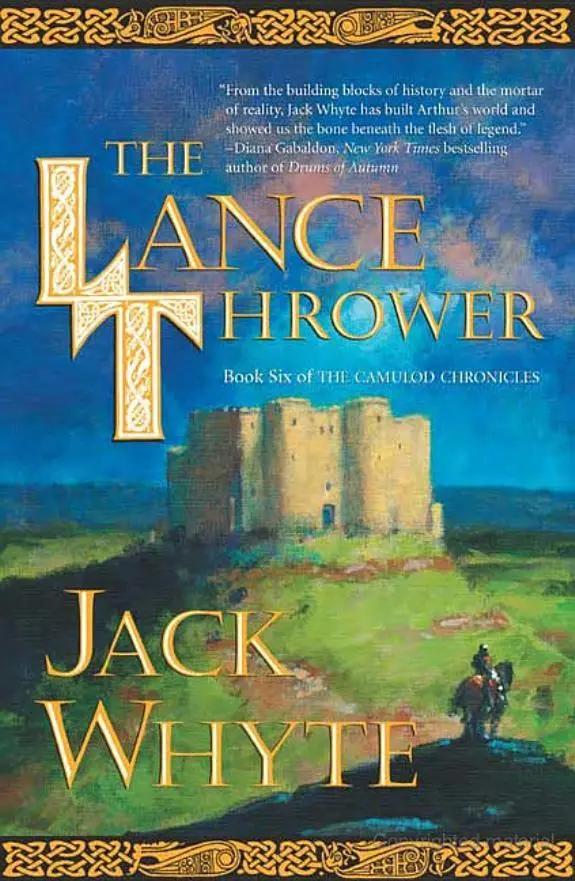
- Название:The Lance Thrower
- Автор:
- Жанр:
- Год:неизвестен
- ISBN:нет данных
- Рейтинг книги:5 / 5. Голосов: 1
-
Избранное:Добавить в избранное
- Отзывы:
-
Ваша оценка:
The Lance Thrower: краткое содержание, описание и аннотация
Предлагаем к чтению аннотацию, описание, краткое содержание или предисловие (зависит от того, что написал сам автор книги «The Lance Thrower»). Если вы не нашли необходимую информацию о книге — напишите в комментариях, мы постараемся отыскать её.
Clothar is a young man of promise. He has been sent from the wreckage of Gaul to one of the few schools remaining, where logic and rhetoric are taught along with battle techniques that will allow him to survive in the cruel new world where the veneer of civilization is held together by barbarism. He is sent by his mentor on a journey to aid another young man: Arthur Pendragon. He is a man who wants to replace barbarism with law, and keep those who work only for destruction at bay. He is seen, as the last great hope for all that is good.
Clothar is drawn to this man, and together they build a dream too perfect to last--and, with a special woman, they share a love that will nearly destroy them all...
The name of Clothar may be unknown to modern readers, for tales change in the telling through centuries. But any reader will surely know this heroic young man as well as they know the man who became his king. Hundreds of years later, chronicles call Clothar, the Lance Thrower, by a much more common name.
That of Lancelot.
The Lance Thrower — читать онлайн бесплатно полную книгу (весь текст) целиком
Ниже представлен текст книги, разбитый по страницам. Система сохранения места последней прочитанной страницы, позволяет с удобством читать онлайн бесплатно книгу «The Lance Thrower», без необходимости каждый раз заново искать на чём Вы остановились. Поставьте закладку, и сможете в любой момент перейти на страницу, на которой закончили чтение.
Интервал:
Закладка:
“It’s not a memento, and I don’t intend to shoot it at anyone. It’s evidence of murder and it will be identifiable because it’s identical to all the others. Whoever made all these arrows is a master fletcher, and if we find him, we’ll find the people for whom he makes his arrows. What have you found?”
“It’s a saddle roll. Must have been snagged in the brambles there and pulled off without anyone noticing it. Couldn’t have been too well secured in the first place.”
I crouched on the narrow path and untied the knots binding the bundle, then rolled it out with a flip of my arms.
Ursus whistled, a long, drawn-out sound of approbation. The main binding of the roll was a standard brown woolen blanket, Roman army issue, heavy and densely woven from untreated wool so that it retained its natural water-repellent attributes. It had been thinly layered with beeswax on one side, too, to increase its resistance to rainwater, and then it had been folded and wrapped into a tight cylinder. Within its folds, however, it contained a change of clothing for its owner, including a plain gray, quilted tunic, the left shoulder of which was emblazoned with a sewn-on patch of brightly colored yellow cloth, edged in dark green and cut in the shape of a bull’s head.
“Gunthar’s bull,” I said.
Ursus nodded and held out his hand. “I had a thought it might be. Let me look at it.”
I passed the tunic over to him and he peered closely at it, then wadded it up roughly and handed it back to me along with the arrow he had collected. “Good. It’s not exactly proof of who did the killing here, but it would convince ninety-nine out of every hundred men I know. Wrap it in the blanket with this and bring it with you.
“Now let’s move on and see what lies ahead of us on the remainder of the trail, but brace yourself, lad. You might not like what we find.”
I was too enervated by then to show surprise. “Why?” was all I asked him.
“Because there’s worse to come, I fear. What would have happened when your cousin Theuderic realized his infantry were slow in catching up?”
“He would have come back to find them.”
“Right. And he’s not here, is he? My guess is that he made the attempt and rode into the same kind of trap, set elsewhere for him.”
“Which means he’s dead. Is that what you are saying?”
“He could be, aye.” Ursus nodded, sober-faced. “Probably is, to tell the truth, for otherwise he would have been here before now, to find out what happened to these people. I think you had better prepare yourself for finding him and his men dead between here and Vervenna.”
We rode on, neither of us saying another word, both of us expecting to find another scene of murderous destruction beyond every turn in the road and over the crest of every hill until, about a mile beyond the scene of the massacre, we emerged from the edge of a screen of small trees and saw a wide, smooth, grassy slope stretching up and away from us to the crest of a ridge that stretched all the way across our front. As soon as I saw it I drew rein.
Ursus, seeing my sudden reaction from the corner of his eye, turned toward me. “What?” he asked. “What’s wrong?”
“I know this place. I remember it”
Ursus sat looking at me patiently, holding his mount tightly reined so that its neck arched tautly and it stamped its forefeet, trying to sidle away from the curbing bit. He said nothing, controlling his restless mount, content to wait for what I had to say, and after a while I continued.
“We used to play here, as young boys. We would run up to the crest there and throw ourselves over the top, then roll downhill on the other side. It’s all grassy and soft over there, no trees and not even any stones. The hillside slopes down from the crest on that side for about two hundred paces, perhaps slightly more. It’s a gentle slope. At the bottom of it, though, it butts right into another hill and the terrain changes. That whole hillside on the other side is covered with trees … hardy old things, stunted and twisted and not very big. There’s a narrow stream cutting through the line where the two hills meet—it’s very fast, very powerful, fed by an enormous spring that bubbles up out of the solid rock, higher up the far hillside on the left, close to the top. The channel it has cut over the years is deep but not wide. It levels out only in one narrow spot, where the ford is. That’s the only way across the gully, and no more than two horsemen can cross it at a time, side by side. And then to the right of that, the slope falls away dangerously until it drops into a ravine that’s choked lower down with moss-covered old trees—ancient old thorn trees and stunted oaks. It’s a wonderful place for boys to play, but you wouldn’t want to ride a horse down there.” I stopped, reluctant to say any more but unwilling to kick my horse into motion again.
“So why did you stop here?” Ursus asked. “If that’s all you had to tell me, you could have done it as we rode.”
“It’s a natural place for an ambush.” I had been reluctant to voice my sudden conviction lest somehow, by naming it, I made it come true. “It’s a perfect trap. Beyond the ford the slope climbs steeply up to another high crest, but that slope’s grassy, too, and soft like this one, so in the heavy rain it’ll be a quagmire. There are trees on that hillside, too, on either side, pointing away from you, up toward the crest, and they act like a funnel, pushing people inward to the center. So you’re going uphill more and more steeply, and there’s less and less room on either side. And up ahead of you, there’s ample cover to screen an attacking force, while behind you, on the far side of the stream at the bottom, there’s that beautiful slope for anyone charging at you from the rear to smash whatever troops you have remaining there, waiting to cross two at a time. It’s a nasty, nasty place.”
I looked Ursus in the eye. “So … if your theory holds true and we’re to find that Theuderic has been ambushed, this is where we’re most likely to find him—on the other side of that crest up there.”
He nodded, mute, and then his eyes drifted away from mine and focused on something behind me, in the distance. Before I could begin to turn around to see what he was looking at, he had loosened his reins and nudged his horse forward and past me. I spun my mount around and moved to join him where he sat gazing at a dark scar in the grass less than fifty paces from where we sat.
“It looks as though you might be right,” he said quietly. What he had found was the darkened path worn into the muddy ground by a large number of horses as they emerged from a trail through the woodlands at our back and spilled out onto the soaked grass of the slope ahead. They had been riding in columns of four when they came out of the trees, but then they peeled off, right and left, to fan out and form a single line abreast as they made their way uphill toward the crest of the ridge, and we had no difficulty following them or seeing the moves of individual horsemen. There was a broad and much-trampled quagmire of muddied grass forming a lateral line less than twenty paces from the crest, where the advance had halted and stayed for a time, presumably safe beneath the skyline of the ridge while the leaders rode forward to look beyond and wait for their signal to attack.
Ursus glanced at me again, a wry expression on his face. “Well,” he said quietly, “we can’t very well ride away without looking, can we?”
“No, we can’t, but I wish we hadn’t come this way.”
He nodded in agreement and dug in his spurs, sending his horse bounding forward, and I followed him, roweling my own horse hard, driving him forward and uphill until I was riding knee to knee with Ursus. As we approached the crest of the ridge the ground beneath us showed all the scars born of the passage of three score of heavy horses digging their hooves in hard to gain purchase in the mud of the slippery, rising ground. Then we were on the crest itself and the scene below us opened up and spread out at our feet.
Читать дальшеИнтервал:
Закладка:
Похожие книги на «The Lance Thrower»
Представляем Вашему вниманию похожие книги на «The Lance Thrower» списком для выбора. Мы отобрали схожую по названию и смыслу литературу в надежде предоставить читателям больше вариантов отыскать новые, интересные, ещё непрочитанные произведения.







Обсуждение, отзывы о книге «The Lance Thrower» и просто собственные мнения читателей. Оставьте ваши комментарии, напишите, что Вы думаете о произведении, его смысле или главных героях. Укажите что конкретно понравилось, а что нет, и почему Вы так считаете.