Jack Whyte - The Lance Thrower
Здесь есть возможность читать онлайн «Jack Whyte - The Lance Thrower» весь текст электронной книги совершенно бесплатно (целиком полную версию без сокращений). В некоторых случаях можно слушать аудио, скачать через торрент в формате fb2 и присутствует краткое содержание. Жанр: Старинная литература, на английском языке. Описание произведения, (предисловие) а так же отзывы посетителей доступны на портале библиотеки ЛибКат.
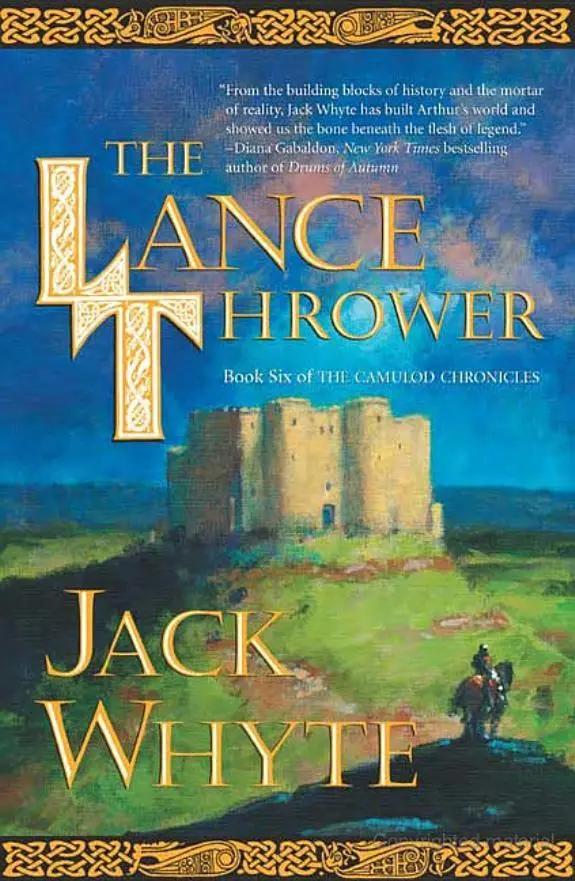
- Название:The Lance Thrower
- Автор:
- Жанр:
- Год:неизвестен
- ISBN:нет данных
- Рейтинг книги:5 / 5. Голосов: 1
-
Избранное:Добавить в избранное
- Отзывы:
-
Ваша оценка:
The Lance Thrower: краткое содержание, описание и аннотация
Предлагаем к чтению аннотацию, описание, краткое содержание или предисловие (зависит от того, что написал сам автор книги «The Lance Thrower»). Если вы не нашли необходимую информацию о книге — напишите в комментариях, мы постараемся отыскать её.
Clothar is a young man of promise. He has been sent from the wreckage of Gaul to one of the few schools remaining, where logic and rhetoric are taught along with battle techniques that will allow him to survive in the cruel new world where the veneer of civilization is held together by barbarism. He is sent by his mentor on a journey to aid another young man: Arthur Pendragon. He is a man who wants to replace barbarism with law, and keep those who work only for destruction at bay. He is seen, as the last great hope for all that is good.
Clothar is drawn to this man, and together they build a dream too perfect to last--and, with a special woman, they share a love that will nearly destroy them all...
The name of Clothar may be unknown to modern readers, for tales change in the telling through centuries. But any reader will surely know this heroic young man as well as they know the man who became his king. Hundreds of years later, chronicles call Clothar, the Lance Thrower, by a much more common name.
That of Lancelot.
The Lance Thrower — читать онлайн бесплатно полную книгу (весь текст) целиком
Ниже представлен текст книги, разбитый по страницам. Система сохранения места последней прочитанной страницы, позволяет с удобством читать онлайн бесплатно книгу «The Lance Thrower», без необходимости каждый раз заново искать на чём Вы остановились. Поставьте закладку, и сможете в любой момент перейти на страницу, на которой закончили чтение.
Интервал:
Закладка:
At first glance there appeared to be nothing unusual in view. The ground sloped gently down in front of us for more than two hundred paces, exactly as I had described to Ursus, and the deep gully that marked the bed of the fast-flowing stream at the bottom was a brown and black gash slanting downward from left to right, its line obscured from our view by treetops and the natural fall of the land. I looked beyond that, however, knowing that anything there was to see would be lying on the sloping hillside on the far side of the gully. Even so, there was nothing unusual to be seen from the distance at which we sat peering, and so, feeling slightly more hopeful, I kicked my horse again and put him to the downhill slope, hearing Ursus following close behind me.
By the time we were halfway down the slope, we had begun to see what we had feared we might. There were bodies among the long grass down there, but we were still a hundred and more paces away and so the only forms we could recognize were the swollen bellies of horses that had begun to bloat and now rose above the top of the grass. We increased our pace, knowing what we would find, and closed the distance quickly, and as we did so the bodies littering the upper slope ahead of us came into prominence.
It was almost exactly as I had described the probability to Ursus. Deep scars gouged by hooves scrabbling urgently in the rain-soaked ground showed where Theuderic’s party had made their crossing and started up toward the top of the distant hill. They had bunched together more and more as they penetrated farther into the funnel formed by the encroaching trees until—and even from the bottom by the ford, looking up the hill, it was plain to see where—at the very steepest part of the climb just short of the summit, they had been confronted by an enemy force. It must have been a heavy concentration of bowmen who had lain concealed until then among the trees. Perhaps a half score of bodies, men and horses, showed how far the advance had gone before that first attack. They had been in the front rank of the advancing party and had taken the brunt of the first volley of arrows. When we arrived there later to look at them we saw how, like their infantry counterparts in the first trap, they lay where they had fallen, without a drawn weapon among them.
It was evident, too, from the deeply scored muddy scars on the steep slope, that the advance had turned immediately to head back down to the bottom of the hill and safety. Save that there had been no safety, for where there had been a pleasantly sloping, empty meadow at their back, Theuderic’s force now found themselves confronted by a waiting formation of cavalry that sat safely ensconced on a slight upslope beyond a deep gully with only one narrow ford.
The slaughter that had ensued had been much like the earlier massacre of the foot soldiers, save that this time there were horses among the dead. From the arrows that were stuck in the ground on our side of the ford it was evident that Theuderic had made a stand at the bottom of the hill and deployed his own bowmen against the cavalry facing him, but he had very few of those and their arrows were soon used up. Outnumbered and outmaneuvered on two fronts, Theuderic had then led a charge against the narrow ford, on a two-horse front, in a desperate attempt to win through and establish a foothold on the far bank and thereby give some protection to the troopers following behind him.
We found him quickly, in the mud, pressed against the stream’s bank at the bottom of the ford, sitting almost upright with his lower body crushed beneath the weight of two dead horses. The steep-sided streambed on both sides of him was so full of dead men and horses that the water had piled up above the obstruction they formed and found a new path down the hillside. Two broken arrows projected from Theuderic’s body, one that had pierced the layered leather of his cuirass and another that had found its way between the rear and front plates of his armor, under his right arm. A third arrow, however, had transfixed his neck just below the Adam’s apple and would most certainly have killed him, no matter what harm he might or might not have taken from the other two.
I climbed down from my horse to remove his helmet, for although I believed the dead man was Theuderic, having judged so from the size of him and the richness of his armor and clothing, I had not set eyes on him for six years and so could not trust myself to recognize him properly without seeing the face beneath the closed metal flaps of his helmet’s mask. I recognized him quickly, for all that, even before I cut the leather strap beneath his chin and tugged the helmet from his head. Theuderic had always been the most comely of the four brothers, with large, bright, wide-set eyes of dark, sparkling blue and a clean-shaven face that emphasized the squareness of his dimpled chin and the regularity of his strong white teeth. Now those eyes, open in death, were dull and clouded, unutterably vacant, showing none of the laughing, amiable attributes of the cousin I remembered so clearly. He had not been a vain man, my cousin Theuderic, at least as far as I could remember, save in that one matter of keeping his face cleanly shaved at all times, and as I gazed on his dead face now it occurred to me that I could not recall ever having seen him with a trace of stubble marring the perfect smoothness of his face. Kneeling there above his cold, rain-soaked corpse, unable to move him in the slightest way because the mountain of flesh towering beside me was the rump of one dead horse lying on the carcass of another that was lying on his legs, I felt a welling sadness in my chest and then, for the first time since finding Chulderic and the King, a stirring of cold, clear anger. This was fratricide, the curse of Cain; the shameless and inexcusable murder of one brother by another, over the matter of pride and worldly possessions.
The anger grew brighter until I could feel it blazing deep inside me. Unable to kneel still any longer, I rose to my feet and made my way up out of the streambed to my horse, where I tied my cousin’s helmet to one of the straps hanging from my saddle. It would constitute proof of his death, should anyone require it later. That thought angered me even more and I walked away, stiff-legged and fighting to put down the flaring rage that now threatened to consume me. I was not accustomed to such anger. In fact, I could not remember ever having felt even remotely as I did then, and that made me walk faster than ever, trying to run away from the sensations bubbling inside me until I slipped suddenly on the treacherously sloping ground and wound up teetering at the top of the precipitous drop into the tree-choked ravine down which the stream cascaded. I regained my balance easily enough, but found myself gazing down to where a horse and its rider had fallen and died while attempting to escape from the trap. The horse had impaled itself on a broken stump some twenty paces below me, and its rider lay close beside it, broken and twisted into an unnatural shape. Not far from where they lay, the earth and moss had been torn up by other hooves.
I shouted for Ursus, and he came to me at once, rubbing his palms together briskly, trying to rub off the mud that had caked them. When he reached my side I pointed down.
“Someone got out. Look down there, and over there to the right, beyond the dead horse. It’s hard to tell from up here, but it looks as though there could have been three, perhaps four of them got away. You can see where at least one horse went almost straight down here, on this side, see? And another over there on the right. Look at those marks! It doesn’t seem possible that anyone could have survived that descent, but there’s only one dead horse and rider down there, so someone made the leap.”
Mere moments later we were at the bottom of the ravine, having made our way carefully down the precipitous slope by clinging to moss-encrusted trees and lunging with care from one to the next, making sure to lodge our feet behind tree trunks whenever we could, which was most of the time. Now, at the bottom, we made our way quickly toward the marks we had seen from above and were quickly able to es-. tablish that a respectable number of mounted men—six at least and perhaps twice as many—had managed to escape the trap. Whether or not they had been pursued was moot, and some of the tracks we found might conceivably have been made by others riding in pursuit of a few escapees, but we were heartened to know that the slaughter in this second entrapment had not been as complete as in the other.
Читать дальшеИнтервал:
Закладка:
Похожие книги на «The Lance Thrower»
Представляем Вашему вниманию похожие книги на «The Lance Thrower» списком для выбора. Мы отобрали схожую по названию и смыслу литературу в надежде предоставить читателям больше вариантов отыскать новые, интересные, ещё непрочитанные произведения.







Обсуждение, отзывы о книге «The Lance Thrower» и просто собственные мнения читателей. Оставьте ваши комментарии, напишите, что Вы думаете о произведении, его смысле или главных героях. Укажите что конкретно понравилось, а что нет, и почему Вы так считаете.