Jack Whyte - The Lance Thrower
Здесь есть возможность читать онлайн «Jack Whyte - The Lance Thrower» весь текст электронной книги совершенно бесплатно (целиком полную версию без сокращений). В некоторых случаях можно слушать аудио, скачать через торрент в формате fb2 и присутствует краткое содержание. Жанр: Старинная литература, на английском языке. Описание произведения, (предисловие) а так же отзывы посетителей доступны на портале библиотеки ЛибКат.
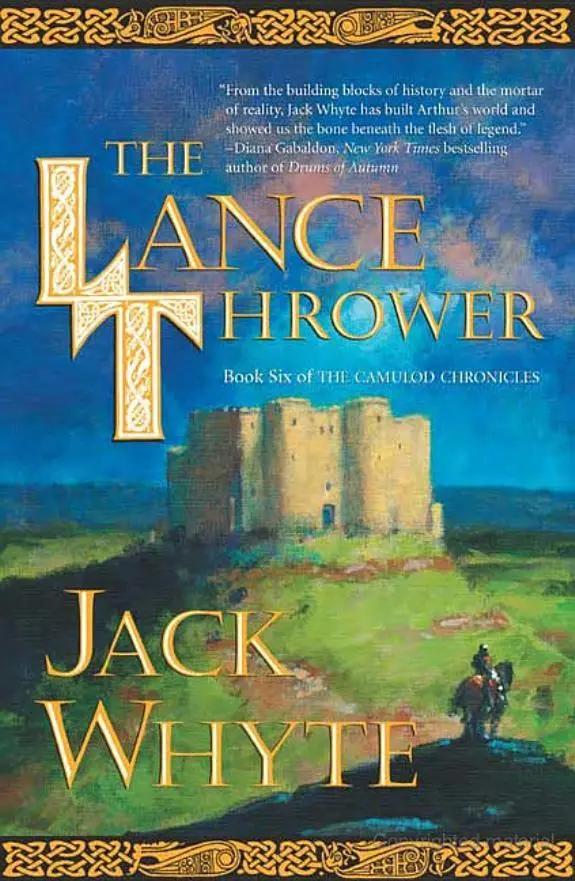
- Название:The Lance Thrower
- Автор:
- Жанр:
- Год:неизвестен
- ISBN:нет данных
- Рейтинг книги:5 / 5. Голосов: 1
-
Избранное:Добавить в избранное
- Отзывы:
-
Ваша оценка:
The Lance Thrower: краткое содержание, описание и аннотация
Предлагаем к чтению аннотацию, описание, краткое содержание или предисловие (зависит от того, что написал сам автор книги «The Lance Thrower»). Если вы не нашли необходимую информацию о книге — напишите в комментариях, мы постараемся отыскать её.
Clothar is a young man of promise. He has been sent from the wreckage of Gaul to one of the few schools remaining, where logic and rhetoric are taught along with battle techniques that will allow him to survive in the cruel new world where the veneer of civilization is held together by barbarism. He is sent by his mentor on a journey to aid another young man: Arthur Pendragon. He is a man who wants to replace barbarism with law, and keep those who work only for destruction at bay. He is seen, as the last great hope for all that is good.
Clothar is drawn to this man, and together they build a dream too perfect to last--and, with a special woman, they share a love that will nearly destroy them all...
The name of Clothar may be unknown to modern readers, for tales change in the telling through centuries. But any reader will surely know this heroic young man as well as they know the man who became his king. Hundreds of years later, chronicles call Clothar, the Lance Thrower, by a much more common name.
That of Lancelot.
The Lance Thrower — читать онлайн бесплатно полную книгу (весь текст) целиком
Ниже представлен текст книги, разбитый по страницам. Система сохранения места последней прочитанной страницы, позволяет с удобством читать онлайн бесплатно книгу «The Lance Thrower», без необходимости каждый раз заново искать на чём Вы остановились. Поставьте закладку, и сможете в любой момент перейти на страницу, на которой закончили чтение.
Интервал:
Закладка:
“He has made the Queen welcome? In her own domain?”
Corbus inclined his head respectfully enough, but his words implied a hint of censure. “The Queen is aware that some of her people have lived here since before this was a kingdom. In their time, they were kings of their own lands.”
“I see. How is the Queen?”
“Mourning a new-lost son. Apart from that, she’s well.”
“And now I have to tell her of her husband.”
Corbus nodded, his face solemn. “Aye, you do, and that will not be a pleasant task. But my lady the Queen already knows her life has changed beyond redemption. She is so deeply steeped in grief that increasing her burden is a mere matter of degree.” He sighed. “Still, we should go to her directly. She will be happy to see you, after such a long absence.”
“Aye, mayhap … until I tell her what she wishes least to hear. Take me to her, if you please.”
“I will, as soon as you are ready.”
As I turned toward my own horse, I saw the third man extend his arm to the horseless man called Charibert and pull him up to ride double with him. Ursus’s horse and mine stood side by side, not far from where we were, and as we walked toward them Ursus finally spat out his last word on the subject of my enthusiastic error.
“It was a stupid thing to do.”
I stopped. “I know, Ursus, and I almost died of it. I know that, believe me, I know. I can but promise you that I will never again take the appearance of a stranger at face value.”
“Fine, then.” He made one last harrumphing sound in his throat and swung himself up into the saddle, and we made our way over to where Corbus and his two companions sat waiting for us. As soon as we reached them, Ursus nodded to the man Charibert and apologized for killing his horse. Charibert, now mounted behind the third man, nodded in acknowledgment, his face unreadable, and then murmured that he would rather be looking at his horse lying dead than have others looking at him lying dead. They turned their mounts around and accompanied us, but no sooner had we left the large meadow and entered the woods from which they had first appeared than the horses were fetlock deep in standing water.
“I knew it had rained a lot,” Ursus said, looking down at it. The long grass through which we were riding was almost completely submerged and the lower branches of the trees and shrubbery ahead of us were barely above water. “But I didn’t think it was this bad.”
“It’s not,” Corbus replied. “It’s always like this here. It gets better, too, wait and see.”
Sure enough, as we progressed into the woods, the water rapidly grew deeper until it was knee deep on the animals and the last vestiges of grass had disappeared beneath the surface. And yet we were still within the woods. Trees towered all around us, although we could now see that many of them were dead or dying, and the dead growth increased as the distance increased, so that the trees farthest from us were uniformly gray and lifeless, drowned by the lake in which they stood.
Corbus tugged on his reins and brought his horse to a halt. “This is as far as we can go in safety.” He lifted his hand to his mouth and blew a low, piercing whistle that was answered instantly from deeper among the trees, then went on speaking as though we were in the middle of a common grazing ground. “Something broke, underground, about two lifetimes ago, according to the man you are about to meet, and what had always been a small, healthy spring became a raging torrent.” He glanced over at Ursus. “You saw the gully carved by the stream where we were attacked, did you not? That is spring-fed, too. There’s something about the terrain here that causes water to come up to the surface from beneath the ground with great force—force that does not abate and is impossible to withstand.” He waved a hand toward the figure who was approaching us, wading through water that rose almost as high as his crotch. “This is Elmo. He’ll tell you about it better than I can.”
We sat silent, watching the man called Elmo approach, and eventually he came to a stop just in front of us, still ankle deep in water and clad from head to foot in a single robe of blackish brown wool that was completely drenched. There he stood, staring up at Ursus first, taking in every detail of my friend’s appearance before turning his eyes on me and scanning me so carefully that I felt as though there could be no flaw, no blemish on or about my appearance that escaped his scrutiny. Only when he had finished cataloguing me did he glance at Corbus, who told him immediately who we were, naming me first as Ban’s youngest son. Corbus continued, “They know nothing of you or why you are here, Elmo. I was about to tell them the history of this place when you came, but decided to wait and let you tell them. Will you?”
Elmo’s eyes narrowed as he looked at me. “I live hereabouts, and my family has been here more than six full generations. My brother Theo rides with Corbus. My grandsire’s grandsire name was Elmo, too, and he lived here before your grandfather, Ban the Bald, was even born, before there was a king of Benwick, and when what is now called Benwick had no name at all. When my ancestor Elmo lived here, though, this place was like that other place at your back, green sward and scattered trees, and we grazed our kine on it—oxen, sheep, and goats. It was sheltered, and close to where we lived, yet far enough removed to keep our beasts free from being plundered. It was boggy in places and it could be dangerous, but it was well watered with sweet, clear-running springs, half a score and more of them.
“But then one day, during my ancestor Elmo’s sixteenth summer, something happened here—a great shifting, somewhere in the earth, beneath the ground. Elmo was here tending his kine when it occurred and he told people the earth shook and threw him on his back and he could not stand up again while it lasted. And after that the springs all dried up and ran no more. People were afraid, thinking some god had grown angered at them and they offered sacrifices of all kinds to every god they knew and some even to gods they didn’t know but thought might be there, watching.
“Even the Romans heard of it and sent some soldiers—engineers, they called themselves—to look at what had happened. But nothing came of it for nigh on another year. The springs were all dried up, but nothing else had changed, and the ground was still a bog in some places, although different places than before.” He paused to scratch his nose, and I found myself wondering, although not yet impatiently, what the import of all this could be. Why were we sitting our mounts knee deep in water listening to a tale from a stranger, when we should be on our way to deliver our tidings to the Queen? Elmo heaved a deep sigh at that point, reclaiming my attention, and turned with lowered head to look at the surrounding water.
“In the spring of the following year, less than a year after the upheavals, my ancestor heard a great cracking noise in the middle of the night and awoke to the terrified screaming of all his cattle and a great hissing, splashing noise of roaring, rushing water. It was the dead of night and there was no moon, so it was black as charcoal here under the trees, and all he could tell was that in the midst of the unseen but frightening chaos around him he felt, and seemed to be, safe against the bole of the tree under which he had been sleeping. He crouched there all night long, waiting for the sun to rise, and when it did he could not believe the sight that awaited him.” Elmo paused again and glanced up at us to see if he had all our attention, knowing full well that he had. We all sat rapt, even the three who had heard the story before.
“He found himself sitting on what would turn out to be a spine of stone running most of the way across the meadow. It had not looked anything like that the day before, but something had ruptured in the ground and released a terrifying scourge of solid water that had scoured away all the soil in its path and bared the rocky sides of the spine. There was another outcrop of rock behind the place where he now sat, and it was crowned with dirt and grass, but the face of it was the clean, bright gray of new-split rock and it was out of a fissure there, lower down than my ancestor’s perch, that the water was spewing.
Читать дальшеИнтервал:
Закладка:
Похожие книги на «The Lance Thrower»
Представляем Вашему вниманию похожие книги на «The Lance Thrower» списком для выбора. Мы отобрали схожую по названию и смыслу литературу в надежде предоставить читателям больше вариантов отыскать новые, интересные, ещё непрочитанные произведения.







Обсуждение, отзывы о книге «The Lance Thrower» и просто собственные мнения читателей. Оставьте ваши комментарии, напишите, что Вы думаете о произведении, его смысле или главных героях. Укажите что конкретно понравилось, а что нет, и почему Вы так считаете.