Jack Whyte - The Lance Thrower
Здесь есть возможность читать онлайн «Jack Whyte - The Lance Thrower» весь текст электронной книги совершенно бесплатно (целиком полную версию без сокращений). В некоторых случаях можно слушать аудио, скачать через торрент в формате fb2 и присутствует краткое содержание. Жанр: Старинная литература, на английском языке. Описание произведения, (предисловие) а так же отзывы посетителей доступны на портале библиотеки ЛибКат.
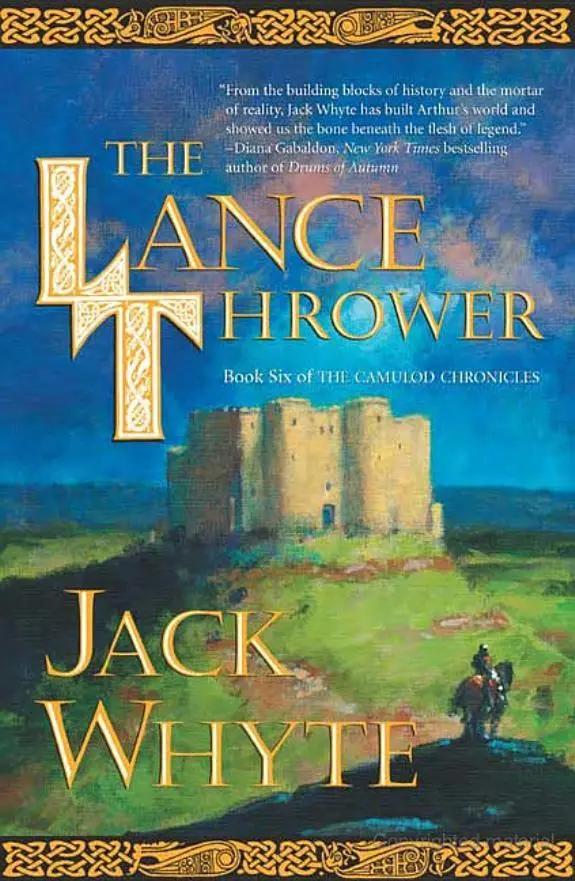
- Название:The Lance Thrower
- Автор:
- Жанр:
- Год:неизвестен
- ISBN:нет данных
- Рейтинг книги:5 / 5. Голосов: 1
-
Избранное:Добавить в избранное
- Отзывы:
-
Ваша оценка:
The Lance Thrower: краткое содержание, описание и аннотация
Предлагаем к чтению аннотацию, описание, краткое содержание или предисловие (зависит от того, что написал сам автор книги «The Lance Thrower»). Если вы не нашли необходимую информацию о книге — напишите в комментариях, мы постараемся отыскать её.
Clothar is a young man of promise. He has been sent from the wreckage of Gaul to one of the few schools remaining, where logic and rhetoric are taught along with battle techniques that will allow him to survive in the cruel new world where the veneer of civilization is held together by barbarism. He is sent by his mentor on a journey to aid another young man: Arthur Pendragon. He is a man who wants to replace barbarism with law, and keep those who work only for destruction at bay. He is seen, as the last great hope for all that is good.
Clothar is drawn to this man, and together they build a dream too perfect to last--and, with a special woman, they share a love that will nearly destroy them all...
The name of Clothar may be unknown to modern readers, for tales change in the telling through centuries. But any reader will surely know this heroic young man as well as they know the man who became his king. Hundreds of years later, chronicles call Clothar, the Lance Thrower, by a much more common name.
That of Lancelot.
The Lance Thrower — читать онлайн бесплатно полную книгу (весь текст) целиком
Ниже представлен текст книги, разбитый по страницам. Система сохранения места последней прочитанной страницы, позволяет с удобством читать онлайн бесплатно книгу «The Lance Thrower», без необходимости каждый раз заново искать на чём Вы остановились. Поставьте закладку, и сможете в любой момент перейти на страницу, на которой закончили чтение.
Интервал:
Закладка:
I admit I knew that things had changed greatly in much too short a space of time, and that the welcome of which I had dreamed and for which I had yearned would not—could not—be as I had envisioned it. The Queen who would have welcomed me with love and joy a mere week earlier was now a widow, burdened by a newborn widow’s grief, and a tormented mother, too, who could not fail to be torn and distracted by the rivalry and conflict so suddenly flung up between her sons. I knew I would be fortunate indeed were the Lady Vivienne even to notice my arrival. All of that was in my mind, as I have said, and in my thinking as a man, but in the hidden recesses of my heart, wherein I was still merely a boy, I dared yet to hope that Vivienne of Ganis would welcome me with radiant smiles and open arms.
We caught up to Beddoc and his band late that afternoon and avoided them easily by leaving the road and sweeping around them, leaving more than sufficient room between us and them to ensure that they would have no suspicion of our presence. They had been marching hard all day, knowing they had a three-hour head start on anyone pursuing them, and to the best of my knowledge, none of them save Beddoc knew that Ursus and I existed, and not even he knew that we had swift horses at our disposal. Beddoc’s sole concern, I was convinced, was to reach Benwick and align himself with Gunthar before any word could reach the castle from King Ban’s party. To that end, he had struck out and away in the middle of the night, knowing that no one he had left behind owned horses that were fast enough to overcome a three-hour lead. His men might be vigilant in watching for pursuers but, human nature being what it is, they would not suspect they might be overhauled as quickly as they had been, and even had they seen us by mischance, they would not have recognized us as representatives of King Ban’s men.
Avoiding them was easy. We had known for some time before finding our quarry that we were gaining on them rapidly. The great road that stretched, magnificently straight, all the way from Lugdunum to Genava carried little traffic nowadays, even at the best of times, and this was far from being that. The threats of war and invasion were enough to deter all but the strongest and most desperate travelers, and so we had the rain-swept causeway all to ourselves, and we saw not the slightest sign of military activity anywhere as we progressed.
Solid and arrow-straight, the roadway provided us with significantly greater advantages than it permitted Beddoc and his men. We were heavily cloaked and well protected from the wind and rain, mounted on strong horses that moved swiftly and cared nothing for the driving downpour. Beddoc and his people, on the other hand, were afoot and heavily laden, making heavy going of their forced march, trudging through heavy, unrelenting rain under full military field packs, because when they had crept away from Samson’s camp in the dead of night they had not dared to risk the noise of harnessing and stealing baggage wagons for their gear and equipment. They had left their cumbersome leather legionary tents behind, confident that they were but one night’s sleep beneath the stars away from home, and so each of them lacked that heavy burden, at least. And so they plodded now through the pouring rain, huddled in misery, footsore, aching, and feeling very sorry for themselves, their sodden clothing and ice cold armor chafing painfully wherever they touched skin.
We came closest to them at the point where they had stopped for their last rest of the day. They had been stopping regularly, once every hour, as marching legions always had from the earliest days of Rome’s soldier-citizenry, and at one point Ursus waved to me to slow down and moved out slowly ahead of me, scanning the wet earth along the roadside. Sure enough, we soon found the spot where Beddoc’s men had spilled off the hard top of the road in search of relief from the cobbled surface and whatever shelter they could find beneath the canopy of the trees on either side. We reined in and Ursus swung down from his saddle to search for whatever it was that he expected to find. I sat straight in my saddle and dug my thumbs into the small of my back, under the edge of my cuirass, grimacing as I stretched and flexed my spine and stared ahead, over my horse’s ears, along the tunnel of the road that stretched ahead of us.
Had the terrain here been as flat as the road was straight, we should have been able to see Beddoc and his party long before this, but the ground in this region undulated gently, in long, rolling ripples that stretched east and west, so that the road ahead rose and fell constantly. You might be able to see as far as half a mile ahead at any time, but then the road would crest and fall away into the next gentle valley and be lost to sight. The sight lines here were impaired, too, by the foliage of the trees that had encroached almost to the edges of the road in some spots, so that their lower boughs appeared from a distance to sweep down completely, to brush the surface of the very stones.
That, I knew, was something new, because I also knew that there had once been a time, extending into the boyhood of King Ban’s grandsire, when an entire department of the imperial civil service had existed solely to maintain the roads in central and southern Gaul. Under its supervision the great roads, so long and straight, had been maintained and regularly repaired, and huge swaths of cleared land, fifty paces wide, had been kept free of growth on either side of each one. But after nigh on a hundred years of neglect and untrammeled growth, the protective borders were now choked with all kinds of brushwood, and large, mature trees now towered close beside the roads themselves, close enough, in many cases, for their massive roots to have damaged the edges of the paving, heaving the paved and metalled surface upward and causing cracks and fractures in the very fabric of the road. Those insignificant-seeming invasions of the roadbeds, according to the wisdom of Bishop Germanus, marked the beginnings of a process of disintegration that would eventually and inevitably, with the hungry assistance of time and weather, bring about the ruin and destruction of most of Rome’s wondrous network of roads.
I saw Ursus stoop and pick something up, and then he came back toward me, gazing down at whatever it was he had found, then lobbing it toward me when he was close enough. I caught it and held it up to see it properly. It was the heel of a loaf of bread, just small enough to fill my palm and hard enough that I could clearly see the gnawed marks where someone had tried in vain to bite into it with strong teeth.
“It’s still dry,” Ursus said, standing now by my knee, “in this weather, save on the very outside. That means we can’t be any more than a quarter of an hour behind the man who threw it away. There’s an abandoned mansio about five miles ahead. They’ll stop there for the night. Or at least, they ought to.”
A mansio was an inn—one of the hostelries provided by the Empire for the comfort and convenience of couriers traveling the main roads upon Imperial business. Imperial couriers had seldom been seen in this part of Gaul for nigh on two decades now, however, and most of the old hostelries had been shut down and abandoned long since.
“Why there?”
“No other choice.” He reached up with a bent finger and flicked a drop of rain from the end of his nose. The downpour suddenly intensified, the rain falling harder than ever, and I had to bend down toward him and listen closely to hear his voice above the thunder of it on my helmet, even though he was shouting at me. “They’ve no tents, remember? And it’s too damn wet for them to even try to shelter under the trees.” He moved even closer to me, leaning against my horse’s side, his left hand holding my ankle as he shouted up at me and his face twisted into a rictus that I soon recognized, to my complete astonishment, as a grin. He was absolutely enjoying all of this, the journey, the chase, and the deluge.
Читать дальшеИнтервал:
Закладка:
Похожие книги на «The Lance Thrower»
Представляем Вашему вниманию похожие книги на «The Lance Thrower» списком для выбора. Мы отобрали схожую по названию и смыслу литературу в надежде предоставить читателям больше вариантов отыскать новые, интересные, ещё непрочитанные произведения.







Обсуждение, отзывы о книге «The Lance Thrower» и просто собственные мнения читателей. Оставьте ваши комментарии, напишите, что Вы думаете о произведении, его смысле или главных героях. Укажите что конкретно понравилось, а что нет, и почему Вы так считаете.