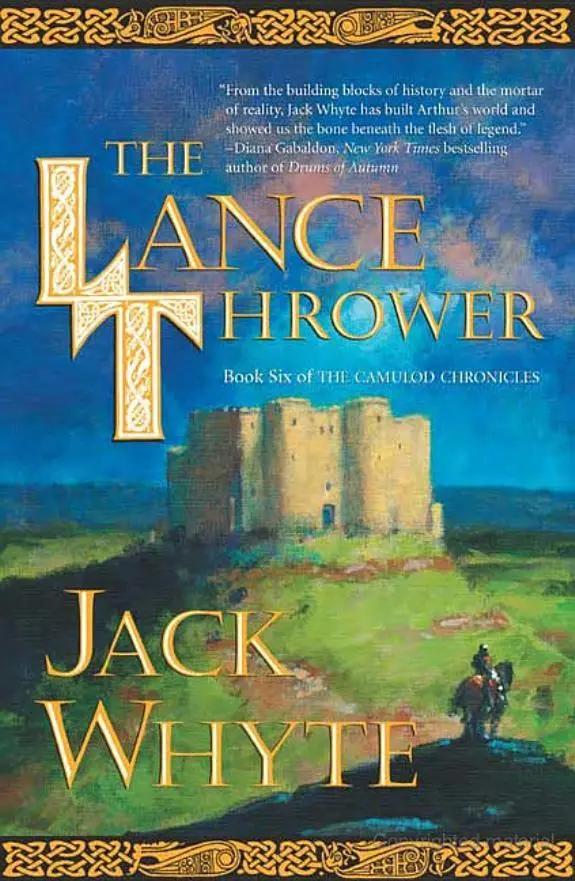
Jack Whyte - The Lance Thrower
Здесь есть возможность читать онлайн «Jack Whyte - The Lance Thrower» весь текст электронной книги совершенно бесплатно (целиком полную версию без сокращений). В некоторых случаях можно слушать аудио, скачать через торрент в формате fb2 и присутствует краткое содержание. Жанр: Старинная литература, на английском языке. Описание произведения, (предисловие) а так же отзывы посетителей доступны на портале библиотеки ЛибКат.
- Название:The Lance Thrower
- Автор:
- Жанр:
- Год:неизвестен
- ISBN:нет данных
- Рейтинг книги:5 / 5. Голосов: 1
-
Избранное:Добавить в избранное
- Отзывы:
-
Ваша оценка:
The Lance Thrower: краткое содержание, описание и аннотация
Предлагаем к чтению аннотацию, описание, краткое содержание или предисловие (зависит от того, что написал сам автор книги «The Lance Thrower»). Если вы не нашли необходимую информацию о книге — напишите в комментариях, мы постараемся отыскать её.
Clothar is a young man of promise. He has been sent from the wreckage of Gaul to one of the few schools remaining, where logic and rhetoric are taught along with battle techniques that will allow him to survive in the cruel new world where the veneer of civilization is held together by barbarism. He is sent by his mentor on a journey to aid another young man: Arthur Pendragon. He is a man who wants to replace barbarism with law, and keep those who work only for destruction at bay. He is seen, as the last great hope for all that is good.
Clothar is drawn to this man, and together they build a dream too perfect to last--and, with a special woman, they share a love that will nearly destroy them all...
The name of Clothar may be unknown to modern readers, for tales change in the telling through centuries. But any reader will surely know this heroic young man as well as they know the man who became his king. Hundreds of years later, chronicles call Clothar, the Lance Thrower, by a much more common name.
That of Lancelot.
The Lance Thrower — читать онлайн бесплатно полную книгу (весь текст) целиком
Ниже представлен текст книги, разбитый по страницам. Система сохранения места последней прочитанной страницы, позволяет с удобством читать онлайн бесплатно книгу «The Lance Thrower», без необходимости каждый раз заново искать на чём Вы остановились. Поставьте закладку, и сможете в любой момент перейти на страницу, на которой закончили чтение.
Интервал:
Закладка:
Ban’s castle, I saw at a glance, was now invulnerable behind its new defenses, accessible only by an imposing and weighty drawbridge, which for the time being lay open, bridging the chasm of the ditch. Perhaps the assembled might of the Empire would be able to bring Ban’s castle down now, but even that was questionable. The fortress beside the lake had its own deep wells, ensuring an ample and permanent supply of fresh water for the garrison, and any successful attack against it must entail a prolonged land siege and a simultaneous naval blockade to prevent reprovisioning of the garrison from the lake side of the defenses. Anyone with any awareness of the logistics involved in such a venture knew too that the Empire no longer had such naval power at its ready disposal.
I was aware of Ursus sitting tall beside me, taking everything in.
“All that looks new,” he said. “Must be for the Burgundians.”
“Alamanni. Chulderic said the Alamanni were on the march.”
“Aye, but didn’t he say at the same time that the Burgundians were causing him more trouble than the Alamanni ever had? Whichever’s right, he’s gone to a power of trouble to deter one or both of them. I wouldn’t like to be the attacking commander responsible for capturing that place now. Once that bridge goes up, there’s no way of getting it down again if the defenders don’t want you to.”
I had been staring at the bridge as he spoke, having recognized it as a masterpiece of defensive engineering from earlier times, one of the great Roman drawbridges. I had heard of such devices from my tutors at the Bishop’s School and had examined ancient drawings and plans for building them, but I had never seen a real one, and now I wondered who had designed and built this one.
Even from where we sat on the hill’s crest gazing at it, and even through the drifting curtains of heavy rain, I could see that it was solid and massive, the bridge deck itself roughly thirty paces in length and fashioned of long, straight logs carefully selected for their uniform size and thickness. They had then been hand sawn, lengthwise, and squared so their sides would fit together, after which they had been covered with a layer of thick, heavy planking set crosswise and secured in place with heavy metal spikes. But that was merely the smallest and least important part of the construction. A drawbridge, no matter how soundly built the bridge deck might be, was completely useless if it could not be raised and lowered, and therein lay the challenge of construction. The end of the bridge on our side of the great ditch overlapped the edge of the excavation by several paces and fitted into a deep channel that had been carefully dug to accommodate its thickness and to bring its surface level with the ground. The far end, however, on the castle side, was very different.
The bridge deck there terminated a good ten paces, perhaps even fifteen paces, beyond the edge of the ditch in what appeared to be a high, blank wall of stone, so that traffic crossing the ditch had to turn sharply right at that point, immediately veering again to enter the protection of the curtain wall that shielded the approach to the main gates. Halfway between the edge of the ditch and the wall at the end of the bridge deck, however, a huge log, two long paces in diameter, had been carefully sunk across the approach and firmly anchored into the ground above the narrow edge of a long, deep pit, the high, vertical sides of which had been lined with logs to guard against subsidence. The pit had originally been dug as a sawpit for the dressing and shaping of the enormous matched logs that formed the foundation of the bridge deck, but it had been sited in that specific spot to serve another, more enduring purpose: the log across the end of the pit, between it and the ditch, was the fulcrum of the bridge, and the blank wall at the bridge end was merely the front surface of a massive counterweight that made it possible for the drawbridge to be raised and lowered with the help of an intricate system of windlasses and pulley hoists. The counterweight itself comprised several thick sheets of iron, hand riveted and bolted to the thick beams of the bridge deck’s end and then surmounted with great squared blocks of solid granite that were secured to the metal plates in turn by welded straps of iron a handspan wide and a thumb’s width thick. When the bridge was raised, the counterweighted end sank into the pit. Twin towers of massive logs flanked the pit right and left and contained the system of giant windlasses and torsion brakes that enabled crews of men to raise and lower the bridge by means of pulleys and enormous chains of iron links.
“You’re right,” I said belatedly. “Once that bridge is up, there’s no way across. The place is impregnable.”
“Aye. So what will you do if your brother Gunthar’s seized it?”
“He is my cousin, not my brother.”
“Cousin, brother, makes no difference to my question. What if he has taken the place?”
“He hasn’t.” I pointed to where a military standard was visible on the highest peak of the battlements above the main gate. “That’s still King Ban’s standard.”
He squinted at it. “How can you tell? It’s a length of soaked, bedraggled fabric beneath a Roman eagle standard on a staff. That’s all I can see, through this rain. It could be anyone’s.”
“No, because it’s pale blue and gold. Even wet and dirty, those colors are recognizable. And they’re Ban’s colors. He was always most particular about visible insignia, and he issued personal colors to each of his four sons with much ceremony as they attained manhood. Gunthar’s is pale green with a wide yellow border; Samson’s is two broad lateral bars, scarlet and white; Theuderic’s is bright yellow with a broad diagonal band of black, from right to left; and Brach’s is blue and white vertical stripes. Had Gunthar moved to usurp the kingship, his green-and-yellow banner would be hanging up there now.”
“Perhaps he forgot to change it. Could he do that, forget such a thing?”
I glanced at him, wondering if he was being facetious, but then I shrugged. “Gunthar is not the kind of man who forgets details of that kind. Appearances are everything to him, which is part of his particular … charm. You’ll understand when you meet him. What Gunthar chooses to show you and what you actually see are seldom the same thing.” I turned again to look at the rain-drenched blue-and-gold standard on the walls and shook my head, this time more decisively. “No, had Gunthar taken over already, he would want everyone to know it—immediately—and one of the most obvious ways to achieve that would be to hoist his standard, his colors, above his fortress for all to see.”
“He sounds like a wonderful fellow,” my companion drawled. “But speaking of things that are there for all to see, there’s not much to see here at all, is there? Were it not for that cluster of guards above the main gate there, I would have thought this place was deserted.”
I looked again, at the walls this time rather than at the bridge. There were some guards above the main gate, as he had said, but there was no one else in sight, and the so-called guards had not yet seen us, although we had been there long enough to examine their new defenses in detail. I felt a kick of sudden misgivings stir in my gut and sat straighter in the saddle, taking up the slack in my reins.
“You’re right. They’re too few, and negligent. They have not even looked in this direction since we arrived. We had better get down there.” I kicked my horse into motion and heard, rather than saw, Ursus’s mount fall into line behind me, and all the way from there to the final approach to the bridge I kept my eyes fastened on the men above the main gates.
Читать дальшеИнтервал:
Закладка:
Похожие книги на «The Lance Thrower»
Представляем Вашему вниманию похожие книги на «The Lance Thrower» списком для выбора. Мы отобрали схожую по названию и смыслу литературу в надежде предоставить читателям больше вариантов отыскать новые, интересные, ещё непрочитанные произведения.







Обсуждение, отзывы о книге «The Lance Thrower» и просто собственные мнения читателей. Оставьте ваши комментарии, напишите, что Вы думаете о произведении, его смысле или главных героях. Укажите что конкретно понравилось, а что нет, и почему Вы так считаете.