Jack Whyte - The Lance Thrower
Здесь есть возможность читать онлайн «Jack Whyte - The Lance Thrower» весь текст электронной книги совершенно бесплатно (целиком полную версию без сокращений). В некоторых случаях можно слушать аудио, скачать через торрент в формате fb2 и присутствует краткое содержание. Жанр: Старинная литература, на английском языке. Описание произведения, (предисловие) а так же отзывы посетителей доступны на портале библиотеки ЛибКат.
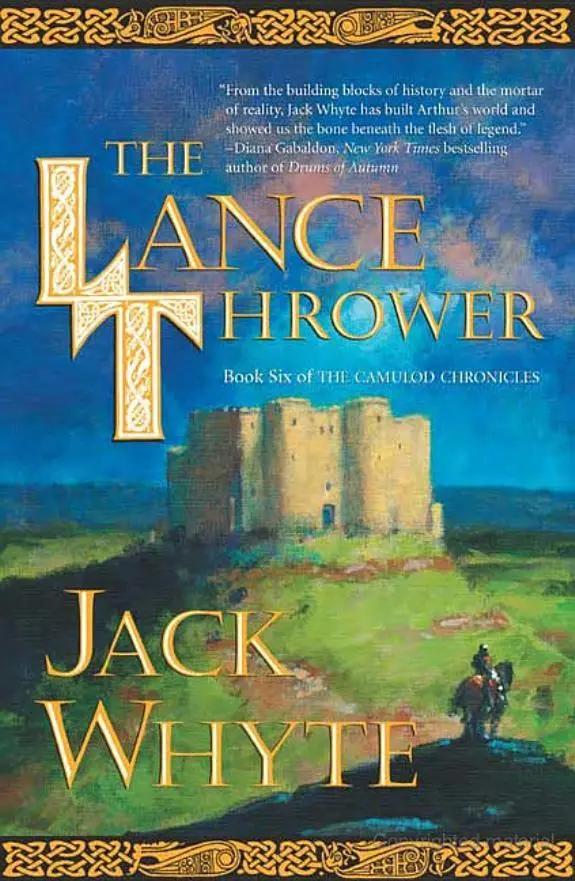
- Название:The Lance Thrower
- Автор:
- Жанр:
- Год:неизвестен
- ISBN:нет данных
- Рейтинг книги:5 / 5. Голосов: 1
-
Избранное:Добавить в избранное
- Отзывы:
-
Ваша оценка:
The Lance Thrower: краткое содержание, описание и аннотация
Предлагаем к чтению аннотацию, описание, краткое содержание или предисловие (зависит от того, что написал сам автор книги «The Lance Thrower»). Если вы не нашли необходимую информацию о книге — напишите в комментариях, мы постараемся отыскать её.
Clothar is a young man of promise. He has been sent from the wreckage of Gaul to one of the few schools remaining, where logic and rhetoric are taught along with battle techniques that will allow him to survive in the cruel new world where the veneer of civilization is held together by barbarism. He is sent by his mentor on a journey to aid another young man: Arthur Pendragon. He is a man who wants to replace barbarism with law, and keep those who work only for destruction at bay. He is seen, as the last great hope for all that is good.
Clothar is drawn to this man, and together they build a dream too perfect to last--and, with a special woman, they share a love that will nearly destroy them all...
The name of Clothar may be unknown to modern readers, for tales change in the telling through centuries. But any reader will surely know this heroic young man as well as they know the man who became his king. Hundreds of years later, chronicles call Clothar, the Lance Thrower, by a much more common name.
That of Lancelot.
The Lance Thrower — читать онлайн бесплатно полную книгу (весь текст) целиком
Ниже представлен текст книги, разбитый по страницам. Система сохранения места последней прочитанной страницы, позволяет с удобством читать онлайн бесплатно книгу «The Lance Thrower», без необходимости каждый раз заново искать на чём Вы остановились. Поставьте закладку, и сможете в любой момент перейти на страницу, на которой закончили чтение.
Интервал:
Закладка:
“Aye. But why would you say that?”
“Because that is the only way to go, as a thinking man. Going in expecting the very worst, anything you find that’s less than that will appear to be welcome. I have the feeling that we are about to be involved in a struggle, you and I—perhaps a civil war between brothers—whether we like it or no. The stakes are high enough to justify a war, no doubt about that—a kingship and its power for the winner. I don’t believe in auguries but I mislike the way things have fallen out, these past few days. This brother of yours, Gunthar, sounds like a bad one to me. He does not strike me as the kind of man who’ll be content to sit quietly back and run the risk of being frustrated and deposed. Granted, he doesn’t know yet that King Ban dispossessed him, or that Ban himself is dead, but he does know Ban was seriously wounded, and that in itself might have been enough to make him react according to his true nature.
“I hope I’m wrong and everything is well, and I would be happy to admit within a few days that I’ve been speaking like an old woman tonight, but we’ll find out the truth tumor-row, when we reach Genava. Sleep well, in the meantime, and hope the rain stops before dawn. At least we’ll start out warm and dry in the morning, which is more than can be said for Beddoc’s cattle.”
With that, Ursus turned noisily around in his bed and was snoring heavily in the space of what seemed like several heartbeats, but his last words had bereft me of any easy ability to sleep and I lay awake with my own thoughts until the fire had died out completely and even the roaring of the rain on the roof dwindled into silence.
How would Gunthar react, I wondered, now that Ban’s last decision had been made public? I had always been as one with his half-brothers in believing him to be abnormal in his responses to being thwarted or crossed in any way, and we had often laughed derisively at his excessive reactions on such occasions, declaring him, among ourselves, to be insane and beyond redemption, simply because we had had no fear of him in those days, confident in our father’s protection and in our own conviction that Ban’s firstborn son was different in almost every way to each and all of us. But the last time I had laughed thus, I was less than ten years old and knew nothing of the world. Six years had elapsed since then and I had barely thought of Gunthar in all that time. How had he changed during those years, I wondered now, and I doubted that any change he might have undergone would be for the better.
It was more than conceivable, I thought, that Ursus was exactly correct and that we might be hovering on the verge of falling into a situation that was beyond our control, within the next few days. And thinking that, I fastened upon the phrase, beyond our control, and tried to think what that meant. My entire life, I realized now lying there in the flickering firelight, had been entirely under the control of other people, King Ban, Chulderic, Tiberias Cato, and Bishop Germanus foremost among them, until the day of the ambush in which Lorco lost his life. Since then, from that day forward, I had thought I was controlling my own life without help, but by then I had become dependent upon Ursus, exchanging one mentor for another so that even now, gazing into the future, I was being guided by his wisdom and experience. Be prepared for the worst, he had said, because that way anything less looks like a reprieve. I tried earnestly to envision the very worst that could occur to us in the days ahead, but all I could think of in those terms was Lorco’s head suddenly changing shape and bursting apart with the impact of the arrow, because that was the very worst thing that had ever happened to me. I could not imagine anything ever being more dreadful than that, and thinking that, I must have drifted off to sleep.
BOOK TWO
BROTHERS AND COUSINS

V
GUNTHAR AND THEUDERIC
 GUNTHAR’S WAR. I have no idea why I still think of that squalid episode in those terms. It was Gunthar’s, certainly; he brought it about and he was the dominant participant, but it was not a war. It never came close to being a war.
Wars have at least an illusion of grandeur and respectability attached to them; there is always the notion involved that, in a just war, some of the participants are motivated by high ideals and honorable intentions and that they fight to defend and protect something of value. Gunthar’s War stirred no such thoughts. There was nothing noble or inspiring within its entire duration to stir the minds or imaginations of adventurous boys. The people ranged against Gunthar and his depravity, myself included, fought out of sheer terror and desperation, knowing that to do less, to refuse to fight, was to surrender their lives and their entire world to the dementia of a murderous degenerate. Gunthar’s War was a morass of filth and wretchedness from beginning to end. Nothing good came out of it. It was a bloodbath of mindless slaughter and godless atrocities too foul for the ordinary mind to accommodate, and merely being involved in it was a disgusting experience, easily the bleakest and blackest part of my early manhood.
Even so, I came of age in the course of it, and I learned much about the ways of men, because it presented me a study in treachery and an object lesson in how one evil man can spawn corruption and perdition and thrust it on to other, better men. Gunthar’s “War” was no more and no less than a vicious internecine squabble. It was born of greed, betrayal, duplicity, and the lust for power, and it demeaned and came nigh to destroying everyone caught up in it.
We rode into it, literally, the morning following our night in the shepherd’s hut.
I had been dreaming for years of the first view I would have of King Ban’s castle after my lengthy absence, and I had seen every detail of the place clearly outlined in my memory, so that even in the pouring rain, which had not abated in the slightest overnight, I found myself almost laughably anxious as Ursus and I approached the brow of the last rise in the road that concealed the castle from our view. And then we were level with the top and I was gazing hungrily at the sight that awaited me, only to find that it was vastly different from what I remembered leaving behind me six years earlier.
An enormous ditch had been dug around the entire castle, and the excavated earth had been used to build a steeply sloping rampart on the far side, in front of the castle walls, which thus became a secondary line of defense rather than the primary one. The work had been done very recently, too. I could see that by the rawness of the logs that had been used to stabilize the slope of the earthen wall. It was a classical Roman fortification of vallum et fossam: an unscalable, ramped wall of earth and clay excavated from, and used to back, a deep and dangerous protective ditch. The defenders were all but invulnerable, at the top of the sloping wall, where they could overlook and annihilate their attackers, who had to cross the exposed ditch and then fight their way up the steep clay face. In this instance, however, the effect of the fortification was doubly enhanced by the towering height of the castle walls that loomed behind the earthen one, for the stone battlements were more than twice as high again as the new ramparts at their foot, and the defenders up there could shoot down easily and without fear of counterattack into the mass of any attackers who might dare to attempt a crossing.
Читать дальшеИнтервал:
Закладка:
Похожие книги на «The Lance Thrower»
Представляем Вашему вниманию похожие книги на «The Lance Thrower» списком для выбора. Мы отобрали схожую по названию и смыслу литературу в надежде предоставить читателям больше вариантов отыскать новые, интересные, ещё непрочитанные произведения.







Обсуждение, отзывы о книге «The Lance Thrower» и просто собственные мнения читателей. Оставьте ваши комментарии, напишите, что Вы думаете о произведении, его смысле или главных героях. Укажите что конкретно понравилось, а что нет, и почему Вы так считаете.