Jack Whyte - The Lance Thrower
Здесь есть возможность читать онлайн «Jack Whyte - The Lance Thrower» весь текст электронной книги совершенно бесплатно (целиком полную версию без сокращений). В некоторых случаях можно слушать аудио, скачать через торрент в формате fb2 и присутствует краткое содержание. Жанр: Старинная литература, на английском языке. Описание произведения, (предисловие) а так же отзывы посетителей доступны на портале библиотеки ЛибКат.
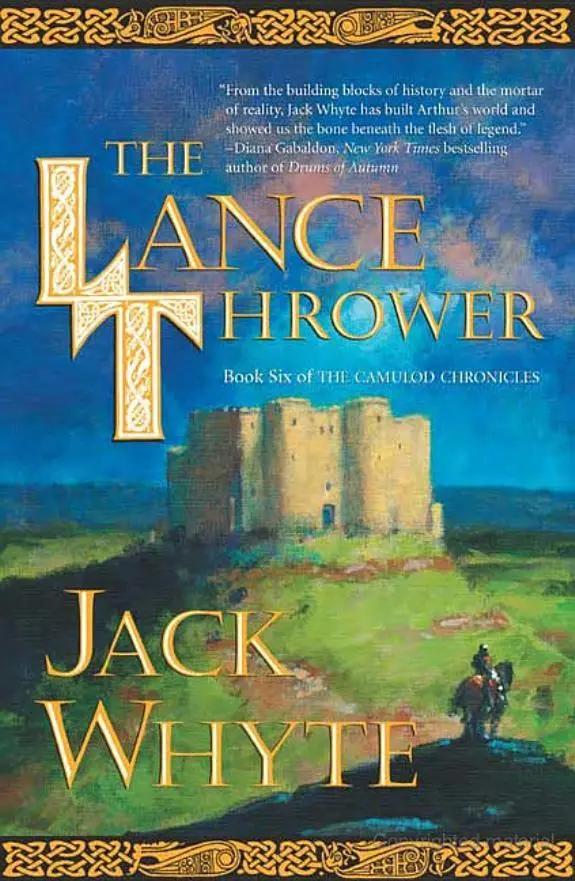
- Название:The Lance Thrower
- Автор:
- Жанр:
- Год:неизвестен
- ISBN:нет данных
- Рейтинг книги:5 / 5. Голосов: 1
-
Избранное:Добавить в избранное
- Отзывы:
-
Ваша оценка:
The Lance Thrower: краткое содержание, описание и аннотация
Предлагаем к чтению аннотацию, описание, краткое содержание или предисловие (зависит от того, что написал сам автор книги «The Lance Thrower»). Если вы не нашли необходимую информацию о книге — напишите в комментариях, мы постараемся отыскать её.
Clothar is a young man of promise. He has been sent from the wreckage of Gaul to one of the few schools remaining, where logic and rhetoric are taught along with battle techniques that will allow him to survive in the cruel new world where the veneer of civilization is held together by barbarism. He is sent by his mentor on a journey to aid another young man: Arthur Pendragon. He is a man who wants to replace barbarism with law, and keep those who work only for destruction at bay. He is seen, as the last great hope for all that is good.
Clothar is drawn to this man, and together they build a dream too perfect to last--and, with a special woman, they share a love that will nearly destroy them all...
The name of Clothar may be unknown to modern readers, for tales change in the telling through centuries. But any reader will surely know this heroic young man as well as they know the man who became his king. Hundreds of years later, chronicles call Clothar, the Lance Thrower, by a much more common name.
That of Lancelot.
The Lance Thrower — читать онлайн бесплатно полную книгу (весь текст) целиком
Ниже представлен текст книги, разбитый по страницам. Система сохранения места последней прочитанной страницы, позволяет с удобством читать онлайн бесплатно книгу «The Lance Thrower», без необходимости каждый раз заново искать на чём Вы остановились. Поставьте закладку, и сможете в любой момент перейти на страницу, на которой закончили чтение.
Интервал:
Закладка:
Astonishingly, Ban had then, and thus publicly, rescinded his acknowledgment of his firstborn son, Gunthar, as his legal heir and follower, denying him the right to claim the crown of Benwick. His second son, the twenty-three-year-old Samson, Ban had declared in front of everyone assembled, would be his heir henceforth and would assume the crown on Ban’s death. It was a momentous announcement and apparently a spontaneous one, in the eyes of those who were present for the occasion, notwithstanding the King’s claim that he had been considering it for years, believing he yet had years ahead of him to resolve such matters.
My own belief is that the King’s claim, disregarded and generally discounted as it was, was no less than the truth. I knew from comments made by Samson and Brach that Ban had been having serious misgivings for years about Gunthar’s fitness to succeed him, but I also accepted that Ban truly had believed there was no shortage of time ahead of him and that he was under no urgency to make such a grave decision. As soon as his circumstances changed, however, Ban the King, who had always been a pragmatist adapting constantly to the real world in which he lived and ruled, made a final and irrevocable decision and announced it bluntly, in the presence of witnesses.
So now my cousin Samson would be king of Benwick. And my cousin Gunthar would not. Wrack, ruin, and chaos lay between those two statements.
Even as I listened to Chulderic’s report of the King’s pronouncement, I knew that the old warrior was as perturbed by the development as I was—it was plain to be heard in his tone. He had been counselor to Ban for many years, but he had always held his personal opinions close and was notoriously tight-lipped on matters of the King’s concerns, so I had no real knowledge of how he felt about what he was reporting to me, nor had I any insight into whether he might approve or disapprove of the King’s decision. Such perceptions, however, were irrelevant. The King had made up his mind and had then made his decision public. Neither Chulderic nor anyone else, and least of all I, could do anything to change what had been done. But neither one of us could ever have envisioned the carnage and the depredations that were to follow from the King’s decision. That all lay in the future.
For the time being, once the first impact of the news of Ban’s decision had passed by, my own mind became entirely preoccupied with the awareness that the King’s sudden decision on this matter of the succession must reflect his own belief that he was going to die. It was a notion that my mind could not encompass. Ban of Benwick, my uncle, father, guardian, was and had always been the single, strongest constant in my life, far more so at that time than even Germanus. The perfect embodiment of the term “warrior king,” he had always been indomitable and indefatigable, a champion among champions of any stripe, with an upright, unimpeachable integrity and dignitas that had won him the respect and admiration of everyone who knew him and had dealings with him. And now this paragon was to die? It was simply unacceptable and I would not, could not countenance the possibility. I knew he was sorely wounded and I had seen the proof of that with my own eyes, but he was Ban of Benwick, indestructible. His wounds might be grievous and even life threatening, I told myself, but they would not be fatal. Ban would overcome them. He would. He must.
In the meantime, however, in complete defiance of all my expectations and my most sincere prayers, King Ban grew increasingly drowsy and more weakened from day to day, sleeping for longer and longer periods until eventually, four days after his fateful pronouncement, he slipped backward into a deep slumber from which he was never to awaken.
He asked for me, however, on the day following my arrival while he was yet in fair condition, given the serious nature of his injuries, and when I went into his presence he knew me immediately and made me feel very welcome. He was lying strangely, propped up carefully and off-center on a mountain of soft skins because of the seriousness of his wound, and he still had that curious protective construction about his chest and shoulder. His face was gaunt and haggard, deeply lined and gray with pain, and his voice was whispery, his breathing shallow and careful. Nevertheless, despite all his discomfort and my own discomfiture, he made it possible for me to gain great pleasure from his company. According me the status of manhood by speaking to me as an equal, he asked me all about my school and my various tutors, all of whom he knew by name thanks to the dutiful correspondence of the bishop’s chief scribe and secretary, Ludovic. He asked me, too, about his old friend Germanus, but I had the distinct feeling—why, I could not have explained—that he already knew more about the bishop and his affairs than I could tell him. Then, too, he praised me for my prowess in arms and asked me about the adventures I had shared with Ursus on our way here, eliciting the information from me, almost without my volition, that I had killed my first enemies along the way.
I was aware of Sakander the surgeon sitting at the rear of the tent throughout all this, but the man never stirred and offered no interruption at any time. He merely sat watching, alert to the condition of his charge.
Finally, however, Ban raised his uninjured hand slightly and waved the fingers gently from side to side as though indicating that he had something more to say on another topic. I nodded, my eyes fixed upon his lips, and he began to speak again in a papery whisper, speaking words that I have never forgotten.
“You have always been a fine boy, Clothar. You would have been … you are a living tribute to your parents, and I have been proud to watch you grow toward manhood. Now I shall watch you no more … not from this side of Heaven’s veil … .” He paused, and I remained motionless, waiting for him to continue but thinking that I had never before heard him mention the Christian Heaven by name. He coughed very gently, deep in his throat, then continued. “Young as you are, you have never been afraid of facing your duties, and that … that is as it should be. Duty comes first for a man of honor, Clothar. Never forget that. Never lose sight of it. So long as you hold fast to duty, you will hold fast to God, for He it is who defines duty, and He has great things in store for you. Be ready for them, Clothar, for they await you … but be ready, too, to find that they are onerous. Great rewards demand great sacrifices.” His eyes closed, but he held his hand still raised above the surface of his bedding, so I knew he was merely resting, not yet finished, and I waited until he spoke again.
“Auxerre,” he whispered then, his voice a mere breath. “Auxerre. Germanus. You must return there, to Auxerre, to Germanus. And let nothing come between you and that goal.” His eyes widened and it seemed to me a fiery spark sprang to life deep within them. “Promise me you will,” he said, reaching out to grasp my fingers in his own and surprising me with the strength of his grip. “Swear it to me: you will go from Benwick to Auxerre, to Germanus. Swear—” He stopped abruptly, and his eyes narrowed as he peered at me, pulling me down toward him. “You understand the swearing of an oath, what it means? Do you, boy?”
“Aye, Lord,” I nodded, repeating what I had been taught at the Bishop’s School. “It is a sacred promise to God Himself, not to be undertaken lightly and never to be broken, upon pain of damnation.”
“Aye, boy, that is what an oath is. Swear then, to me, that you will do as I bid you and that nothing will prevent you from doing it.”
I swore the oath at his request, looking directly into his eyes and accepting the duty he thus placed upon me, but even as I did so it was halfhearted, diluted by a reluctance that was born of a silent, sneaking belief that the King was not altogether strong in mind. In all the years that I had known him I had never heard him talk so fervently before about God and God’s expectations of real, living people. Truth to tell, I had never heard him speak of God at all, under any circumstances. That he should do so now was, I feared, an indication of just how weakened he had become.
Читать дальшеИнтервал:
Закладка:
Похожие книги на «The Lance Thrower»
Представляем Вашему вниманию похожие книги на «The Lance Thrower» списком для выбора. Мы отобрали схожую по названию и смыслу литературу в надежде предоставить читателям больше вариантов отыскать новые, интересные, ещё непрочитанные произведения.







Обсуждение, отзывы о книге «The Lance Thrower» и просто собственные мнения читателей. Оставьте ваши комментарии, напишите, что Вы думаете о произведении, его смысле или главных героях. Укажите что конкретно понравилось, а что нет, и почему Вы так считаете.