Jack Whyte - The Lance Thrower
Здесь есть возможность читать онлайн «Jack Whyte - The Lance Thrower» весь текст электронной книги совершенно бесплатно (целиком полную версию без сокращений). В некоторых случаях можно слушать аудио, скачать через торрент в формате fb2 и присутствует краткое содержание. Жанр: Старинная литература, на английском языке. Описание произведения, (предисловие) а так же отзывы посетителей доступны на портале библиотеки ЛибКат.
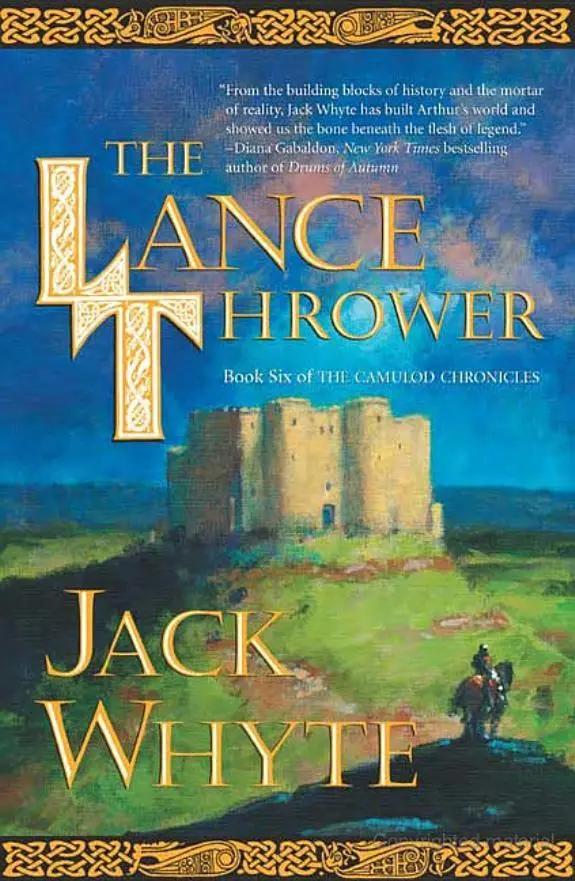
- Название:The Lance Thrower
- Автор:
- Жанр:
- Год:неизвестен
- ISBN:нет данных
- Рейтинг книги:5 / 5. Голосов: 1
-
Избранное:Добавить в избранное
- Отзывы:
-
Ваша оценка:
The Lance Thrower: краткое содержание, описание и аннотация
Предлагаем к чтению аннотацию, описание, краткое содержание или предисловие (зависит от того, что написал сам автор книги «The Lance Thrower»). Если вы не нашли необходимую информацию о книге — напишите в комментариях, мы постараемся отыскать её.
Clothar is a young man of promise. He has been sent from the wreckage of Gaul to one of the few schools remaining, where logic and rhetoric are taught along with battle techniques that will allow him to survive in the cruel new world where the veneer of civilization is held together by barbarism. He is sent by his mentor on a journey to aid another young man: Arthur Pendragon. He is a man who wants to replace barbarism with law, and keep those who work only for destruction at bay. He is seen, as the last great hope for all that is good.
Clothar is drawn to this man, and together they build a dream too perfect to last--and, with a special woman, they share a love that will nearly destroy them all...
The name of Clothar may be unknown to modern readers, for tales change in the telling through centuries. But any reader will surely know this heroic young man as well as they know the man who became his king. Hundreds of years later, chronicles call Clothar, the Lance Thrower, by a much more common name.
That of Lancelot.
The Lance Thrower — читать онлайн бесплатно полную книгу (весь текст) целиком
Ниже представлен текст книги, разбитый по страницам. Система сохранения места последней прочитанной страницы, позволяет с удобством читать онлайн бесплатно книгу «The Lance Thrower», без необходимости каждый раз заново искать на чём Вы остановились. Поставьте закладку, и сможете в любой момент перейти на страницу, на которой закончили чтение.
Интервал:
Закладка:
“How is he?” This was Chulderic, growling at Sakander.
“How would you be, given the same affliction?” The surgeon’s voice was deep and level in tone, his diction precise and utterly lacking in the pompous affectation assumed by so many of his colleagues. He spoke to Chulderic as to an equal, and I had little doubt that the two of them were friends of long standing. “He is near death and I am powerless to help him. This was a freakish wound, the like of which I’ve never seen before, but the unlikelihood of it does nothing to lessen its gravity.”
“Hmm.” Chulderic gazed down to where his friend the King lay sleeping. As though he knew Chulderic would say no more, the surgeon continued speaking.
“Whoever the bowman was, he must have had the strength of a demon, for the arrowhead struck hard and sank deep, dislodging solid bone. It pierced the hollow of the shoulder socket beneath his upraised arm, deflected off the ball of the bone, I suspect, and then again, sideways and inward from the angled plate of his shoulder blade. From there it sliced through flesh and muscle, turning all the time because of the curvature of the arrowhead blades, until it struck his spine, lodging solidly this time, perhaps between two of the vertebrae.”
He paused, then cleared his throat before going on. “That is what I suspect, but I have no way of proving or disproving it, short of killing him by cutting into him and mutilating him further, digging for the arrowhead. But we have other arrowheads that illustrate the problem facing us. See for yourself.”
He indicated a table opposite him, where lay four war arrows, all identical to each other. “Those came from the same quiver as the one that shot down the King. They are identical in the fletching, as you can see, and in the shaping and weight of the warheads. No reason to suspect that the one in the King’s wound should be any different.”
I looked carefully at the four arrows, seeing the bright yellow feathers with which they had been fletched, and as I did so Chulderic picked one up, holding it close to his eyes to examine the heavy iron head. I leaned closer to him to share his appraisal. The thing was a work of art, made by a master craftsman and comprising three razor-sharp, wedge-shaped blades of thin, tempered metal cunningly welded into a lethal tapering triple-edged point. At the broadest end of each blade the metal had been flared and twisted out of true to form wickedly curving barbs that, once set in a wound, would be impossible to remove without destroying all the flesh surrounding the entry channel. The very sight of the curved barbs made me wince and grind my teeth, imagining the bite of their entry.
“By the balls of Mithras,” Chulderic growled, “the man who made these things knows his craft.” He wrapped his fingers firmly around the center of the shaft he held, then moved it around behind his back as he bent toward the unconscious form of the King, peering closely at the sleeping face.
“How long will he sleep?”
“Two hours, I hope, perhaps longer. But it could be less. It depends upon how well his mind blocks out the pain.”
“That’s what you gave him the potion for?”
“Aye. The substance is strong. It induces sleep and stifles pain.”
“What is it called, this substance?”
“It has no name of its own. It is one of a range of marvelous powders, all of them white, that are miscible in water and produce wondrously beneficent effects. We call them opiates, and although I know not where they come from, they are supposedly distilled from the essence of white poppy flowers in a distant land to the east, beyond the Empire’s bounds.”
“The Kingdom,” I whispered, remembering something Tiberias Cato had told me about his days as a boy there.
Sakander turned his keen gaze on me immediately. “What did you say?”
He did not call me “boy” but I felt the rebuke nonetheless and I felt myself flushing. “I said, the Kingdom. It is what the Smoke People call the ancient land far to the east, beyond this Empire.”
“The Smoke People. And who are they?”
I shrugged, feeling foolish to be talking of such irrelevant and inconsequential things over the unconscious body of the King. “A tribe of nomads, horsemen, thousands of miles from here. A friend of mine, one of my teachers, once lived among them for a while and learned from them about the Kingdom, an ancient place of great wisdom and learning, peopled by men with yellow skin, black eyes, and straight black hair.”
I was conscious of both men staring at me, and then Chulderic, his voice inflectionless and unreadable, said, “Sakander, this is the King’s youngest son, Clothar. He has been away, in the north, attending Bishop Germanus’s school in Auxerre since before you came to us. Apparently they have taught him some novel notions.” He looked back to the King. “When will we be able to move him?”
Sakander began speaking without removing his eyes from mine. “He should not be moved at all, but since it is clearly both dangerous and foolish for us to remain here, separated from the army, then we may as well move him immediately and hope to achieve the worst of it while he is still in the grasp of the opiate.” He turned back to the King then, dismissing me for more important matters. “I have him lying on a board, beneath those covers, for ease of carrying, because I did not know how soon we might want to move him. Four strong men should be able to bear him easily from here to the largest of the commissary wagons. It is well sprung—as well as any wagon can be—and I have it already stripped of all its contents and layered thick with straw to guard him as well as may from bumps and bruises.” The surgeon shook his head. “I don’t know whether it is better to move quickly or slowly in such cases, but whichever way we go, Lord Ban will be badly jarred in transit. Fortunately we are but four miles from the main encampment, so if we leave within the hour we can be there before noon.”
“Aye, four miles from the army’s camp, but we’re fifty miles from home.”
Sakander nodded, his face expressionless. “True. Will you give orders to break camp?”
“Aye.” Chulderic called to Samson, who came in immediately. The old warrior explained what he and Sakander had decided, then instructed the younger man to choose four men to move the King, and then to make the necessary traveling arrangements to rejoin the main body of the army.
Ban of Benwick remained unconscious while he was gently moved, and he slept through the entire four-mile journey to the main camp. Sakander sat beside the King the entire time and his face was somber and unreadable, but I suspected that he was not entirely grateful for the King’s lack of awareness. It seemed to me, watching him as he bent forward time after time to wipe the King’s face with a moist cloth, that the surgeon might have been happier had he discerned even a hint of discomfort in the King’s demeanor. But that was purely a personal conjecture and I had nothing at all on which to base my suspicion, beyond an insistent prompting from somewhere in my own head. It simply seemed to me that the King slept too profoundly.
Ban slept that entire day away, and the night as well, opening his eyes only at midmorning on the following day. I had ridden out of camp by that time, accompanied by Ursus, unable to remain waiting passively for something to happen and even less able to sit quietly by while my father—this title in defiance of the fact that I knew him to be my uncle—fought for his very life. Chulderic told me later that the King was very weak, but free of pain and lucid when he awoke, and that he remained that way for nigh on two hours, during which time Chulderic had been able to pass on to him the gist of the messages I had brought from Germanus. The King had listened and understood, and had made several pronouncements, in addition to which he had had Chulderic summon the cadre of his senior officers, both to witness and thereafter attest to his lucidity, his soundness of mind, and his self-possession, and also to bear witness to his issuance of several specific instructions concerning the immediate future of his lands and his people.
Читать дальшеИнтервал:
Закладка:
Похожие книги на «The Lance Thrower»
Представляем Вашему вниманию похожие книги на «The Lance Thrower» списком для выбора. Мы отобрали схожую по названию и смыслу литературу в надежде предоставить читателям больше вариантов отыскать новые, интересные, ещё непрочитанные произведения.







Обсуждение, отзывы о книге «The Lance Thrower» и просто собственные мнения читателей. Оставьте ваши комментарии, напишите, что Вы думаете о произведении, его смысле или главных героях. Укажите что конкретно понравилось, а что нет, и почему Вы так считаете.