Bernard Cornwell - Stonehenge
Здесь есть возможность читать онлайн «Bernard Cornwell - Stonehenge» — ознакомительный отрывок электронной книги совершенно бесплатно, а после прочтения отрывка купить полную версию. В некоторых случаях можно слушать аудио, скачать через торрент в формате fb2 и присутствует краткое содержание. Жанр: Старинная литература, на русском языке. Описание произведения, (предисловие) а так же отзывы посетителей доступны на портале библиотеки ЛибКат.
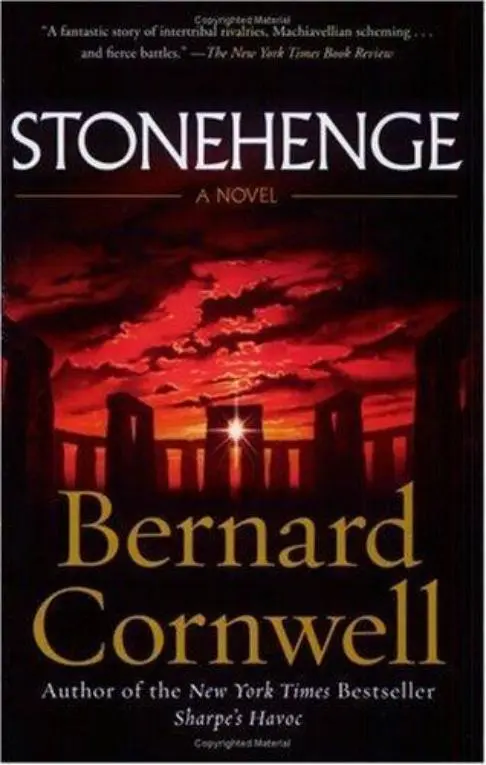
- Название:Stonehenge
- Автор:
- Жанр:
- Год:неизвестен
- ISBN:нет данных
- Рейтинг книги:3 / 5. Голосов: 1
-
Избранное:Добавить в избранное
- Отзывы:
-
Ваша оценка:
Stonehenge: краткое содержание, описание и аннотация
Предлагаем к чтению аннотацию, описание, краткое содержание или предисловие (зависит от того, что написал сам автор книги «Stonehenge»). Если вы не нашли необходимую информацию о книге — напишите в комментариях, мы постараемся отыскать её.
Stonehenge — читать онлайн ознакомительный отрывок
Ниже представлен текст книги, разбитый по страницам. Система сохранения места последней прочитанной страницы, позволяет с удобством читать онлайн бесплатно книгу «Stonehenge», без необходимости каждый раз заново искать на чём Вы остановились. Поставьте закладку, и сможете в любой момент перейти на страницу, на которой закончили чтение.
Интервал:
Закладка:
'Kill her?' Saban asked, shocked.
'We send her to Erek.' Erek was the Outfolk's name for Slaol. 'And one year,' Haragg went on, 'we chose Miyac'
Saban flinched. 'You chose her?'
'The priests chose her,' Haragg said, 'and I was a priest. My wife screamed at me, she hit me, but I thought it was an honour to our family. What greater husband could Miyac have than Erek? And so my daughter went to her death and my wife died within a moon, and I fell into a black sadness, and when I came from that sadness I no longer wanted to be a priest and my ideas were unwelcome and so I began to wander the land. I traded.' The sadness showed on his face and Cagan whimpered so that Haragg leaned over and patted his son's hand to show that everything was well.
Saban shifted closer to the fire, dragged the pelt around his shoulders and wondered if the world would ever be warm again.
'My twin brother was the high priest in Sarmennyn,' Haragg said, 'and when I told him I no longer believed in sacrifice he allowed me to become a trader instead of a priest. His name is Scathel. You will meet him, if he still lives.'
Something about the way Haragg said his brother's name suggested that Saban did not want to meet Scathel. 'Is your brother still the high priest?' he asked.
Haragg shrugged. 'He lost his wits when the treasures were stolen and fled into the mountains, so now I do not know if he is alive or dead.'
'Who stole the treasures?' Saban asked.
'His name is never spoken,' Haragg answered, 'but he was a son of our chief and he wanted to be chief himself, except he had three older brothers and all were greater men than he and so he stole the tribe's treasures to bring ill luck on Sarmennyn. He had heard of Sannas, and he believed she could use the treasures to make a magic that would kill his father and brothers and give him the chieftainship. We know that, for he said as much to his woman, and she told us before we killed her, and then Scathel averted the ill luck by killing the chief and all his family. So the gold never did reach Sannas, but Scathel still went mad.' He paused. 'And perhaps the ill luck was not averted, I don't know. What I do know is that my people will do anything, give anything, to have the treasures returned.'
'They must give a temple,' Saban said, remembering what Lengar had told him on the morning of his enslavement.
'They must listen to Camaban,' Haragg said softly, and once again Saban was filled with wonderment that his awkward, crippled brother had suddenly gained such an awesome reputation.
A few days later, when a thaw had melted some of the snow on the passes through the hills and Haragg's precious white pelts had been delivered, and as the days lengthened again as Slaol recovered his strength, Haragg took Saban and Cagan westwards. Ostensibly they went to buy some axes made from black stone that were much prized in the south country, but Saban suspected there was another purpose in the journey. It took half a day until, quite unexpectedly, they reached a high hill that ended abruptly at a sea cliff. This was the first time Saban had ever seen the sea and he whimpered at the sight. He had never imagined anything so dark, grey, cold and venomous. It heaved constantly, as though muscles worked beneath its white-flecked surface, and where it met the land it broke into a myriad wind-whipped fragments, then sucked and drained and surged to shatter again. Shrieking white birds filled the air. He could have gazed at it for ever, but Haragg stirred him northwards along the shore. Monsters' bones littered the small beaches in the cliff bends and, when they came to the settlement that sold the axes, Saban found himself sleeping in a hut whose rafters were made of those vast curved bones that arched above him to support a low roof of wood and turf.
Next morning Haragg took Cagan and Saban to a narrow fragment of high land that jutted into the vast ocean and, at the land's end, atop a cliff that seemed to shake with the endless thunder of the sea, there was a temple. It was a simple enough shrine, a mere ring of eight tall stones, but one stone stood proud of the circle. 'Erek again,' Haragg said, 'for wherever you travel, you will find Erek is worshipped. Always Erek.' The outlying stone, Saban guessed, stood towards the place where the sun rose in midsummer and its shadow would pierce the circle as the sun gave life to the earth. Small sprigs of dead heather lay at the foot of the stones, evidence of prayers made, and not even the skirling sea wind could wholly snatch away the blood stink of a beast that had been sacrificed at the temple not long before. 'We have a shrine like this in Sarmennyn,' Haragg said softly, 'and we call it the Sea Temple, though it has nothing to do with Dilan.' Dilan, Saban now knew, was Sarmennyn's sea god. 'Our Sea Temple doesn't face the rising sun,' Haragg went on, 'but looks to where it sets in midsummer, and if I had my way I would pull it down. I would take its stones and cast them into the sea. I would obliterate it.' He spoke with an uncommon bitterness.
'The sun bride?' Saban guessed diffidently.
Haragg nodded. 'She dies at the Sea Temple.' He closed his eyes for a few heartbeats. 'She goes to the temple arrayed in Erek's gold and there she is stripped naked, just as a bride should go to her husband, and sent to her death.' Haragg hugged his knees, and Saban could see tears on his face, or perhaps that was just the effect of the wind that flecked the sea ragged and whirled the shrieking birds about the sky. Saban understood now why Haragg had come to this high place, because from here he could gaze into the vastness above the sea where his daughter's spirit flew with the soaring white birds. 'The gold was a gift from Dilan,' Haragg went on. 'The treasures were washed ashore in a swamped boat, close to where the Sea Temple stands, and so our ancestors decided the gold was a gift from one god to the other, and perhaps they were right.'
'Perhaps?'
'Boats do get swamped,' Haragg said, 'and traders from the land across the sea do bring us gold.'
Saban frowned at the scepticism in the big man's voice. 'Are you saying…' he began to ask.
Haragg turned on him fiercely. 'I am saying nothing. The gods do talk to us, and maybe the gods did send us the gold. Perhaps Dilan swamped the boat and steered it to that beach under the cliff, but why?' Haragg frowned into the wind. 'We never did ask why, we just wrapped a girl in gold and killed her, and we went on doing it year after year after year!' He was angry now, spitting at the temple stone where the sacrificial blood, stuck with brown hairs, still showed. 'And it is always the priests who demand sacrifice,' Haragg went on. 'From every beast that is killed they get the liver and kidney and brain and the meat of one leg. When the sun bride is a goddess she is given treasure, but who keeps it when she is dead? The priests! Sacrifice, the priests say, or else the harvest will be bad, and when the harvest is bad anyway they simply say you did not sacrifice enough and so demand more!' He spat again.
'Are you saying there should be no more priests?' Saban asked.
Haragg shook his head. 'We need priests. We need people who can translate the gods to us, but why do we choose our priests from the weakest?' He gave Saban a wry look. 'Just like your tribe, we choose our priests from those who fail the ordeals. I failed! I cannot swim and I almost drowned, but my brother saved me, and in so doing he failed his own ordeal too, but Scathel always wanted to be a priest.' He shrugged, dismissing the story. 'So most priests are weak men, but like all men, given some small authority, they become tyrants. And because so many priests are fools they will not think, but simply repeat the things they learned. Things change, but priests do not change. And now things are changing fast.'
Читать дальшеИнтервал:
Закладка:
Похожие книги на «Stonehenge»
Представляем Вашему вниманию похожие книги на «Stonehenge» списком для выбора. Мы отобрали схожую по названию и смыслу литературу в надежде предоставить читателям больше вариантов отыскать новые, интересные, ещё непрочитанные произведения.







Обсуждение, отзывы о книге «Stonehenge» и просто собственные мнения читателей. Оставьте ваши комментарии, напишите, что Вы думаете о произведении, его смысле или главных героях. Укажите что конкретно понравилось, а что нет, и почему Вы так считаете.