Bernard Cornwell - Stonehenge
Здесь есть возможность читать онлайн «Bernard Cornwell - Stonehenge» — ознакомительный отрывок электронной книги совершенно бесплатно, а после прочтения отрывка купить полную версию. В некоторых случаях можно слушать аудио, скачать через торрент в формате fb2 и присутствует краткое содержание. Жанр: Старинная литература, на русском языке. Описание произведения, (предисловие) а так же отзывы посетителей доступны на портале библиотеки ЛибКат.
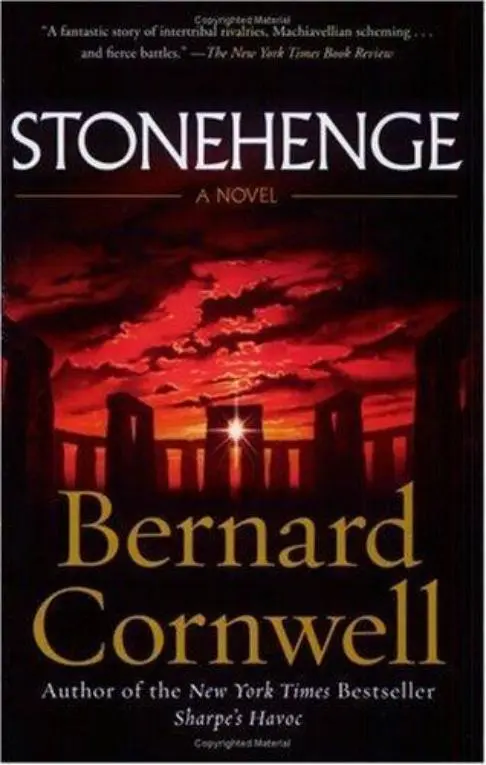
- Название:Stonehenge
- Автор:
- Жанр:
- Год:неизвестен
- ISBN:нет данных
- Рейтинг книги:3 / 5. Голосов: 1
-
Избранное:Добавить в избранное
- Отзывы:
-
Ваша оценка:
Stonehenge: краткое содержание, описание и аннотация
Предлагаем к чтению аннотацию, описание, краткое содержание или предисловие (зависит от того, что написал сам автор книги «Stonehenge»). Если вы не нашли необходимую информацию о книге — напишите в комментариях, мы постараемся отыскать её.
Stonehenge — читать онлайн ознакомительный отрывок
Ниже представлен текст книги, разбитый по страницам. Система сохранения места последней прочитанной страницы, позволяет с удобством читать онлайн бесплатно книгу «Stonehenge», без необходимости каждый раз заново искать на чём Вы остановились. Поставьте закладку, и сможете в любой момент перейти на страницу, на которой закончили чтение.
Интервал:
Закладка:
'Are they?' Saban asked.
Haragg gave him a pitying look. 'Our gold is stolen! Your father is killed! These are signs from the gods, Saban. The difficulty is knowing what they mean.'
'And you do?'
Haragg shook his head. 'No, but your brother Camaban does.'
For a moment Saban's soul rebelled against this fate, which had brought him to a strange temple above an unforgiving sea. Camaban and Haragg, he thought, had entangled him in madness, and he felt a huge resentment against the destiny that had snatched him from Ratharryn and from Derrewyn's arms. 'I just want to be a warrior!' he protested.
'What you want counts for nothing,' Haragg said curtly, but what your brother wants is everything, and he saved your life. You would be dead now, cut down by Lengar's spear, if Camaban had not arranged otherwise. He has given you life, Saban, and the rest of that life must be in his service. You have been chosen.'
To make the world anew, Saban thought, and was tempted to laugh. Except that he was trapped in Camaban's dream and, whether he wanted to or not, he was expected to fulfil that vision.
—«»—«»—«»—
Camaban returned to Sarmennyn at the beginning of spring. He had wintered in the forest at an ancient timber temple. It was overgrown and decaying, but he had cleared the undergrowth and watched the sun retreat about the ring of poles and then start back again towards its summer fullness, and all the time he had talked with Slaol — even argued with the god, for at times Camaban resented the burden laid on him. He alone understood the gods and the world, and he knew he alone could turn the world back to its beginnings, but sometimes, as he tested his ideas, he would groan in agony and rock backwards and forwards. Once a hunting party of Outfolk, seeking slaves, had heard him, seen him and fled from him because they understood he was a holy man. He was also a hungry man by the time he reached Sarmennyn: hungry, sour and gaunt, and he came to the tribe's chief settlement on a day of festival like a mangy crow alighting amid a flock of swans. The settlement's main gate was hung with white garlands of cow parsley and pear blossom, for this was the day on which the new sun bride would be greeted by her people.
Kereval, the chief of Sarmennyn, greeted Camaban warmly. At first glance Kereval was an unlikely chief for such a warlike nation, for he was neither the tallest nor the strongest man in the tribe. However, he was reckoned to have wisdom and, in the wake of their treasures' loss, that was what the people of Sarmennyn had sought in their new leader. He was a small and wiry man with dark eyes that peered from the tangle of grey tattoos that covered his cheeks; his black hair was pinned with fishbones; his woollen cloak was dyed blue. His people asked only one thing of him: that he retrieve the treasures, and that Kereval was seeking to do by his alliance with Lengar. A bargain had been struck by which a small war band of Sarmennyn's feared warriors would help Lengar defeat Cathallo and a temple of Sarmennyn would be given to Ratharryn, and in return the golden lozenges would be sent home.
'There are those who think your brother cannot be trusted,' Kereval told Camaban. The two men squatted outside Kereval's hut where Camaban greedily ate a bowl of fish broth and a piece of hard flat bread.
'Of course they think that,' Camaban retorted, though in truth he did not care what people thought for his head was dizzy with the glory of Slaol.
'They believe we should go to war,' Kereval said, peering towards the gate to see if the sun bride had yet appeared.
'Then go to war,' Camaban said carelessly, his mouth full. 'You think it matters to me whether your miserable treasures are returned?'
Kereval said nothing. He knew he could never hope to lead an army to Ratharryn for it was too far away and his spearmen would meet too many enemies on the way, despite the fact that those spearmen were famous for their bravery, and were feared by all their neighbours for they were as hard and pitiless as the land they came from. Sarmennyn was a rocky land, a bitter place trapped between the sea and the mountains where even the trees grew bent as old folk, though few in the tribe ever did grow old. The hardships of life bent the people as the wind bent the trees, a wind that rarely ceased from wailing about the rocky tops of the mountains beneath which the folk of Sarmennyn lived in low huts made of stone and thatched with driftwood, seaweed, straw and turf. The smoke from their crouched huts mixed with mist, rain and sleet. It was a land, the people said, that no man wanted, and so the Outfolk tribe had occupied it and made a living from the sea, by carving axes from the dark stones of the mountains and by stealing from their neighbours. They had thrived in their barren country, but since their treasures had been stolen nothing had gone well in the land. There had been more disease than usual, and the disease had afflicted the tribe's cattle and sheep. A score of boats had been lost at sea, their crew's bodies washed ashore all white and swollen and sea-nibbled. Storms had flattened the land's few crops so there was hunger. Wolves had come down from the hills and their howling was like a lament for the lost treasures.
'If your brother does not keep our bargain—' Kereval began.
'If my brother breaks his word,' Camaban interrupted the chief, 'then I will undertake to return the gold. I, Camaban, will send you the gold. You trust me, do you not?'
'Of course,' Kereval said, and he did, for Camaban had cured the chief's favourite wife who had been dying of the wasting disease when Camaban had first visited Sarmennyn. Kereval's priests and healers had achieved nothing, but Camaban had given the woman a potion he had learned from Sannas and she had recovered swiftly and wholly.
Camaban wiped the broth from the clay bowl with the last of the bread then turned towards the crowd at the garlanded gate who had suddenly sunk to their knees. 'Your newest bride is here?' he asked Kereval sarcastically. 'Another child with twisted teeth and tangled hair to throw at the god?'
'No,' Kereval said, standing to join the crowd at the gate. 'Her name is Aurenna, and the priests tell me we have never sent a girl so lovely to the sun. Never. This one is beautiful.'
'They say that every year,' Camaban said, and that was true, for the sun brides were always reckoned beautiful. The tribe gave their best to the god, but sometimes, in years past, when parents had a beautiful daughter, they would hide the girl when the priests came to search for the bride. But the parents of this year's sun bride had not hidden her, nor married her to some young man who, by taking her virginity, would have made her ineligible for the sun god's bed. Instead they had kept her for Erek, although Aurenna was a girl so lovely that men had offered her father whole herds of cattle for her hand, while a chieftain from across the sea, a man whose traders brought gold and bronze into Sarmennyn, had said he would yield Aurenna's own weight in metal if she would just take ship to his far island.
Her father had rejected all the suitors, even though he desperately needed wealth for he had no cattle, no sheep, no fields and no boat. He chipped stone every day. He and his wife and their children all chipped the dark, greenish stone that came from the mountains to make axe-heads, which his children polished with sand, and then a trader would come and take away the heads and leave a little food for Aurenna's family. Aurenna alone had not chipped or polished stone. Her parents would not permit it for she was beautiful and a local priest had prophesied that she would become the sun bride, and so her family had protected her until the priests came to take her away. Her father had wept and her mother had embraced her when that moment arrived. 'When you are a goddess,' her mother pleaded, 'look after us.'
Читать дальшеИнтервал:
Закладка:
Похожие книги на «Stonehenge»
Представляем Вашему вниманию похожие книги на «Stonehenge» списком для выбора. Мы отобрали схожую по названию и смыслу литературу в надежде предоставить читателям больше вариантов отыскать новые, интересные, ещё непрочитанные произведения.









Обсуждение, отзывы о книге «Stonehenge» и просто собственные мнения читателей. Оставьте ваши комментарии, напишите, что Вы думаете о произведении, его смысле или главных героях. Укажите что конкретно понравилось, а что нет, и почему Вы так считаете.