W.E.B. Griffin - Retreat, Hell!
Здесь есть возможность читать онлайн «W.E.B. Griffin - Retreat, Hell!» весь текст электронной книги совершенно бесплатно (целиком полную версию без сокращений). В некоторых случаях можно слушать аудио, скачать через торрент в формате fb2 и присутствует краткое содержание. Год выпуска: 0101, Жанр: Старинная литература, на английском языке. Описание произведения, (предисловие) а так же отзывы посетителей доступны на портале библиотеки ЛибКат.
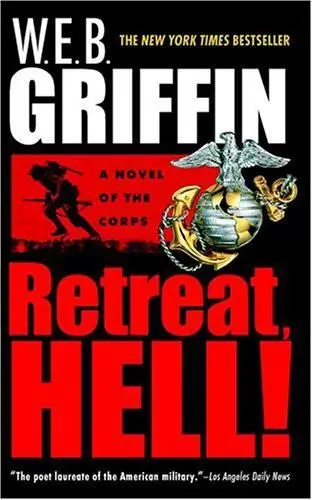
- Название:Retreat, Hell!
- Автор:
- Жанр:
- Год:0101
- ISBN:нет данных
- Рейтинг книги:3 / 5. Голосов: 1
-
Избранное:Добавить в избранное
- Отзывы:
-
Ваша оценка:
Retreat, Hell!: краткое содержание, описание и аннотация
Предлагаем к чтению аннотацию, описание, краткое содержание или предисловие (зависит от того, что написал сам автор книги «Retreat, Hell!»). Если вы не нашли необходимую информацию о книге — напишите в комментариях, мы постараемся отыскать её.
Megaseller Griffin (Honor Bound; Brotherhood of War; Men at War) musters another solid entry in his series chronicling the history of the U.S. Marines, now engaged in the Korean War. Gen. Douglas MacArthur, nicknamed El Supremo by his subordinates, is taken by surprise when the North Korean Army surges south across the 38th parallel. After early losses, he rallies his troops and stems the tide, but not for long. Intertwining stories of literally an army of characters reveal how MacArthur and his sycophantic staff overlook the entire Red Chinese Army, which is massed behind the Yalu River and about to enter the war. Brig. Gen. Fleming Pickering attempts to mediate the ongoing battles between feisty, give-'em-hell Harry Truman and the haughty MacArthur, while worrying about his pilot son, Malcolm "Pick" Pickering, who has been shot down behind enemy lines. The introduction of the Sikorsky H-19A helicopter into the war by Maj. Kenneth "Killer" McCoy and sidekick Master Gunner Ernie Zimmerman details the invention of tactics that will become commonplace in Vietnam. Readers looking for guts and glory military action will be disappointed, as barely a shot is fired in anger, but fans of Griffin's work understand that the pleasures are in the construction of a complex, big-picture history of war down to its smallest details: "There were two men in the rear seat, both of them wearing fur-collared zippered leather jackets officially known as Jacket, Flyers, Intermediate Type G-1." Veterans of the series will enjoy finding old comrades caught up in fresh adventures, while new-guy readers can easily enter here and pick up the ongoing story.
Retreat, Hell! — читать онлайн бесплатно полную книгу (весь текст) целиком
Ниже представлен текст книги, разбитый по страницам. Система сохранения места последней прочитанной страницы, позволяет с удобством читать онлайн бесплатно книгу «Retreat, Hell!», без необходимости каждый раз заново искать на чём Вы остановились. Поставьте закладку, и сможете в любой момент перейти на страницу, на которой закончили чтение.
Интервал:
Закладка:
"They may not have had the time," McCoy said, "or there may have been a political officer who decided that rotting bodies would really send the message he wanted to send."
Donald blurted what he was thinking. "You don't seem overly upset about this."
"Alex, you have no idea how close I am to tossing my cookies," McCoy said. "Let's get the fuck out of here!" They trotted back to the L-19.
[SEVEN]
Near Seoul, South Korea
O93S 1 October 195O
McCoy pressed the black button on his microphone and asked Donald, "Is there some reason we can't land at Kimpo, K-16?"
"No. You want to go to the hangar?"
"I've just decided I'm going to use some of the Marines there before they take them away from me," McCoy said.
"I thought the general said he was going to speak to the CG of the Marine Division about them."
"He did. And the 1st MarDiv CG may say, 'Not only no, but hell no.' Take us to the hangar."
"Captain," Major McCoy said to Captain Howard C. Dunwood, USMCR, as they stood outside the hangar, "I don't know what, if any, authority I have over you and your Marines, but—"
"Sir, I can answer that question."
"Okay, Captain, answer it."
"There was a captain from 1st MarDiv G-3 here yesterday, sir. He said my orders, until I hear to the contrary, are to take my orders from you."
"Yesterday, you said? Not today?"
"Late yesterday afternoon, sir."
"Never look a gift horse in the mouth, Captain. Write that down."
Dunwood smiled.
"Aye, aye, sir."
"There's a tiny fishing village on the east coast called Socho-Ri. I want you to leave enough men here to keep the curious away from the helos, and make for this village with the rest. Take everything with you we got from the dumps. Don't take any chances. If you run into North Koreans, turn around and run. Getting to this village is the priority. By the time you're loaded up, Master Gunner Zimmerman will be here. He'll have maps, radios, et cetera."
"Yes, sir."
"When you get to the village, clean it up—there's bodies all over it. Find someplace to bury them, and do what you can to collect identification, et cetera."
"Aye, aye, sir."
"Then set up a perimeter guard, and stay there. I'll be in touch. "Can I ask what this is all about, Major?" "Not yet. I'll tell you when I can."
"Aye, aye, sir."
Chapter Seven
[ONE]
San Francisco International Airport
San Francisco, California
1145 3 October 195O
Two cars, a black Chevrolet with the insignia of the U.S. Immigration and Naturalization Service painted on its doors and a black Lincoln limousine bearing the California license plate US SEN 1, followed a Ford truck with stairs mounted in back toward the City of Los Angeles as the aircraft shut down its engines.
An INS officer and an officer from the Bureau of Customs got out of the Chevrolet, and a Marine colonel got out of the limousine. As soon as the stairs had been put in place against the Constellation and the rear door had been opened, they all went up the stairs.
They found Brigadier General Fleming Pickering in seat 1 -A.
"That's all the hell I need," Pickering said to the Marine colonel as he put out his hand, "a full bull colonel of the Regular Marine Corps to look askance at my appearance."
Two hours into the final Honolulu—San Francisco leg of his flight, as he was having his breakfast, there was unexpected turbulence, and the front of his uniform jacket still showed—despite the frenzied, even valiant efforts of two stewardi—the remnants of most of a cup of coffee, a half-glass of tomato juice, and two poached eggs.
"You look shipshape to me, General," Colonel Edward J. Banning, an erect, stocky, six-foot-tall, 200-pound forty-five-year-old, said with a straight face.
Pickering snorted, then asked, "What's going on here, Ed? Isn't that Senator Fowler's car?" "Yes, sir, it is."
"Fowler's car? Or Fowler himself?" Pickering asked.
"Senator Fowler himself, General."
"What the hell does he want?" Pickering asked rhetorically.
"General," the customs officer said, extending a printed form to him. "If you'll just sign this, sir, it will complete the Customs and Immigration procedure."
Pickering scrawled his signature on the form and handed it and the pen back to the customs officer.
"What about our luggage?" Pickering asked, looking at Banning.
"It'll be off-loaded first, sir. While you're still on the tarmac."
"Well, at least that will limit the number of people who'll get a look at this," Pickering said, gesturing with both hands toward the mess on his tunic. "Let's go, George."
"Had a little accident, did you, sir?" the INS officer asked sympathetically.
" 'Little' isn't the word," Pickering said sharply, and then added: "But it certainly wasn't your fault. I didn't mean to snap at you."
The INS officer raised both hands, palms outward, indicating the apology wasn't necessary, then stepped out of the way so Hart and Pickering could precede him off the airplane.
Fred Delmore, a tall, gray-haired black man who had been Senator Fowler's chauffeur for twenty years, had the rear door of the limousine open before Pickering reached it. Pickering motioned for Banning to get in first, then followed him. Hart ran around and got in the front passenger seat.
Senator Richardson K. Fowler, a tall, silver-haired, regal-looking sixty-seven-year-old, was sitting on the right side. He and Pickering looked at each other but didn't speak for a moment.
"I was just wondering, Flem," the senator said finally, "if you'd had your breakfast. I suppose I have the answer before me."
"Fuck you, Dick," General Pickering said.
"My, we are back in the Marines, aren't we?" Fowler said. "Such language!"
"Fuck you twice, Dick," Pickering said.
"Is he always this way, George?" Fowler asked innocently. "Or has he been at the booze?"
"Not yet," Pickering replied. "To what do I owe this dubious honor, Dick?"
Fowler shook his head in resignation and smiled.
"As a courtesy, one of Truman's people called to tell me you were on your way, and when, but that they doubted there would be time to meet, as you were to be immediately transferred to Travis Air Force Base for your trip to Washington. An Air Force plane—"
"Not that again," Pickering interrupted.
"Not what again?"
"The last time he sent for me, I flew across the country in the backseat of an Air Force jet."
"Oh, yes, I remember. Today, I understand, we will travel in a backup airplane—one of the big Douglases—to the Independence."
" We will travel?"
" We. I invited myself to go with you. I thought you might need some moral support. As I was saying, your aircraft awaits at Travis."
"Sir," Colonel Banning said, "if I may interrupt, I think you'd better take a look at this."
He handed Pickering a sealed, business-size envelope.
Pickering opened the envelope, read the message it contained, and then handed it to Hart.
"That's already in Washington, sir," Banning said.
Hart put the message back in the envelope and handed it back to Banning, who put it carefully into his hip pocket.
"I suppose what that is is none of my business," Senator Fowler said.
"Dick, you're putting me on a spot," Pickering said.
"And what the hell, I'm only a United States Senator, right?"
"Let him see it, Ed," Pickering ordered.
Banning handed Fowler the envelope.
"That's from General Howe to Truman," Pickering said. "MacArthur plans to reembark X Corps and reland it far up the east coast."
"I know you won't believe this, Fleming, but I do know how to read," Fowler said as he took the message from the envelope.
Читать дальшеИнтервал:
Закладка:
Похожие книги на «Retreat, Hell!»
Представляем Вашему вниманию похожие книги на «Retreat, Hell!» списком для выбора. Мы отобрали схожую по названию и смыслу литературу в надежде предоставить читателям больше вариантов отыскать новые, интересные, ещё непрочитанные произведения.







Обсуждение, отзывы о книге «Retreat, Hell!» и просто собственные мнения читателей. Оставьте ваши комментарии, напишите, что Вы думаете о произведении, его смысле или главных героях. Укажите что конкретно понравилось, а что нет, и почему Вы так считаете.