W.E.B. Griffin - Retreat, Hell!
Здесь есть возможность читать онлайн «W.E.B. Griffin - Retreat, Hell!» весь текст электронной книги совершенно бесплатно (целиком полную версию без сокращений). В некоторых случаях можно слушать аудио, скачать через торрент в формате fb2 и присутствует краткое содержание. Год выпуска: 0101, Жанр: Старинная литература, на английском языке. Описание произведения, (предисловие) а так же отзывы посетителей доступны на портале библиотеки ЛибКат.
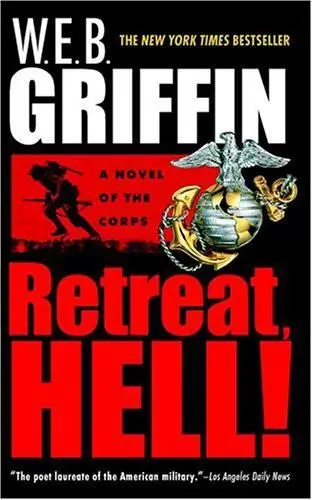
- Название:Retreat, Hell!
- Автор:
- Жанр:
- Год:0101
- ISBN:нет данных
- Рейтинг книги:3 / 5. Голосов: 1
-
Избранное:Добавить в избранное
- Отзывы:
-
Ваша оценка:
Retreat, Hell!: краткое содержание, описание и аннотация
Предлагаем к чтению аннотацию, описание, краткое содержание или предисловие (зависит от того, что написал сам автор книги «Retreat, Hell!»). Если вы не нашли необходимую информацию о книге — напишите в комментариях, мы постараемся отыскать её.
Megaseller Griffin (Honor Bound; Brotherhood of War; Men at War) musters another solid entry in his series chronicling the history of the U.S. Marines, now engaged in the Korean War. Gen. Douglas MacArthur, nicknamed El Supremo by his subordinates, is taken by surprise when the North Korean Army surges south across the 38th parallel. After early losses, he rallies his troops and stems the tide, but not for long. Intertwining stories of literally an army of characters reveal how MacArthur and his sycophantic staff overlook the entire Red Chinese Army, which is massed behind the Yalu River and about to enter the war. Brig. Gen. Fleming Pickering attempts to mediate the ongoing battles between feisty, give-'em-hell Harry Truman and the haughty MacArthur, while worrying about his pilot son, Malcolm "Pick" Pickering, who has been shot down behind enemy lines. The introduction of the Sikorsky H-19A helicopter into the war by Maj. Kenneth "Killer" McCoy and sidekick Master Gunner Ernie Zimmerman details the invention of tactics that will become commonplace in Vietnam. Readers looking for guts and glory military action will be disappointed, as barely a shot is fired in anger, but fans of Griffin's work understand that the pleasures are in the construction of a complex, big-picture history of war down to its smallest details: "There were two men in the rear seat, both of them wearing fur-collared zippered leather jackets officially known as Jacket, Flyers, Intermediate Type G-1." Veterans of the series will enjoy finding old comrades caught up in fresh adventures, while new-guy readers can easily enter here and pick up the ongoing story.
Retreat, Hell! — читать онлайн бесплатно полную книгу (весь текст) целиком
Ниже представлен текст книги, разбитый по страницам. Система сохранения места последней прочитанной страницы, позволяет с удобством читать онлайн бесплатно книгу «Retreat, Hell!», без необходимости каждый раз заново искать на чём Вы остановились. Поставьте закладку, и сможете в любой момент перейти на страницу, на которой закончили чтение.
Интервал:
Закладка:
"I was going to ask him to ask General Smith if we could keep at least some of the Flying Fish Marines," McCoy said. "They're at the hangar with the helos. General Almond had them guarding them."
"I saw them," General Howe said.
He exchanged glances with Master Sergeant Rogers, who knew about his luncheon conversation with General Smith.
"Would you like me to ask General Smith for those men, Ken? To at least loan them to you for a while?"
"I hate to ask you to do that, sir. And for all I know, the 1st MarDiv may need them."
"All he can say is no," Howe said. "I'll ask him when I see him in the morning."
"If you think it would be all right, sir."
"I have a feeling it will be," Howe said. "Okay, Ken. Presuming you can keep the Flying Fish Channel Marines for a while, what are you going to do with them?"
"These helos are supposed to be able to carry ten men. That would be twelve, if we got rid of the copilot and the crew chief. I figure that's about the same weight as a pretty heavily armed eight-man fire team. I'd like to train maybe six or eight teams to get carried somewhere—for example, if we find Pick, or to pick up an agent the NKs have discovered on their side of the line."
"You think that can be done?"
"We won't know until we try it, sir."
"It sounds like a pretty good idea to me."
"That still leaves us with the problem of how to get the helos into the air without going on the radio and announcing, 'Here we come.' "
"Is there any way, Major," Howe asked Donald, "not to use the radios?"
"Not on an airfield, sir. It's a question of being clear to land or take off—I mean, so there's no midair collisions."
"You'd need, in other words, your own airfield?" Howe asked.
"Where would we get our own airfield?" McCoy asked.
"Killer," Zimmerman said. "You don't need an airfield for these things. You saw where we landed at Inchon. All we need is a good-sized parking lot, far enough away from an airfield so airplanes don't run into them."
"He's right, McCoy," Donald said.
"Okay. Shoot this down, please," McCoy said. "We find a large enough parking lot someplace, preferably with a building we can hide the helos in in the daytime—"
"You get me some canvas and some camouflage netting, and I'll hide them," Zimmerman said.
"—Okay. And we paint them black, so they can't be seen at night."
"Black or not, they make a hell of a racket," Zimmerman said.
"But they would be harder to see," McCoy said.
It was not an argument, Major Donald understood. The almost new, very expensive, glossy olive-drab paint scheme on the H-19s was about to be covered with flat black paint.
"What do we do now?" Zimmerman asked. "Start looking for a parking lot?"
"That would seem logical, Mr. Zimmerman," McCoy said, lightly sarcastic.
"It would be easier if we knew where to look for a parking lot."
"Ken, do you know Socho-Ri?" Dunston asked.
McCoy shook his head no.
"It's on the east coast, close to the 38th Parallel," Dunston went on.
"And?" McCoy asked.
Dunston looked at Donald. It was obvious that he was deciding whether to go on in the presence of someone who was not in the CIA.
McCoy picked up on this.
"He has to know, Bill," he said.
"Before the war, I used it as a base for the Wind of Good Fortune" Dunston said. "There is— was —a dozen or so thatch-roofed hootches and sort of a wharf, and a—"
"I don't understand," Donald said, and parroted, "Wind of good fortune?"
"You don't know what's there now?" McCoy asked, ignoring Donald's question, and then, before Dunston could reply, asked, "Is there room for the helos?"
"I had them clear a landing strip for an L-19," Dunston said, "to take the wounded out if necessary. I never had to use it. And when the war started, the NKs were there before I could get an L-19 or anything else over there to try to evacuate them. I lost some good men there."
"And you don't know what's there now?"
"I'm not even sure the ROKs have gone that far north yet," Dunston said.
"But there was a landing strip?" Zimmerman said, and went on without waiting for a response. "If there was a landing strip, there's room to operate helos."
"I think we should have a look at this place as soon as we can," McCoy said. He turned to Donald. "Two questions. I don't want to use helos if I don't really have to. So, Question One: What's the chances—without calling a lot of attention to it—of getting an L-l9 from the X Corps Air Section long enough for us to fly over there? Question Two: If you had an L-19, could you find Socho-Ri if Dunston marked it on a map?"
"I think we could get an L-19 without any trouble, particularly if you showed Colonel Jamison, the X Corps Army Aviation officer, your credentials," Donald said. "And sure, I could find it using a map."
"I noticed, Major," General Howe said, "that you said, ' We could get an L-19.' That's the attitude Major McCoy needs from you. Whether you like it or not, you're part of this now." "Yes, sir," Donald said.
"Maybe, with a little bit of luck, we could do that at first light," McCoy said. "And maybe we can get around flashing credentials at this colonel."
"Maybe we can," Donald said.
"Where's the X Corps airstrip?" McCoy asked.
"At what used to be the Seoul racetrack," Donald said.
"Jennings, how are we fixed for black paint?" McCoy said.
"There must be fifty gallons of it, sir, over the garage. There's also some white, and some red. I guess the NKs missed it when they were here."
"Or booby-trapped it," McCoy said. "After supper, I want you to load twenty gallons of paint, a generator, and the spray gun in a weapons carrier. Take it to the hangar. What I'm going to do is drive Major Donald over there so that he can tell them the helos will be painted, and then bring him back here so that we can get an early start in the morning. Any problem with that, Donald?"
"None," Donald said.
"I wonder, Bill," McCoy said, "how much the X Corps G-2 and/or G-3 would know about how far the South Koreans have moved up the east coast?"
"Probably very little," Dunston said. "The impression I get is that Eighth Army doesn't talk to X Corps unless absolutely necessary, and vice versa."
"Well, give it a shot anyway, will you? Maybe we'll get lucky. We really need to know where they are."
"I'll go to the X Corps CP after supper," Dunston said.
[FIVE]
The House
Seoul, South Korea
21O5 3O September 195O
"Dunston's back from the X Corps CP," Major Kenneth R. McCoy announced unnecessarily to Major Alex Donald as they pulled up to the front of the house in the Russian jeep.
They found him and Zimmerman sitting at the dining room table. Dunston was bent over a stereoptical viewing device looking at an aerial photograph. Zimmerman was flipping through a three-inch-high stack of ten-by-ten-inch aerials on the table.
Dunston raised his eyes from the device as McCoy and Donald came into the room.
"These are yesterday's Air Force aerials," he said. "I got them just before the X Corps G-2 was going to burn them."
"They wouldn't give you today's?" McCoy asked.
"No. And they have no idea what, if any, South Korean troops are in this area. The last word—yesterday—was that 'lead elements' of I ROK (Republic of (South) Korea—ROK—Corps were numbered, like U.S. Army Corps, with Roman numerals.) Corps— probably the Capital ROK Division—were about ten miles south. They may have moved that far today, but even if they have, I don't think they went into Socho-Ri."
"Why not?" McCoy asked.
Dunston got out of his chair and waved McCoy into it.
Читать дальшеИнтервал:
Закладка:
Похожие книги на «Retreat, Hell!»
Представляем Вашему вниманию похожие книги на «Retreat, Hell!» списком для выбора. Мы отобрали схожую по названию и смыслу литературу в надежде предоставить читателям больше вариантов отыскать новые, интересные, ещё непрочитанные произведения.



Обсуждение, отзывы о книге «Retreat, Hell!» и просто собственные мнения читателей. Оставьте ваши комментарии, напишите, что Вы думаете о произведении, его смысле или главных героях. Укажите что конкретно понравилось, а что нет, и почему Вы так считаете.