W.E.B. Griffin - Retreat, Hell!
Здесь есть возможность читать онлайн «W.E.B. Griffin - Retreat, Hell!» весь текст электронной книги совершенно бесплатно (целиком полную версию без сокращений). В некоторых случаях можно слушать аудио, скачать через торрент в формате fb2 и присутствует краткое содержание. Год выпуска: 0101, Жанр: Старинная литература, на английском языке. Описание произведения, (предисловие) а так же отзывы посетителей доступны на портале библиотеки ЛибКат.
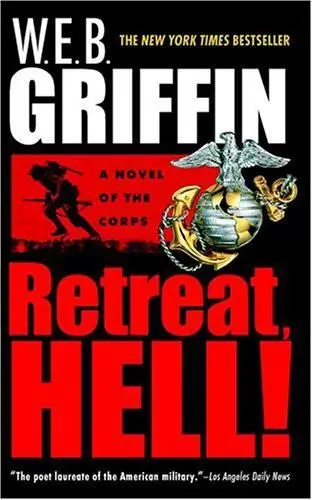
- Название:Retreat, Hell!
- Автор:
- Жанр:
- Год:0101
- ISBN:нет данных
- Рейтинг книги:3 / 5. Голосов: 1
-
Избранное:Добавить в избранное
- Отзывы:
-
Ваша оценка:
Retreat, Hell!: краткое содержание, описание и аннотация
Предлагаем к чтению аннотацию, описание, краткое содержание или предисловие (зависит от того, что написал сам автор книги «Retreat, Hell!»). Если вы не нашли необходимую информацию о книге — напишите в комментариях, мы постараемся отыскать её.
Megaseller Griffin (Honor Bound; Brotherhood of War; Men at War) musters another solid entry in his series chronicling the history of the U.S. Marines, now engaged in the Korean War. Gen. Douglas MacArthur, nicknamed El Supremo by his subordinates, is taken by surprise when the North Korean Army surges south across the 38th parallel. After early losses, he rallies his troops and stems the tide, but not for long. Intertwining stories of literally an army of characters reveal how MacArthur and his sycophantic staff overlook the entire Red Chinese Army, which is massed behind the Yalu River and about to enter the war. Brig. Gen. Fleming Pickering attempts to mediate the ongoing battles between feisty, give-'em-hell Harry Truman and the haughty MacArthur, while worrying about his pilot son, Malcolm "Pick" Pickering, who has been shot down behind enemy lines. The introduction of the Sikorsky H-19A helicopter into the war by Maj. Kenneth "Killer" McCoy and sidekick Master Gunner Ernie Zimmerman details the invention of tactics that will become commonplace in Vietnam. Readers looking for guts and glory military action will be disappointed, as barely a shot is fired in anger, but fans of Griffin's work understand that the pleasures are in the construction of a complex, big-picture history of war down to its smallest details: "There were two men in the rear seat, both of them wearing fur-collared zippered leather jackets officially known as Jacket, Flyers, Intermediate Type G-1." Veterans of the series will enjoy finding old comrades caught up in fresh adventures, while new-guy readers can easily enter here and pick up the ongoing story.
Retreat, Hell! — читать онлайн бесплатно полную книгу (весь текст) целиком
Ниже представлен текст книги, разбитый по страницам. Система сохранения места последней прочитанной страницы, позволяет с удобством читать онлайн бесплатно книгу «Retreat, Hell!», без необходимости каждый раз заново искать на чём Вы остановились. Поставьте закладку, и сможете в любой момент перейти на страницу, на которой закончили чтение.
Интервал:
Закладка:
McCoy sat down and bent over the device, which functioned on the same principle as the disposable glasses given to 3-D motion picture patrons. There were two lenses mounted on a wire frame. They provided a three-dimensional view of a photograph placed under it.
McCoy saw what looked like eighteen or twenty burned-out stone Korean houses, their thatch roofs gone.
"What am I looking at?" he asked, raising his head.
"That's Socho-Ri," Dunston said. "It's obviously been torched. We don't know when or by whom. My people could have torched it right after the invasion. Or the NKs may have torched it then, or two days ago."
McCoy got out of the chair and motioned Donald into it.
"Okay," McCoy said. "Tell me about this place."
"In the first part of 1949, I realized I needed a base for the Wind of Good Fortune. . ." Dunston began.
Without raising his eyes from the viewing device, Donald asked, "Can I ask what that is?"
"It's our navy, Major," Zimmerman said.
McCoy chuckled, then explained: "It looks like your typical, ordinary junk. You know. High prow and stern, one mast, with a square sail that's raised and lowered like a Venetian blind."
"Okay," Donald said. "What do you use it for? Can I ask?"
"To insert and extract agents in North Korea," Dunston said.
"You did that with a junk?” Donald asked incredulously.
"I said the Wind of Good Fortune looks like a typical junk," McCoy said. "But she was prepared for the smuggling trade by some very good shipwrights in Macao. You know, near Hong Kong?"
Donald nodded.
"How prepared?" he asked.
"Wind of Good Fortune has a two-hundred-horse Caterpillar diesel, and fuel tanks therefore in her holds," McCoy said. "And some basic, but pretty reliable, radio direction finder equipment. She'll make thirteen, fourteen knots, even with her sail acting as a windbreak."
"Sound like something out of Terry and the Pirates" Donald said, referring to Milton Caniff's popular comic strip.
"Why Socho-Ri?" McCoy asked. "Why there?"
Dunston went to the stack of aerials, searched through them, and slipped one under the viewing device.
"For several reasons," he said. "For one thing, it's tiny. For another, it's about fifteen miles south of the 38th Parallel. Highway Five runs up to the border, but—since it had nowhere to go beyond the border—the closer it got to the border it was less traveled and not maintained. And even better, between the highway and the shoreline"—he took a pencil and used it as a pointer on the aerial—"there's this line of hills. You can't tell from the aerial, but they're (a) too steep-sided to build rice paddies on them and (b) from 100 to 200 feet high, so that you can't see the village from Highway 5."
McCoy touched Donald's shoulder. Donald moved his head out of the way, and McCoy studied the aerial.
"I'm surprised I don't see much of a road," he said.
"We didn't use the road—actually just a path—unless we had to. We supplied the place using the Wind of Good Fortune"
"Okay," McCoy said.
"When I found Socho-Ri," Dunston went on, "there were about a dozen fishermen and their families in the village. They (a) not only hated the North Koreans but (b) were delighted to find someone willing to buy their dried fish from them, and at a better price than they had been able to get after having to take it by oxcart south to Kangnung, the closest 'city,' thirty miles to the south. "So I hired the fishermen to build four more stone, thatch-roofed houses, and to repair the existing, fallen-into-repair-because-their-small-boats-didn't-need-it wharf so the Wind of Good Fortune could tie up to it," Dunston went on. "And then went to work."
"How did it work?" McCoy asked.
"The Wind of Good Fortune called on Socho-Ri on an irregular basis. Sometimes once a week, sometimes twice, sometimes not for two weeks. She sailed into Socho-Ri late in the afternoon, unloaded rice, live chickens, the occasional porker, and started taking aboard dried fish. And, at first light the next morning, sailed away."
"And during the night..." McCoy began admiringly.
Dunston smiled.
"We fired up her diesels and did our business up north. Always being careful to be back at Socho-Ri before dawn."
"And you never got caught?" Zimmerman asked.
"Honestly, Zimmerman, I don't think they suspected a thing," Dunston said. "Not even when we built the new buildings. They were visible from the sea."
"And used for what?" Donald asked.
"They housed a diesel generator, radios, weapons, and a detachment of from four to six agents."
"And what do you see when you look at these aerials?' McCoy asked.
"Twenty burned-out hootches, and no people," Dunston said.
"Alex," McCoy asked. "Are these aerials going to help you find this place?"
“Oh, sure.”
"Well, then, I guess we'll find out what happened at Socho-Ri in the morning, won't we?" McCoy said.
[SIX]
Near Socho-Ri, South Korea
O8O5 1 October 195O
The view afforded the observer—Major Kenneth R. McCoy, USMCR—in the backseat of the high-winged, two-place, single-engine L-19 was all that could be asked for. But despite looking very carefully, and twice making the pilot— Major Alex Donald, USA—turn around for a better, lower-level look, McCoy didn't see any sign of Major Malcolm S. Pickering, USMCR, in the one hour and twenty minutes it took them to fly from the Municipal Race Track in Seoul to the east coast just above Kangnung.
There, north of the city on Highway 5, they could look down on what were apparently elements of the South Korean army, but attempts to make radio contact with what they saw failed, and there didn't seem to be a place where Donald could safely land the airplane.
They flew north.
"There it is," Donald said, pointing.
"Can you land there?" McCoy asked.
"I'll make a couple of passes and see," Donald said. "But I have to tell you, when we leave, we're going to have to fly straight back to Seoul. We have less than half fuel."
"Okay."
Alex made two low-level passes over the tiny village, then turned a final time and touched down smoothly on a narrow, half-sand, half-grassed field.
McCoy raised the side window of the L-19, then opened the door, got out, and reached back inside and came out with a Thompson submachine gun. Then he waited for Donald to get out. Donald nodded at the Thompson.
"If we're going to be doing more of this sort of thing, I'd be more comfortable if I had one of those."
"Can you shoot one?"
"I had, you know, familiarization."
"I'll have Jennings get you an automatic carbine," McCoy said. "Thompsons are a lot harder to shoot than it seems in the movies." He started walking toward the burned-out hootches. Before they reached it, there was the smell of putrefying flesh, and then they came across the first, near-skeletal body.
"Jesus Christ!" Donald exclaimed, fighting back nausea. McCoy didn't reply.
He walked into the village, where there were more bodies, including three with their hands tied behind them.
"Jesus, what happened here?" Donald asked.
"If I had to guess, I would guess that a North Korean patrol, covering the flanks, or maybe just coming down the coastline, came here, found something— the generator, the radios, anything—that suggested these people had some government connection."
"You mean, they knew what this place was used for?"
"No. I mean they thought it was a government outpost of some sort. So, to make everybody understand the rules of the liberation, they shot everybody they could find, then burned the place down."
"And didn't bury the bodies."
Читать дальшеИнтервал:
Закладка:
Похожие книги на «Retreat, Hell!»
Представляем Вашему вниманию похожие книги на «Retreat, Hell!» списком для выбора. Мы отобрали схожую по названию и смыслу литературу в надежде предоставить читателям больше вариантов отыскать новые, интересные, ещё непрочитанные произведения.



Обсуждение, отзывы о книге «Retreat, Hell!» и просто собственные мнения читателей. Оставьте ваши комментарии, напишите, что Вы думаете о произведении, его смысле или главных героях. Укажите что конкретно понравилось, а что нет, и почему Вы так считаете.