W.E.B. Griffin - Retreat, Hell!
Здесь есть возможность читать онлайн «W.E.B. Griffin - Retreat, Hell!» весь текст электронной книги совершенно бесплатно (целиком полную версию без сокращений). В некоторых случаях можно слушать аудио, скачать через торрент в формате fb2 и присутствует краткое содержание. Год выпуска: 0101, Жанр: Старинная литература, на английском языке. Описание произведения, (предисловие) а так же отзывы посетителей доступны на портале библиотеки ЛибКат.
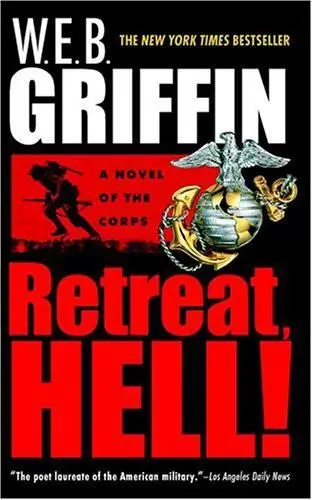
- Название:Retreat, Hell!
- Автор:
- Жанр:
- Год:0101
- ISBN:нет данных
- Рейтинг книги:3 / 5. Голосов: 1
-
Избранное:Добавить в избранное
- Отзывы:
-
Ваша оценка:
Retreat, Hell!: краткое содержание, описание и аннотация
Предлагаем к чтению аннотацию, описание, краткое содержание или предисловие (зависит от того, что написал сам автор книги «Retreat, Hell!»). Если вы не нашли необходимую информацию о книге — напишите в комментариях, мы постараемся отыскать её.
Megaseller Griffin (Honor Bound; Brotherhood of War; Men at War) musters another solid entry in his series chronicling the history of the U.S. Marines, now engaged in the Korean War. Gen. Douglas MacArthur, nicknamed El Supremo by his subordinates, is taken by surprise when the North Korean Army surges south across the 38th parallel. After early losses, he rallies his troops and stems the tide, but not for long. Intertwining stories of literally an army of characters reveal how MacArthur and his sycophantic staff overlook the entire Red Chinese Army, which is massed behind the Yalu River and about to enter the war. Brig. Gen. Fleming Pickering attempts to mediate the ongoing battles between feisty, give-'em-hell Harry Truman and the haughty MacArthur, while worrying about his pilot son, Malcolm "Pick" Pickering, who has been shot down behind enemy lines. The introduction of the Sikorsky H-19A helicopter into the war by Maj. Kenneth "Killer" McCoy and sidekick Master Gunner Ernie Zimmerman details the invention of tactics that will become commonplace in Vietnam. Readers looking for guts and glory military action will be disappointed, as barely a shot is fired in anger, but fans of Griffin's work understand that the pleasures are in the construction of a complex, big-picture history of war down to its smallest details: "There were two men in the rear seat, both of them wearing fur-collared zippered leather jackets officially known as Jacket, Flyers, Intermediate Type G-1." Veterans of the series will enjoy finding old comrades caught up in fresh adventures, while new-guy readers can easily enter here and pick up the ongoing story.
Retreat, Hell! — читать онлайн бесплатно полную книгу (весь текст) целиком
Ниже представлен текст книги, разбитый по страницам. Система сохранения места последней прочитанной страницы, позволяет с удобством читать онлайн бесплатно книгу «Retreat, Hell!», без необходимости каждый раз заново искать на чём Вы остановились. Поставьте закладку, и сможете в любой момент перейти на страницу, на которой закончили чтение.
Интервал:
Закладка:
He took the glass of beer, then glanced at the door. A graying master sergeant in fatigues was coming through it. Then another man in fatigues came through, and there were two silver stars on each of his collar points.
Donald popped somewhat awkwardly to attention, the glass of beer in his hand.
"Stand at ease, gentlemen," General Ralph Howe said. He smiled and added: "We'd hoped to arrive at the cocktail hour."
"Or at least before you drank everything," Master Sergeant Charley Rogers said.
He smiled at the Korean woman and held up two fingers. She bowed and left the room.
Howe looked curiously at Major Donald.
"General, this is Major Donald," McCoy said.
"I think we've met, haven't we, Major?" Howe asked.
"Yes, sir," Donald said. "Yesterday, at Kimpo."
"Right," Howe said, as if remembering. "You're the man with the new helicopters."
"Yes, sir."
Howe looked at McCoy for an explanation.
"General," McCoy said, "those helicopters—and Major Donald and his people—have been assigned to us."
Howe pursed his lips thoughtfully.
"Interesting," he said. He looked at Donald. "How did that happen?"
Donald looked at McCoy, remembering what McCoy had said about telling anyone anything.
"You can tell General Howe, Donald. You can—and you'd better—answer anything and everything he asks."
"Sir, at Kimpo, General Almond told me that, at the direction of General MacArthur, the helicopters and everyone associated with them were transferred to Major McCoy."
"He said, 'Transferred to Major McCoy'?"
"No, sir," Donald said. "He said the CIA. And that someone would contact me with further orders. And then Major McCoy, and these other officers, came to Kimpo."
"But he didn't say 'to Major McCoy'?"
"No, sir. I misspoke. General Almond said 'to the CIA.' "
"Interesting," Howe said. "I wonder what General MacArthur had in mind. You know anything about this, Ken? Dunston?"
Dunston said, "No, sir."
McCoy said, "Not a hint, sir."
"I presume by now, Major," Howe said to Donald, "that you have received from Major McCoy, or Major Dunston, the speech about what happens to people who talk too much?"
"Yes, sir, I have."
The Korean woman came back into the room with two crystal whiskey glasses of beer. Howe took one and raised it to Donald.
"Well, in that case, Major, welcome to the CIA and McCoy's private army."
"Yes, sir. Thank you, sir."
Howe and Master Sergeant Charley Rogers exchanged glances, and both thought just about the same thing: Good. McCoy has no idea that it was arranged by Major General Ralph Howe, NGUS.
"Can you use these aircraft, Ken?" Howe asked. "Have you given that any thought?"
"We already have, General," Zimmerman said happily. "We made a very successful raid on supply depots at Inchon in them."
McCoy flashed him a dirty look.
"And then we went looking for Pickering," McCoy said.
"Oh? How did that go?"
"We didn't find him, or any sign of him, but if we had had these helos just a week ago, I think we'd have him back. They're going to be very useful. I've already got some other ideas. Actually, sir, that's what we were about to get into when you came in. We just got back."
"I'd like to sit in on that," Howe said. "But before you get started, two important things. I've got to get a message off. General Almond told me MacArthur ordered him to reembark X Corps 'as soon as possible after Eighth Army makes it up the peninsula to Seoul.' He wants to land them on the East Coast, probably at Wonsan, and cut off the North Korean retreat northward." He paused. "I want to make sure the President knows about that."
"Sir, wouldn't General Pickering have heard about that, and sent that intel?"
"I don't know if he knows, Ken, and it's better not to assume that he does. I presume you know he's on his way to Washington?"
"No, sir, I didn't," McCoy said, and looked at Dunston, who shook his head no.
"Give Charley time to get that message off, and for the both of us to have a shower, and then we can talk about how you're planning to use the helicopters."
"Yes, sir," McCoy said.
Everyone was sitting around the table waiting for Master Sergeant Rogers to finish his shower when the Korean woman who was in charge of the radio room came in and handed McCoy a sheet of typewriter paper. He read it, then slid it across the table to General Howe.
"From Billy Dunn," he explained to the others. "No sign, either visual or from aerial photographs, of our wanderer."
"Which does not mean he's not out there, right?" Howe said.
"No, sir, it doesn't."
"And, from what you've seen, these helicopters MacArthur gave you are going to be useful in getting him back?"
"Absolutely, sir."
Master Sergeant Rogers came into the room.
"Sorry to keep you waiting, but I thought that was important enough to wait for an acknowledgment."
"And you got one?" Howe asked.
"Keller must have been sitting on his radio," Rogers said. "He acknowledged, told us to Hold One, and then sent, 'I have acknowledgment from Camp Pendleton.' "
"Good man, Charley," Howe said. "And I'm sure Colonel Banning will make sure General Pickering sees it before he leaves the coast for Washington." He turned to McCoy.
"Okay, Ken, tell us how you're going to use General MacArthur's helicopters."
"Aside from looking for Pickering, the first thing that comes to mind is using them to insert and extract people behind the NK lines. Maybe even other places, too. ..."
When he sensed Howe was about to say something, McCoy stopped. Howe paused, his mouth open, and then said nothing.
"... But before I can start seriously thinking about any of this, there's a lot I have to know."
"For example?" Howe asked.
McCoy looked at Donald.
"What should I call you? Donald or Alex?"
"Either's fine."
"My name is Ken," McCoy said. "Dunston's is Bill."
"Okay," Donald said.
"Let me give you the problem, and then you give me the solution."
"Okay."
"When the helos first came to K-16,1 presume they went through the same kind of radio chatter—'Kimpo, this is Army six six six or whatever, request landing instructions,' et cetera—that you went through when you brought us back?"
"Yes, they did."
"We have to presume NK agents saw the helos flying over Inchon to come here. And it's a given that somewhere within range of the Kimpo tower is an NK agent with a radio. So they heard that radio chatter. So they now know there are two H-19s in Korea. And didn't you give them a number?"
"What they call the 'tail number,' " Donald said. "You use that to identify yourself when you call the tower."
"And when the other chopper went back to Kimpo, alone, he used his tail number?"
Donald nodded.
"So now they know we have two helos, and even know their tail numbers." He paused, smiled, and went on: "What all the secrecy, all the Marines guarding the hangar, has done is keep the H-19s a secret from everybody but the enemy."
"That's a problem, Ken?" Howe asked. "What's the difference? The enemy will see them eventually."
"Yes, sir. But if we're going to use the helos to insert and extract agents across the line, I don't want to telegraph our intentions. They now know we have helos. They'll figure out in a hurry that we're using them to do the insertions and extractions. That's not a problem. The problem is if we have to go on the radio every time we take off, that's when they'll start looking for helicopters."
"I get it."
"Another thing I don't know is when General Pickering is coming back here," McCoy said. "Can you tell me, sir?"
"All I know is that he was sent for," Howe said. "What do you need from him?"
Читать дальшеИнтервал:
Закладка:
Похожие книги на «Retreat, Hell!»
Представляем Вашему вниманию похожие книги на «Retreat, Hell!» списком для выбора. Мы отобрали схожую по названию и смыслу литературу в надежде предоставить читателям больше вариантов отыскать новые, интересные, ещё непрочитанные произведения.




Обсуждение, отзывы о книге «Retreat, Hell!» и просто собственные мнения читателей. Оставьте ваши комментарии, напишите, что Вы думаете о произведении, его смысле или главных героях. Укажите что конкретно понравилось, а что нет, и почему Вы так считаете.