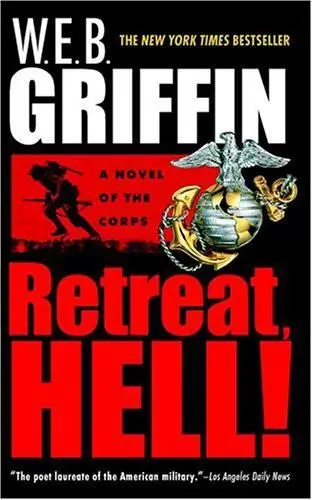
W.E.B. Griffin - Retreat, Hell!
Здесь есть возможность читать онлайн «W.E.B. Griffin - Retreat, Hell!» весь текст электронной книги совершенно бесплатно (целиком полную версию без сокращений). В некоторых случаях можно слушать аудио, скачать через торрент в формате fb2 и присутствует краткое содержание. Год выпуска: 0101, Жанр: Старинная литература, на английском языке. Описание произведения, (предисловие) а так же отзывы посетителей доступны на портале библиотеки ЛибКат.
- Название:Retreat, Hell!
- Автор:
- Жанр:
- Год:0101
- ISBN:нет данных
- Рейтинг книги:3 / 5. Голосов: 1
-
Избранное:Добавить в избранное
- Отзывы:
-
Ваша оценка:
Retreat, Hell!: краткое содержание, описание и аннотация
Предлагаем к чтению аннотацию, описание, краткое содержание или предисловие (зависит от того, что написал сам автор книги «Retreat, Hell!»). Если вы не нашли необходимую информацию о книге — напишите в комментариях, мы постараемся отыскать её.
Megaseller Griffin (Honor Bound; Brotherhood of War; Men at War) musters another solid entry in his series chronicling the history of the U.S. Marines, now engaged in the Korean War. Gen. Douglas MacArthur, nicknamed El Supremo by his subordinates, is taken by surprise when the North Korean Army surges south across the 38th parallel. After early losses, he rallies his troops and stems the tide, but not for long. Intertwining stories of literally an army of characters reveal how MacArthur and his sycophantic staff overlook the entire Red Chinese Army, which is massed behind the Yalu River and about to enter the war. Brig. Gen. Fleming Pickering attempts to mediate the ongoing battles between feisty, give-'em-hell Harry Truman and the haughty MacArthur, while worrying about his pilot son, Malcolm "Pick" Pickering, who has been shot down behind enemy lines. The introduction of the Sikorsky H-19A helicopter into the war by Maj. Kenneth "Killer" McCoy and sidekick Master Gunner Ernie Zimmerman details the invention of tactics that will become commonplace in Vietnam. Readers looking for guts and glory military action will be disappointed, as barely a shot is fired in anger, but fans of Griffin's work understand that the pleasures are in the construction of a complex, big-picture history of war down to its smallest details: "There were two men in the rear seat, both of them wearing fur-collared zippered leather jackets officially known as Jacket, Flyers, Intermediate Type G-1." Veterans of the series will enjoy finding old comrades caught up in fresh adventures, while new-guy readers can easily enter here and pick up the ongoing story.
Retreat, Hell! — читать онлайн бесплатно полную книгу (весь текст) целиком
Ниже представлен текст книги, разбитый по страницам. Система сохранения места последней прочитанной страницы, позволяет с удобством читать онлайн бесплатно книгу «Retreat, Hell!», без необходимости каждый раз заново искать на чём Вы остановились. Поставьте закладку, и сможете в любой момент перейти на страницу, на которой закончили чтение.
Интервал:
Закладка:
But finally everything and everybody was off-loaded, and Captain MacNamara set about setting up the company. Its purpose was to exchange new vehicles for vehicles that had either been damaged in combat or had otherwise failed, and then to make an effort to repair the damaged vehicles that had been turned in, so they could be reissued.
MacNamara had done much the same sort of thing in France during World War II, and most of his men were skilled in performing "third-echelon maintenance" on wheeled vehicles. All he had had to do was get everything running. He felt that he was ahead of schedule. He had found a building in which, once the Engineers got him some decent electrical power, he could perform the duty assigned to the 8023d.
The first thing to do was get what he thought of as "the pool"—the vehicles he had shepherded all the way from Anniston, Alabama—up and running. Actually, that was the second thing he had to do. The first was to lay barbed wire around the pool and set up guard shacks.
There were two things Captain MacNamara had learned in France. One was that an unguarded pool of vehicles would disappear overnight, and the other was that if you listened to some bullshit pull-at-your-heartstrings story of why some guy really needed a vehicle, and why he didn't have a vehicle to exchange for one from the pool, the pool would disappear almost as quickly.
MacNamara believed—after some painful experiences in France—that the Army knew what it was doing when it set the policy, the very simple policy, of "something happens to the vehicle you've been issued, take it to an Ordnance or Transportation Depot, turn it in, and they'll issue you a serviceable one."
Unspoken was: "No vehicle to turn in, no new vehicle."
The reason for that was pretty obvious. If you didn't have to turn a vehicle in, every sonofabitch and his brother would show up and take a vehicle. And the problem with that was that some colonel would show up with a half-dozen wrecked or shot-up jeeps and expect to get half a dozen replacements, and when you didn't have half a dozen jeeps to give him—you'd given every vehicle to every sonofabitch who'd shown up with a hard-luck story—he would ask, "What the hell happened to your pool?"
That had happened to MacNamara in France. They'd as much as accused him of selling vehicles on the black market, and he'd had the MPs' Criminal Investigation Division following him around for months, and he'd gotten a letter of reprimand.
He often thought that letter of reprimand was the reason he had been RIF'd. Now that he was a captain again, because they needed him, he was determined not to fuck up again. Being a captain was better than being a master sergeant, and maybe, if he didn't fuck up again by passing out the Army's vehicles to people who weren't supposed to have them, they'd let him stay on as a captain when this war was over. He might even make major if he didn't fuck up.
Captain MacNamara had spent a good deal of time on the way from the States writing a Standing Operating Procedure for the company that would make it absolutely impossible for anyone who didn't have a busted-up vehicle to turn in to get one from his pool.
He was looking over the SOP when he heard the fluckata-fluckata-fluckata of rotor blades.
He had heard the fluckata-fluckata-fluckata the day before, and had gone outside and seen two enormous helicopters—he didn't know they made them that big—flying over Inchon headed for Seoul.
He had wondered what the hell they were yesterday, and he wondered what the hell they were now.
And then he was more than a little surprised to see first that they seemed to be heading for the 8023d, and then even more surprised when the first of them, and the second, stopped fifty feet over the open area where he was going to store the turned-in vehicles, and then fluttered to the ground.
The sound of their engines died, and the rotors seemed to be slowing.
Captain MacNamara marched toward the machines, his experience telling him that the passengers on something like this were almost certainly going to be heavy brass.
He got, instead, a somewhat rumpled-looking major of the Transportation Corps.
"Good morning, sir," MacNamara said as he saluted.
"Good morning, Captain."
Then he got two more majors, who climbed down from the cockpit— one of them an Army major and the other a Marine. MacNamara saluted again.
"Captain MacNamara," he reported. "Commanding 8023d TC Company."
"You're the senior officer?" the Marine asked him.
"Yes, sir."
The major took a leather wallet from his pocket, unfolded it, and extended it for MacNamara to read. It identified the major as a field officer of the Central Intelligence Agency. It was Captain MacNamara's first contact with the CIA.
"Yes, sir?" he asked.
"Read this, please, Captain," Major McCoy said, extending a business-size envelope to him.
"Yes, sir," MacNamara said, opened the envelope, and took out a single sheet of paper. He read it.
THE WHITE HOUSE
WASHINGTON, D.C.
JULY 8TH, 1950
TO WHOM IT MAY CONCERN:
BRIGADIER GENERAL FLEMING PICKERING, USMCR, IN CONNECTION WITH HIS MISSION FOR ME, WILL
TRAVEL TO SUCH PLACES AT SUCH TIMES AS HE FEELS APPROPRIATE, ACCOMPANIED BY SUCH STAFF AS
HE DESIRES.
GENERAL PICKERING IS GRANTED HEREWITH A TOP-SECRET/WHITE HOUSE CLEARANCE, AND MAY, AT HIS
OPTION, GRANT SUCH CLEARANCE TO HIS STAFF.
U.S. MILITARY AND GOVERNMENTAL AGENCIES ARE DIRECTED TO PROVIDE GENERAL PICKERING AND HIS
STAFF WITH WHATEVER SUPPORT THEY MAY REQUIRE.
HARRY S TRUMAN PRESIDENT OF THE UNITED STATES
1 stINDORSEMENT 1 SEPTEMBER 1950
THE UNDERSIGNED DESIGNATES THE FOLLOWING MEMBERS OF MY STAFF AS FOLLOWS, WITH THE ATTENDANT
SECURITY CLEARANCES AND AUTHORITY TO ACT IN MY BEHALF.
KENNETH R. MCCOY: EXECUTIVE OFFICER
ERNEST W. ZIMMERMAN: DEPUTY EXECUTIVE OFFICER
GEORGE F. HART, CAPT, USMCR: ADMINISTRATIVE OFFICER
Fleming Pickering
FLEMING PICKERING BRIGADIER GENERAL, USMCR
"Jesus H. Christ!" Captain MacNamara said.
"We're going to need some vehicles," McCoy said. "And right now. Is that going to cause any problems?"
Captain MacNamara looked at the lines of vehicles in his pool, then at the signature of the President of the United States, then back at the lines of vehicles in his pool, and then at Major McCoy.
He came to attention, licked his lips, and said, "Not with orders like those. No, sir."
"Good. May I have the orders back, please? And I won't have to tell you, will I, that you are not to reveal anything connected with this?"
"No, sir," MacNamara said, and then had a second thought. "But, sir, somebody will have to sign for the vehicles."
"That's what I'm here for, Captain," Dunston said.
"Sir, could I ask you for some identification?"
"Sure," Dunston said, and handed him an Army Adjutant General's Office photo identifying him as a major, Transportation Corps.
"Thank you, sir."
[TWO]
Detachment A
8119 Quartermaster Company (Forward)
Inchon, South Korea
1O2O 3O September 19SO
Major Kenneth R. McCoy, USMCR, who was sitting beside Major Alex Donald, USA, and Major William Dunston, USA, on the floor of the cargo compartment of one of the H-19s watching Master Gunner Zimmerman supervise the loading of rations, and other items, into a GMC 6x6, turned to Major Dunston and asked, "Do you think we'd be pushing our luck to try to get something from over there?"
He pointed across the Quartermaster Supply Point to an eight-man squad tent, before which was a corporal with a rifle sitting on a folding chair and a small wooden sign reading, "Class VI."
Читать дальшеИнтервал:
Закладка:
Похожие книги на «Retreat, Hell!»
Представляем Вашему вниманию похожие книги на «Retreat, Hell!» списком для выбора. Мы отобрали схожую по названию и смыслу литературу в надежде предоставить читателям больше вариантов отыскать новые, интересные, ещё непрочитанные произведения.








Обсуждение, отзывы о книге «Retreat, Hell!» и просто собственные мнения читателей. Оставьте ваши комментарии, напишите, что Вы думаете о произведении, его смысле или главных героях. Укажите что конкретно понравилось, а что нет, и почему Вы так считаете.