W.E.B. Griffin - Retreat, Hell!
Здесь есть возможность читать онлайн «W.E.B. Griffin - Retreat, Hell!» весь текст электронной книги совершенно бесплатно (целиком полную версию без сокращений). В некоторых случаях можно слушать аудио, скачать через торрент в формате fb2 и присутствует краткое содержание. Год выпуска: 0101, Жанр: Старинная литература, на английском языке. Описание произведения, (предисловие) а так же отзывы посетителей доступны на портале библиотеки ЛибКат.
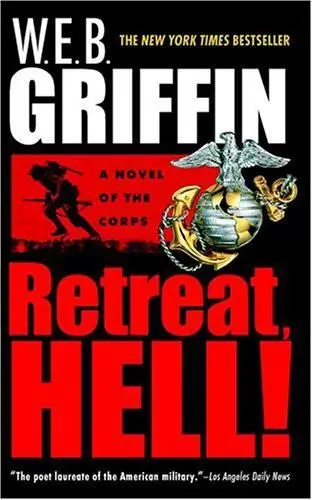
- Название:Retreat, Hell!
- Автор:
- Жанр:
- Год:0101
- ISBN:нет данных
- Рейтинг книги:3 / 5. Голосов: 1
-
Избранное:Добавить в избранное
- Отзывы:
-
Ваша оценка:
Retreat, Hell!: краткое содержание, описание и аннотация
Предлагаем к чтению аннотацию, описание, краткое содержание или предисловие (зависит от того, что написал сам автор книги «Retreat, Hell!»). Если вы не нашли необходимую информацию о книге — напишите в комментариях, мы постараемся отыскать её.
Megaseller Griffin (Honor Bound; Brotherhood of War; Men at War) musters another solid entry in his series chronicling the history of the U.S. Marines, now engaged in the Korean War. Gen. Douglas MacArthur, nicknamed El Supremo by his subordinates, is taken by surprise when the North Korean Army surges south across the 38th parallel. After early losses, he rallies his troops and stems the tide, but not for long. Intertwining stories of literally an army of characters reveal how MacArthur and his sycophantic staff overlook the entire Red Chinese Army, which is massed behind the Yalu River and about to enter the war. Brig. Gen. Fleming Pickering attempts to mediate the ongoing battles between feisty, give-'em-hell Harry Truman and the haughty MacArthur, while worrying about his pilot son, Malcolm "Pick" Pickering, who has been shot down behind enemy lines. The introduction of the Sikorsky H-19A helicopter into the war by Maj. Kenneth "Killer" McCoy and sidekick Master Gunner Ernie Zimmerman details the invention of tactics that will become commonplace in Vietnam. Readers looking for guts and glory military action will be disappointed, as barely a shot is fired in anger, but fans of Griffin's work understand that the pleasures are in the construction of a complex, big-picture history of war down to its smallest details: "There were two men in the rear seat, both of them wearing fur-collared zippered leather jackets officially known as Jacket, Flyers, Intermediate Type G-1." Veterans of the series will enjoy finding old comrades caught up in fresh adventures, while new-guy readers can easily enter here and pick up the ongoing story.
Retreat, Hell! — читать онлайн бесплатно полную книгу (весь текст) целиком
Ниже представлен текст книги, разбитый по страницам. Система сохранения места последней прочитанной страницы, позволяет с удобством читать онлайн бесплатно книгу «Retreat, Hell!», без необходимости каждый раз заново искать на чём Вы остановились. Поставьте закладку, и сможете в любой момент перейти на страницу, на которой закончили чтение.
Интервал:
Закладка:
"Sergeant Alvarez, Colonel."
Colonel Lowman put his right arm—and the .45—behind his back and then opened the door.
It was Sergeant Alvarez, all right, but with him were three officers, all majors. Two of them were Army—a plump, rumpled Army major and an Army aviator. The third was a Marine who had a Thompson submachine gun slung from his shoulder.
"These officers insisted on seeing you, Colonel," Sergeant Alvarez said.
"What can I do for you?" Colonel Lowman asked, aware that he felt a little foolish standing there in his underwear with his pistol hidden behind his back.
"May we come in, please, sir?" the Marine asked.
Colonel Lowman could not think of an excuse not to let them into the van. He backed up and gestured for them to climb up the short flight of stairs.
"Thank you, Sergeant," the Marine said.
"If you'll pull that door closed, we can turn the lights on," Lowman said.
The Marine pulled the door closed and latched it. Lowman switched the lights on.
The rumpled, stout major held out a small leather wallet to Lowman.
Lowman saw the credentials of a Special Agent of the United States Central Intelligence Agency. It was his first contact of any kind with the CIA.
"How can I help the CIA?" Lowman asked.
"In that hangar across the field, Colonel, as I'm sure you know, are two Sikorsky helicopters," the Marine said.
"Yeah, I know. This has to do with them?"
"What we want to do, in the next few minutes, is get them out of here with as few people as possible knowing about it," the Marine said.
"I'm not sure I understand," Lowman confessed.
"We don't want to talk to the tower, sir," the Army aviator said.
"Why not?"
"We have to presume the NKs have people monitoring your tower traffic," the rumpled major said.
"What we hope to do, sir," the Marine said, "by taking off in the dark, and not talking to the tower, is get those machines out of here without letting the NKs know."
"You really think they're listening to the tower traffic?" Lowman asked.
That possibility had never occurred to him.
"I'm sure they are," the Marine said. "And since they were listening when the helos first arrived, and when the helos made their only flight out of here and back, they know about the helos. What we hope to do now is get the helos out of here without them knowing—with a little luck, thinking they're still in that hangar."
"How do you propose to do that?" Lowman asked.
"Sir, we'll fire them up, warm them up, inside the hangar," the Army aviator said. "Then shut them down and roll them out of the hangar. Then we'll call the tower—'K-16, this is Air Force two oh seven, radio check.' If there's no reason we can't take off, the tower will give the radio check. We'll then reply, 'K-16, thank you,' fire them up again, and take off immediately. If you have incoming or departing traffic, just ignore our call, and we'll wait five minutes and call again."
Colonel Lowman considered that a moment.
"That should work. You want me to be in the tower, right?"
"If you would, please, sir," the Marine said. "And if you would, sir, make the point to your tower people that they didn't hear or see anything at all."
"Got it," Colonel Lowman said. "At this hour, there's only one—well, maybe two—guys in there anyway. Give me a minute to get my clothes on."
There were two NCOs, a staff sergeant and a buck sergeant, in the control tower—which was also mounted on a GMC 6x6 truck—when Colonel Lowman climbed up on the truck and went into the small, green, glass-walled, boxlike structure. Both, visibly surprised to see The Colonel, came to attention.
"Good morning," Lowman said. "What's going on?"
"Quiet as a tomb, sir," the staff sergeant said. "It won't be light for another thirty minutes or so."
"We heard some engines starting, sir," the buck sergeant said. "Over there."
He pointed across the field.
"You're sure?" Colonel Lowman said doubtfully.
"Well, sir, it sounded as if it was coming from over there." "As far as I know, there's nothing over there but a shot-up hangar," Colonel Lowman said.
The ground-to-air radio came to life. "K-16, Air Force two oh seven, radio check."
"We don't have anything coming in or going out right now, do we?" Colonel Lowman asked.
"No, sir," the staff sergeant said.
Colonel Lowman took the microphone the buck sergeant held in his hand. Into it he said, "Air Force two oh seven, read you five by five. Niner, eight, seven, six, fiver, four, three, two, one."
"K-16, thank you," the radio said.
Colonel Lowman handed the microphone back to the staff sergeant. Across the field, there were suddenly two spots of orange light, as if coming from the exhaust of an engine. And a moment later, there was the rumble of an engine and a fluckatafluckata-fluckata.
"There it is again," the buck sergeant said. "I knew damned well I heard something."
"I don't hear anything," Colonel Lowman said. "From over there, Colonel!" the buck sergeant insisted. "Sounds like a helicopter to me, sir. Helicopters," the staff sergeant said. The fluckata-fluckata-fluckata fluckata-fluckata-fluckata fluckatafluckata-fluckata sound grew louder.
Lowman thought he could just faintly see one of the H-19s moving rapidly across the field, then taking off into the darkness.
"Goddammit," the staff sergeant said. "That was two helicopters, and not a goddamn navigation light on either of them. What the fuck?"
"I want you two to listen to me carefully," Colonel Lowman said. "I have been here all the time with you. I neither heard or saw anything that sounded remotely like a helicopter."
"But, sir—" the staff sergeant said.
"And neither did you," Colonel Lowman said. "Do we understand each other?"
"Yes, sir," they said, almost in unison.
"And I don't want it to get back to me that whatever you thought you saw or heard, but didn't, is the subject of any conversation anywhere. Clear?" "Yes, sir," they said.
"Keep up the good work, men," Colonel Lowman said, smiled at them, and left the control tower.
Outside, he could hear the fluckata-fluckata-fluckata of rotor blades diminishing to the southeast.
Colonel Lowman wondered where the hell they were going with the H-19s and what they were going to do with them.
But there had been something in the eyes of the Marine major that had told him that his curiosity would have been not only highly unwelcome but maybe even a little dangerous, and he hadn't asked.
[FIVE]
Socho-Ri, South Korea
O54S 4 October 195O
Major Donald had told McCoy there were three ways to get to Socho-Ri, one flying at an altitude that would permit them to look for an arrow stamped out in a rice paddy. The trouble with that option was, Donald said, that if they could see a sign like that, people on the ground could see them.
The second option was to fly what he called "nap of the earth," which meant flying just a few feet off the ground. That would expose them to eyes on the ground for only a fleeting moment, but flying at ninety knots, that wouldn't be much different from driving over the ground at that speed; the chances of spotting a stamped-out arrow would be slim, unless they just happened to fly right over it and were paying close enough attention not to miss it.
The third option—which Donald recommended—would be to ascend quickly to, say, 9,000 feet, which would for all practical purposes make them invisible to eyes on the ground, and incidentally keep them safely above any rock-filled clouds they might encounter en route. There was a line of mountains running down the peninsula, Donald said, and he did not have a deep and abiding faith in the navigation charts he had been given.
Читать дальшеИнтервал:
Закладка:
Похожие книги на «Retreat, Hell!»
Представляем Вашему вниманию похожие книги на «Retreat, Hell!» списком для выбора. Мы отобрали схожую по названию и смыслу литературу в надежде предоставить читателям больше вариантов отыскать новые, интересные, ещё непрочитанные произведения.







Обсуждение, отзывы о книге «Retreat, Hell!» и просто собственные мнения читателей. Оставьте ваши комментарии, напишите, что Вы думаете о произведении, его смысле или главных героях. Укажите что конкретно понравилось, а что нет, и почему Вы так считаете.