W.E.B. Griffin - Retreat, Hell!
Здесь есть возможность читать онлайн «W.E.B. Griffin - Retreat, Hell!» весь текст электронной книги совершенно бесплатно (целиком полную версию без сокращений). В некоторых случаях можно слушать аудио, скачать через торрент в формате fb2 и присутствует краткое содержание. Год выпуска: 0101, Жанр: Старинная литература, на английском языке. Описание произведения, (предисловие) а так же отзывы посетителей доступны на портале библиотеки ЛибКат.
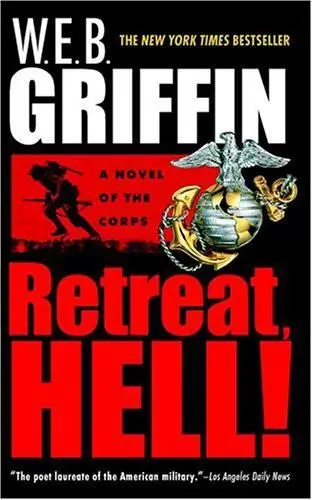
- Название:Retreat, Hell!
- Автор:
- Жанр:
- Год:0101
- ISBN:нет данных
- Рейтинг книги:3 / 5. Голосов: 1
-
Избранное:Добавить в избранное
- Отзывы:
-
Ваша оценка:
Retreat, Hell!: краткое содержание, описание и аннотация
Предлагаем к чтению аннотацию, описание, краткое содержание или предисловие (зависит от того, что написал сам автор книги «Retreat, Hell!»). Если вы не нашли необходимую информацию о книге — напишите в комментариях, мы постараемся отыскать её.
Megaseller Griffin (Honor Bound; Brotherhood of War; Men at War) musters another solid entry in his series chronicling the history of the U.S. Marines, now engaged in the Korean War. Gen. Douglas MacArthur, nicknamed El Supremo by his subordinates, is taken by surprise when the North Korean Army surges south across the 38th parallel. After early losses, he rallies his troops and stems the tide, but not for long. Intertwining stories of literally an army of characters reveal how MacArthur and his sycophantic staff overlook the entire Red Chinese Army, which is massed behind the Yalu River and about to enter the war. Brig. Gen. Fleming Pickering attempts to mediate the ongoing battles between feisty, give-'em-hell Harry Truman and the haughty MacArthur, while worrying about his pilot son, Malcolm "Pick" Pickering, who has been shot down behind enemy lines. The introduction of the Sikorsky H-19A helicopter into the war by Maj. Kenneth "Killer" McCoy and sidekick Master Gunner Ernie Zimmerman details the invention of tactics that will become commonplace in Vietnam. Readers looking for guts and glory military action will be disappointed, as barely a shot is fired in anger, but fans of Griffin's work understand that the pleasures are in the construction of a complex, big-picture history of war down to its smallest details: "There were two men in the rear seat, both of them wearing fur-collared zippered leather jackets officially known as Jacket, Flyers, Intermediate Type G-1." Veterans of the series will enjoy finding old comrades caught up in fresh adventures, while new-guy readers can easily enter here and pick up the ongoing story.
Retreat, Hell! — читать онлайн бесплатно полную книгу (весь текст) целиком
Ниже представлен текст книги, разбитый по страницам. Система сохранения места последней прочитанной страницы, позволяет с удобством читать онлайн бесплатно книгу «Retreat, Hell!», без необходимости каждый раз заново искать на чём Вы остановились. Поставьте закладку, и сможете в любой момент перейти на страницу, на которой закончили чтение.
Интервал:
Закладка:
"Unless they come across something really interesting, the agents will not get on the radio for twenty-four hours, or forty-eight. If they get in trouble, they will yell for help. If they do—Donald makes the decision whether or not the risk is manageable—we'll send one of the helicopters after them and see what happens.
"Presuming they don't get in trouble: Donald, Dunwood, and Zimmerman will start preparing to use the choppers as flying trucks to take a squad of men wherever they have to go. As I understand you, Alex, most of that training will be pretty basic.
"First, Zimmerman decides how they'll be armed and equipped. Then we'll find out how many men we can load on a chopper. Then we practice their getting out of the chopper in a hurry. None of this will require flying the choppers. When they get pretty good at that, we'll start making dry runs, first just taking off and landing here, and finally, flying inland a little to practice insertion and withdrawal on the kind of terrain they'll find up north.
"By the time we do all this, maybe the war will be over. If not, the Wind of Good Fortune will be back here, and we'll decide what to do next." He paused. "That's about it."
"Ernie?" McCoy asked.
"Sounds fine to me," Zimmerman said.
"Donald?"
"What about me going back with you, McCoy? We talked about that. To see about getting a fixed-wing airplane? I'd rather stay here, but. . ."
"Let's see what Dunston and I can do, begging on our knees," McCoy said.
Donald nodded.
"Dunwood?" McCoy asked.
"I don't have any problems with any of this," Dunwood said.
"Okay. That's it," McCoy said, and then added: "I don't think Bill Dunston and I should go back to Seoul together. I think we should go separately—say, an hour apart, in two jeeps. Dunwood, can you let each of us have, say, six Marines? With a couple of BARs?"
"No problem," Dunwood said.
"You go first, McCoy," Dunston said. "I'll want to explain all this to the Koreans, and I'd like to see what I can do about identifying my people the NKs found here."
"The sooner I get out of here, the better," McCoy said, scrambling to his feet. "Ernie, I don't care if you have to keep those fires burning all week."
"That thought ran through my mind, Major, sir," Zimmerman said.
[SIX]
Headquarters,
Capital ROK Division Near
Samchoh, South Korea
O83O 4 October 195O
McCoy's two-jeep convoy was stopped by two diminutive South Korean soldiers who stepped out of the ditches alongside National Route 5, about twenty miles south of Socho-Ri, with their rifles at their shoulders and aimed at McCoy, who was driving the lead jeep.
They wore the shoulder patches of the Capital ROK Division safety-pinned to the shoulders of their too-large U.S. Army fatigues, and looked, on one hand, slightly ludicrous in their outsized uniforms, not looking as if they were large enough to effectively wield the M-l Garands with which they were armed. But on the other hand, they looked tough and mean.
They were visibly surprised to see two jeeps carrying Americans coming toward them from what, so far as they knew, was territory still controlled by the North Koreans.
And even more surprised when McCoy snapped at them, in Korean, "Don't soldiers of the Capital ROK Division salute American officers?"
The rifles were lowered, and almost ludicrous salutes rendered, which McCoy returned with a salute worthy of the parade ground at Camp Lejeune.
The ROK soldiers told him that Capital ROK Division headquarters straddled the highway a mile farther south.
"Get back in your positions," McCoy ordered, and put the jeep in gear.
There were two L-4s parked, one on each side of National Route 5. The ROKs were apparently using the narrow road for an airstrip.
The L-4, essentially a Piper Cub, was the two-passenger, high-wing, low-and-slow observation and liaison aircraft that preceded the Cessna L-19.
McCoy thought the ROKs were like the Marines, being issued only equipment the Army thought it no longer needed.
There was a small tent city on both sides of the road, too, U.S. Army squad tents that had apparently been erected in the belief they would soon have to be struck and moved someplace else.
In front of two tents assembled end-to-end he spotted three flags: the Korean national colors; the blue flag of the United Nations; and a red flag with two stars on it. Two soldiers were standing with the butts of their Garands resting between their feet were guarding the tents, several jeeps parked in front of them, one highly polished with half-doors and a rack of radios in the back.
He drove up to it, the second jeep following.
The guards raised their rifles.
"Stand at ease," McCoy barked in Korean. The guards assumed a position not unlike Parade Rest, and saluted by crossing their right hands to the muzzles of the Garands.
McCoy got out of the jeep and walked into the tent.
It was full of officers and soldiers, radios, telephone switchboards, and desks.
A Korean colonel wearing impeccably fitting and perfectly starched and pressed fatigues, polished boots, with a .45 in a tanker's shoulder holster turned from the map board when McCoy pushed the flap aside and light entered the tent.
McCoy saluted.
"Good morning, Colonel," he said in Korean. "May I have a moment of your time?"
Everybody in the tent was now looking at him.
The colonel returned McCoy's salute crisply.
"Good morning," he said in faultless English. "I'm Colonel Pak. I'm surprised, Major, to see a Marine officer this far east."
"May I have a moment of the colonel's time?" McCoy said, continuing in Korean.
"And, if you don't mind my saying so, one who speaks Korean so well," the colonel replied in English. "How may I be of service to the Marines?"
McCoy decided the colonel was an officer who had most likely learned his English while an officer in the Japanese Army, and had then been one of the rare ex-Japanese officers selected to start up the South Korean Army, and as a result of that had been sent to one or more U.S. Army schools in the States. His English was American accented.
"May I come to the map board, sir?"
Colonel Pak gestured that he could.
McCoy went to the map, found Socho-Ri, and pointed to it.
"Sir, I have established a small camp here," he said.
"That far north?" Pak asked rhetorically. "How long have you been there?"
"The first element arrived two days ago, sir."
"Why do I suspect you are not the lead elements of the First Marine Division?"
"We are not, sir," McCoy said.
Colonel Pak grunted.
"What can I do for you, Major?"
"Two things, sir. I hoped you could get word to your people before they move in that direction that my people are there."
Pak nodded, then picked up a grease pencil and made a check mark on the acetate covering the map.
"And the second?"
"Colonel, it is important that I get to Seoul as quickly as possible," McCoy said.
"And you would like a ride in one of our L-4s?"
"If they are not required for a more important mission, yes, sir."
"At the moment, the CG is at I ROK Corps seeking permission to move north," the general said. "Until we get that permission, they are not very busy. Observation has not revealed any enemy forces within thirty miles of here. Have you seen any indications of the enemy?"
"No, sir. I suspect—but do not know for sure—that they are no closer than twenty miles north of Socho-Ri." Colonel Pak grunted.
"As I said, our aircraft are not being utilized at the moment, Major. But the problem I have is that I cannot afford to lose either of them—either to enemy action or, bluntly, to one of my fellow senior ROK officers who might commandeer it at the Race Track in Seoul. Having one's own aircraft, I'm afraid, has become the ROK equivalent of the German field marshal's baton. My general is known for his temper; I don't want to have to tell him, when he flies back in here in the third of our aircraft, that I loaned one of the others to a Marine who didn't give it back."
Читать дальшеИнтервал:
Закладка:
Похожие книги на «Retreat, Hell!»
Представляем Вашему вниманию похожие книги на «Retreat, Hell!» списком для выбора. Мы отобрали схожую по названию и смыслу литературу в надежде предоставить читателям больше вариантов отыскать новые, интересные, ещё непрочитанные произведения.



Обсуждение, отзывы о книге «Retreat, Hell!» и просто собственные мнения читателей. Оставьте ваши комментарии, напишите, что Вы думаете о произведении, его смысле или главных героях. Укажите что конкретно понравилось, а что нет, и почему Вы так считаете.