Robert Harris - Archangel
Здесь есть возможность читать онлайн «Robert Harris - Archangel» весь текст электронной книги совершенно бесплатно (целиком полную версию без сокращений). В некоторых случаях можно слушать аудио, скачать через торрент в формате fb2 и присутствует краткое содержание. Год выпуска: 2009, ISBN: 2009, Издательство: Arrow, Жанр: Старинная литература, на английском языке. Описание произведения, (предисловие) а так же отзывы посетителей доступны на портале библиотеки ЛибКат.
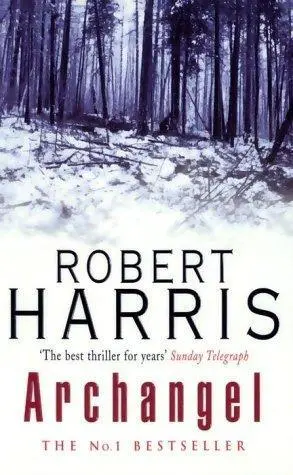
- Название:Archangel
- Автор:
- Издательство:Arrow
- Жанр:
- Год:2009
- ISBN:9780099282419
- Рейтинг книги:4 / 5. Голосов: 1
-
Избранное:Добавить в избранное
- Отзывы:
-
Ваша оценка:
Archangel: краткое содержание, описание и аннотация
Предлагаем к чтению аннотацию, описание, краткое содержание или предисловие (зависит от того, что написал сам автор книги «Archangel»). Если вы не нашли необходимую информацию о книге — напишите в комментариях, мы постараемся отыскать её.
Archangel — читать онлайн бесплатно полную книгу (весь текст) целиком
Ниже представлен текст книги, разбитый по страницам. Система сохранения места последней прочитанной страницы, позволяет с удобством читать онлайн бесплатно книгу «Archangel», без необходимости каждый раз заново искать на чём Вы остановились. Поставьте закладку, и сможете в любой момент перейти на страницу, на которой закончили чтение.
Интервал:
Закладка:
THE snow plough was coming on fast now, thirty, forty miles an hour, rushing down the track, throwing up a great white bow wave of freezing surf that went smashing into the trees on either side. Kretov was driving. His men were jammed together next to him, nursing their guns. Suvorin was hanging on to the metal moorings of the jump seat at the back of the cab, the barrel of the RP46 poking into his thigh, feeling sick from the vibration and the diesel fumes. He marvelled at the complexities that had overwhelmed his life in so short a time, and pondered nervously the wisdom of the old Russian proverb: 'We are born in a clear field and die in a dark forest.
He had plenty of time for his thoughts because none of the other three had addressed a word to him since they left the airfield. They passed chewing gum to one another and TU144 cigarettes and talked quietly so he couldn't hear what they were saying above the racket of the engine. An intimate trio, he thought: clearly a partnership with some history. Where had they been last? Grozny, maybe, taking Moscow's peace to the Chechen rebels? ('The terrorist gunmen all died at the scene...') In which case this would be a holiday for them. A picnic in the woods. And who was giving them their orders? Guess. .
Arsenyev's joke.
It was hot in the cab. The single windscreen wiper batted away the pawprints of snow with a soporific beat.
He tried to shift his leg away from the machine gun.
Serafima had been on at him for months to get out of the service and make some money - her father knew a man on the board of a big privatised energy consortium and, well, let's just say, my dear Feliks, that - how should we put this?
- a number of favours are owed. So what would that be worth, papa, exactly? Ten times his official salary and a tenth of the work? To hell with Yasenevo. Perhaps it was time.
A heavy male voice started grunting from the radio. Suvorin leaned forwards. He couldn't make out exactly what was being said. It sounded like co-ordinates. Kretov was holding the microphone in one hand, steering with the other, craning his neck to study the map on the knee of the man sitting next to him, watching the road. 'Sure, sure. No problem.' He hung up.
Suvorin said, 'What was that?'
Ah,' said Kretov, in mock-surprise, 'you're still here? You got it, Aleksey?' This was to the man with the map, and then, to Suvorin, 'That was the listening post at Onega. They just intercepted a satellite transmission.'
'Fifteen miles, major. It's right on the river.'
'You see?' said Kretov, grinning at Suvorin in the mirror. 'What did I tell you? Home by nightfall.'
KELSO CAME OUT of the trees and walked towards the wooden cabin. The surface of the snow had frozen to a thin crust and the wind had picked up slightly, sending little twisters of powder dancing across the clearing. Rising from the iron chimney the thin brown coil of smoke jerked and snagged in the breeze.
'When one approaches Him, do so openly. 'That was the advice of the maidservant, Valechka. 'He hates it when people creep up on Him. Ifa door has to be knocked upon, knock upon it loudly...'
Kelso tried his best to make his rubber boots thump on the wooden steps, and he hammered on the door with his gloved fist. There was no reply.
Now what?
He knocked again, waited, then raised the latch and pushed open the door, and immediately, the now-familiar smell - cold, close, anim4 with an underlay of stale pipe tobacco - rose to overwhelm him.
The cabin was empty. The rifle was gone. It looked as though the Russian had been working at his table: papers were laid out, and a couple of stubby pencils.
Kelso stood just inside the doorway, eyeing the papers, trying to decide what to do. He checked over his shoulder. There was no sign of movement in the clearing. The Russian was probably down at the river's edge, spying on O'Brian. This was their only tactical advantage, he thought: the fact that there were two of them and only one of him and he couldn't watch them both at once. Hesitantly, he stepped
over to the table.
He only meant to look for a minute, and. probably that was all he did - just long enough to run his fingers through it all: A pair of passports - red, stiff-backed, six inches by four, lion-crested, marked 'PASS' and 'NORGE', issued in Bergen, 1968 - a young couple, identical-looking: long hair, blond, hippyish, the girl quite pretty in a washed-out kind of way; he didn't register their names; entered the USSR via Leningrad, June 1969 -Identity papers - old-style, Soviet Union, three different men: the first, a youngish, jug-eared fellow in spectacles, a student by the look of him; the second, old, in his sixties, weathered, self-reliant, a sailor perhaps; the third, bug-eyed, unkempt, a gypsy or a drifter; the names a blur -And, finally, a stack of sheets, which, as he fanned them out, he saw were six sets of documents, of five or six pages each, pinned together and written in pencil or ink, in various hands - this one neat, that one hesitant, another a wild and desperate scrawl - but always, at the top of the first sheet, in neat Cyrillic capitals, the same word: 'Confession'
Kelso could feel the freezing draught from the open door shifting the hairs on the back of his scalp.
He replaced the pages carefully and backed away from them, his hands raised slightly as if to ward them off, and at the doorway he turned and stumbled out on to the steps. He ( sat down on the weathered planking and when he raised the binoculars and scanned the rim of the clearing he found that. he was shaking.
He stayed there for a couple of minutes, recovering his nerve. It occurred to him that what he ought to do - the calm, rational, sensible thing: the not leaping to any hysterical conclusions kind of thing, that a serious scholar would do - was to return and briefly make a note of the names for checking later.
So when he had satisfied himself for the twentieth time that not a soul was moving in the trees, he stood and ducked back through the low door, and the first thing he saw on re-entry was the rifle propped against the wall, and the second was the Russian, sitting at the table, perfectly still, watching him.
'He possessed in a high degree the gift for silence, 'according to his secretary and in this respect he was unique in a country where everybody talks far too much...'
He was still in full uniform, still in his greatcoat and cap. The gold star of the Order of Hero of the Soviet Union was pinned to his lapel and shone in the dull light of the kerosene lamp.
How had he done that?
Kelso started gabbling into the silence. 'Comrade - you -I'm startled - I - came to find you - I wanted -, He fumbled with the zipper on the front of his jacket and held out the satchel. 'I wanted to return to you the papers of your mother, Anna Mikhailovna Safanova -'
Time stretched. Half a minute passed, a minute, and then the Russian said, softly, 'Good, comrade,' and made a note on the sheet of paper beside him. He indicated the table and Kelso took a pace towards it and laid the satchel down, like an offering placed to appease some unreliable and vengeful god.
Another endless silence followed.
'Capitalism,' said the Russian eventually, putting down his stub of pencil and reaching for his pipe, 'is thievery, and imperialism is the highest form of capitalism. Thus it follows that the imperialist is the greatest thief of all mankind. Steal a man's papers, he will. Oh, easily! Pick the last kopek from' yer pocket! Or steal a man's boat, eh, comrade?'
He winked at Kelso and continued staring at him as he struck a match, sucking the fire into the bowl of his pipe, producing great spurts of smoke and flame.
'Close the door would you, comrade?'
It was beginning to get dark.
If we have to stay here the night, thought Kelso, we shall never leave.
Читать дальшеИнтервал:
Закладка:
Похожие книги на «Archangel»
Представляем Вашему вниманию похожие книги на «Archangel» списком для выбора. Мы отобрали схожую по названию и смыслу литературу в надежде предоставить читателям больше вариантов отыскать новые, интересные, ещё непрочитанные произведения.
Обсуждение, отзывы о книге «Archangel» и просто собственные мнения читателей. Оставьте ваши комментарии, напишите, что Вы думаете о произведении, его смысле или главных героях. Укажите что конкретно понравилось, а что нет, и почему Вы так считаете.