Jack Campbell - Guardian
Здесь есть возможность читать онлайн «Jack Campbell - Guardian» — ознакомительный отрывок электронной книги совершенно бесплатно, а после прочтения отрывка купить полную версию. В некоторых случаях можно слушать аудио, скачать через торрент в формате fb2 и присутствует краткое содержание. Год выпуска: 2013, ISBN: 2013, Издательство: Ace Books, Жанр: Старинная литература, на английском языке. Описание произведения, (предисловие) а так же отзывы посетителей доступны на портале библиотеки ЛибКат.
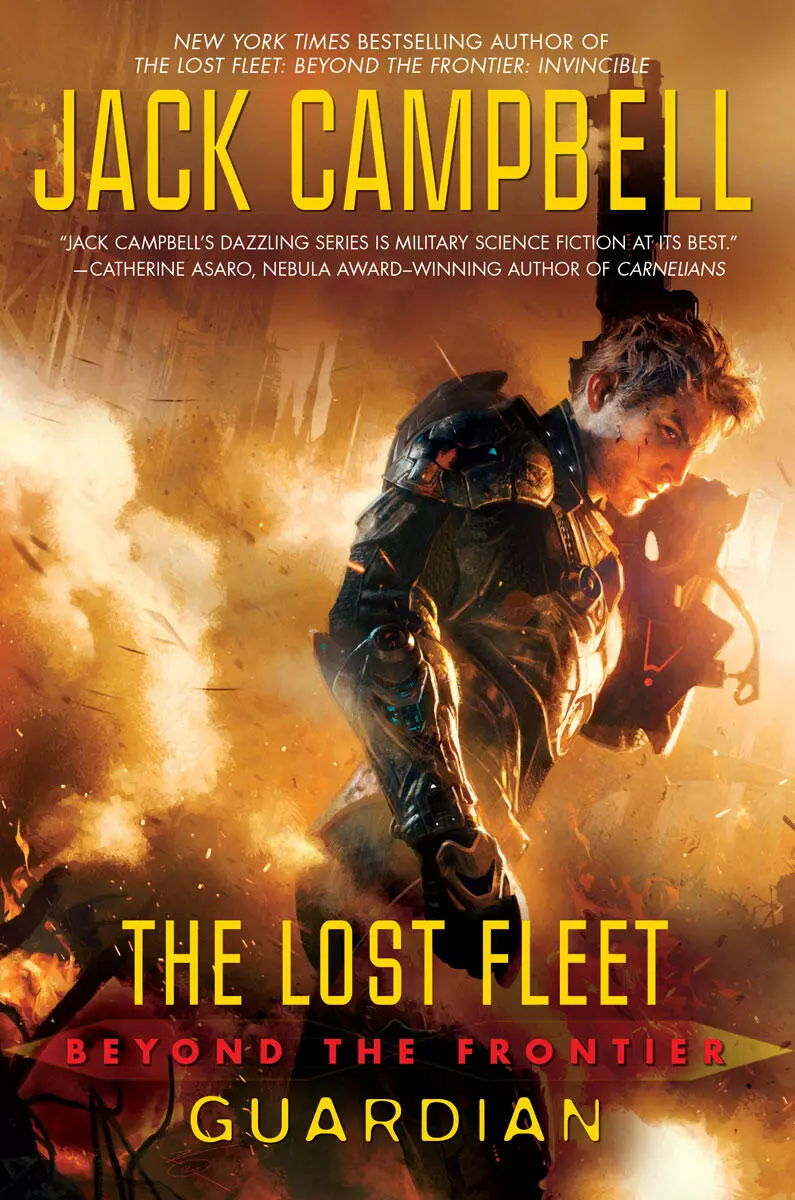
- Название:Guardian
- Автор:
- Издательство:Ace Books
- Жанр:
- Год:2013
- ISBN:978-0-425-26050-0
- Рейтинг книги:3 / 5. Голосов: 1
-
Избранное:Добавить в избранное
- Отзывы:
-
Ваша оценка:
Guardian: краткое содержание, описание и аннотация
Предлагаем к чтению аннотацию, описание, краткое содержание или предисловие (зависит от того, что написал сам автор книги «Guardian»). Если вы не нашли необходимую информацию о книге — напишите в комментариях, мы постараемся отыскать её.
To complicate matters further, Geary also needs to return safely to Alliance space not only with representatives of the Dancers, an alien species, but also with
, a captured warship that could possibly be the most valuable object in human history. Despite the peace treaty that Geary must adhere to at all costs, the Syndicate Worlds regime threatens to make the fleet’s journey back grueling and perilous.
And even if Geary escorts
and the Dancers’ representatives safely unharmed, the Syndics’ attempts to spread dissent and political unrest may have already sown the seeds of the Alliance’s destruction…
Guardian — читать онлайн ознакомительный отрывок
Ниже представлен текст книги, разбитый по страницам. Система сохранения места последней прочитанной страницы, позволяет с удобством читать онлайн бесплатно книгу «Guardian», без необходимости каждый раз заново искать на чём Вы остановились. Поставьте закладку, и сможете в любой момент перейти на страницу, на которой закончили чтение.
Интервал:
Закладка:
Another image, this of a middle-aged man in a shabby executive suit. “They’re leaving us wide open for retaliatory bombardments! We received no warning, no opportunity to evacuate, and we don’t have enough lift capacity here to get everyone out! Am I just supposed to abandon half of my workers and their families? We don’t even have any defenses since they were never rebuilt after the last Alliance attack! Can’t someone stop those Syndicate mobile forces from provoking the Alliance?”
Geary didn’t feel like smiling. He knew why Iger did, and why Desjani probably would have grinned at the Syndic manager’s distress. Serves them right, those who had endured a lifetime of war would think. They started it, they bombarded us countless times, they killed countless numbers of our people, and now they deserve to sweat as they wonder when our rocks will come down like vengeful hammers from the sky.
But he didn’t feel that way. As much as I wanted to get back at the Syndics at Sobek, they had been cooperating with the attacks on us. Or their leaders had been doing that, anyway. But these people are helpless. That Syndic manager is worried about the people who work for him. He and they are just pawns in whatever the Syndic government is doing. Even the Syndic CEO here is being coerced into something.
“All right,” Geary said. “Is that all?”
“There are other messages like that,” Iger offered. “Otherwise, just the usual welter of fragmentary information. We can break out portions of coded messages and pick up open conversations where individuals talk about classified matters, but none of that adds up to any threat that we can identify.”
“Master Chief Gioninni hasn’t come up with anything else,” Desjani noted. “I was going to give him access to the intel summaries, but it turned out he’d already read them.”
“What was that?” Lieutenant Iger asked, alarmed. “The access list for Dauntless doesn’t include Master Chief Gioninni.”
“Isn’t that odd? Don’t worry about it, Lieutenant.”
“Maybe what we need isn’t just a scheming mind,” Geary said, before an aghast Iger could ask more questions about Gioninni. “Maybe what we need is someone who can spot—” Someone who can spot patterns in a mess of data. Someone who can see things concealed in a confusing welter of detail.
And we’ve got that someone.
“Lieutenant Iger, you are to transmit to Tanuki all intelligence collected within this star system since our arrival. Mark it eyes only for Lieutenant Elysia Jamenson.”
Iger, appalled this time, stared back at Geary. “All intelligence? Admiral, who is this Lieutenant Jamenson?”
“An engineer.”
“An engine—” Iger caught himself and spoke with forced control. “Sir, the classification on some of this material—”
“I am aware of the classification and security concerns. On my authority as fleet commander, I am authorizing Lieutenant Jamenson access to any necessary level of data effective immediately. Make sure she sees everything you’ve collected here. Send to Tanuki any necessary read-in documents and security agreements she has to sign. Get this done quickly, Lieutenant Iger.”
“Quickly. Yes, sir.” Despite his words, Iger hesitated. “Admiral, I feel obligated to advise you that this action may result in serious ramifications when we return to Alliance space. Even though you have authority to do this, there may be strong questions raised as to the appropriateness of your decision.”
“I’ll assume that responsibility,” Geary said. “And, for the record, I want it to be clear that you properly advised me regarding your misgivings and that I acknowledged them. This is my decision.”
“Yes, sir. We will get the information package together and have it sent to Tanuki as soon as possible.”
“Make it quick,” Geary emphasized again.
Desjani was giving him a fish eye, but he ignored that for the moment as Iger’s image disappeared, instead calling Tanuki . “Captain Smythe, I need Lieutenant Jamenson. Don’t worry. It’s a temporary assignment, on my word of honor. There will be a package of intel information coming to Tanuki soon, eyes only for Lieutenant Jamenson. I want her to go over it and tell me what she sees.”
Smythe’s expression had shifted through worry to puzzlement and now surprise. “Intelligence material? Lieutenant Jamenson is very good at what she does, Admiral, but that is not something she has experience with.”
“I’m aware of that. But we’re dealing with new tactics by the enemy, and I want to see what a new perspective might spot among the information we have.”
“Very well, Admiral.” Smythe had a calculating look in his eyes. Geary could guess what he was thinking. Is Jamenson even more valuable than I thought?
“Thank you, Captain Smythe. I have every confidence that I can count on you,” Geary said, emphasizing every word.
Smythe jerked as if the phrase had stung him, then smiled. “Of course, Admiral.”
Geary ended the call, then looked at Desjani, who was giving him a flat look. “Lieutenant Jamenson?” she asked. “The one with the green hair?”
“You remember her?”
“She’s hard to forget. What’s the idea?”
“Exactly what I said,” Geary explained. “Maybe she will see something going on in this star system that the Syndics have tried to hide.”
Desjani considered that, then nodded judiciously. “If the Syndics can get something past Gioninni and Jamenson, we might as well throw in the towel.”
Geary took his time preparing for the recovery of the prisoners. He brought the fleet, still in the Armadillo, over the inhabited planet at a slant angle from the prison camp, letting his ship’s sensors scan the entire area while the Marines launched surveillance drones to drop down and check out the camp from low level and at ground level.
Carabali briefed him personally, her image standing in his stateroom before a series of close-ups of the prison camp.
General Carabali pointed to the images near her. “We couldn’t find anything with the remote-surveillance equipment. Nothing is there that shouldn’t be there, as far as we can tell. But remote surveillance can’t be exhaustive. There are too many ways to block signals and signatures, ways often configured to match weaknesses or limitations in remote-surveillance equipment. That’s especially true in a camp that was newly constructed. One of the things we look for is new features. New concrete slabs, newly turned soil, new patches on walls, new underground cisterns and other storage areas, things like that. But the entire camp is new, so that offers us no clues. We know the camp isn’t surface mined because we’ve seen people walk around freely, and command-detonated or -controlled mines could be spotted by the gear we had to check out the camp. Still, the Syndics are very good at booby traps. To be certain that there wasn’t anything hidden, we would need to put a few hundred engineers down there and give them a couple of weeks to probe, dig, and examine with the best gear we’ve got.”
The old headache was back. “But the surveillance confirmed the presence of Alliance prisoners of war,” Geary noted. He could see them in the images, some of them clearly enough that expressions could be identified, clearly enough that friends and relatives could easily know them. The expressions of the Alliance prisoners reflected wariness, hopefulness, disbelief, and other emotions. Very likely, the Syndics had not told them that the war was over. They did not know what star system they were in, and they had never expected rescue.
Читать дальшеИнтервал:
Закладка:
Похожие книги на «Guardian»
Представляем Вашему вниманию похожие книги на «Guardian» списком для выбора. Мы отобрали схожую по названию и смыслу литературу в надежде предоставить читателям больше вариантов отыскать новые, интересные, ещё непрочитанные произведения.







Обсуждение, отзывы о книге «Guardian» и просто собственные мнения читателей. Оставьте ваши комментарии, напишите, что Вы думаете о произведении, его смысле или главных героях. Укажите что конкретно понравилось, а что нет, и почему Вы так считаете.