Upton Sinclair - Love's pilgrimage
Здесь есть возможность читать онлайн «Upton Sinclair - Love's pilgrimage» весь текст электронной книги совершенно бесплатно (целиком полную версию без сокращений). В некоторых случаях можно слушать аудио, скачать через торрент в формате fb2 и присутствует краткое содержание. Год выпуска: 1911, Издательство: New York : M. Kennerley, Жанр: Старинная литература, на английском языке. Описание произведения, (предисловие) а так же отзывы посетителей доступны на портале библиотеки ЛибКат.
- Название:Love's pilgrimage
- Автор:
- Издательство:New York : M. Kennerley
- Жанр:
- Год:1911
- ISBN:нет данных
- Рейтинг книги:4 / 5. Голосов: 1
-
Избранное:Добавить в избранное
- Отзывы:
-
Ваша оценка:
Love's pilgrimage: краткое содержание, описание и аннотация
Предлагаем к чтению аннотацию, описание, краткое содержание или предисловие (зависит от того, что написал сам автор книги «Love's pilgrimage»). Если вы не нашли необходимую информацию о книге — напишите в комментариях, мы постараемся отыскать её.
Love's pilgrimage — читать онлайн бесплатно полную книгу (весь текст) целиком
Ниже представлен текст книги, разбитый по страницам. Система сохранения места последней прочитанной страницы, позволяет с удобством читать онлайн бесплатно книгу «Love's pilgrimage», без необходимости каждый раз заново искать на чём Вы остановились. Поставьте закладку, и сможете в любой момент перейти на страницу, на которой закончили чтение.
Интервал:
Закладка:
it without too much waste* of time. Mr. Ardsley thought it an excellent idea.
After which Thyrsis came, very cautiously, to the meat of the matter. "I want to get away into the country to write it," he said; "and so I wanted to ask you about the manuscripts you are sending me. Have you found my work satisfactory?"
"Why, yes," said the other.
"And do you think ^you can send them through the summer?"
"I presume so. It depends upon how many come to
us.'
"You—you couldn't arrange to let me have any more of them?"
"Not at present," said Mr. Ardsley. "You see, I have regular readers, whose work I know. I'll send you what I have to spare."
"Thank you," said Thyrsis. "I'll be glad to have all you can give me."
So he went away; and in the little room he and Corydon had an anxious consultation. He had been getting about twenty dollars a month; which was not enough for the family to exist upon. "Our only hope is a new book," he declared; and Corydon saw that was the truth. "Each week that I stay here is a loss," he added. "I have to pay room-rent."
"But can you stand tenting out in April?" asked she.
"I'll chance it," he replied—"if you'll say the word."
She saw that her duty was before her; she must nerve herself and face it, though it tore her heartstrings. She must stay and take care of the baby, while he went away to work!
He sat and held her hands, and saw her bite her lips
and fight to keep back the tears in her eyes. Their hearts had grown together, so that it was like tearing their flesh to separate them. They had never imagined that such a thing could come into their lives. "Thyrsis," she whispered—"you'll forget me!" He pressed her hands more tightly. "No, dear! No!" he said.
"But you'll get used to living without me!" she cried. "And it's the time in my life when I need you most!" "I will stay, dearest, if you say so." She exclaimed, "No, no ! I must stand it!" And seeing her grief, his heart breaking with pity, a strange impulse came to Thyrsis. He took her hands in his, and knelt down before her, and began to pray. It had been years since he had thought of prayer, and Corydon had never thought of it in her life. It came from the deeps of him—a few stammering words, simple, almost childish, yet exquisite as music. He prayed that they might have courage to keep up the fight, that they might be able to hold their love before them, that nothing might ever dim their vision of each other. It was a prayer without theology or metaphysics—a prayer to the unknown gods; but it set free the well-spring of tenderness and pity within them; and when he finished Corydon was sobbing upon his shoulder.
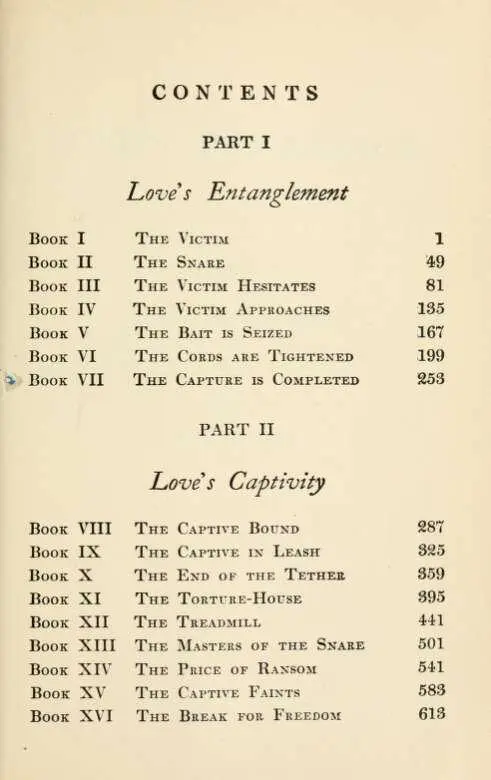
BOOK IX THE CAPTIVE IN LEASH
They were standing on the hill-top, watching the last glimmer of the sinking moon. As the faint perfume of the clover came to them upon the warm evening wind, she sighed, and whispered —
: 'Too rare, too rare, grow now my visits here! 'Mid city noise, not as with thee of yore, Thyrsis! in reach of sheep-bells is my home!
She paused.
"Go 07?," he said, and she quoted-
"Then through the great town's harsh, he art-weary ing
roar, Let in thy voice a whisper always come,
To chase fatigue and fear: Why faintest thou? I wandered till I died.
on! The light we sought is shining still."
§ 1. THYRSIS made his plans and packed his few belongings. There came another pass from the "higher regions", and he took the night-train once more, and came to the little town upon the shores of Lake Ontario. Once more the sun shone on the crystal-green water, and the cold breeze blew from off the lake. There was still snow in the ravines of the deep woods, but Thvrsis got his tent out of the farmer's barn, and patched up the holes the mice had gnawed, and put it up on the old familiar spot.
It was strange to him to be there without Corydon. There were so many things to remind him of her— a sudden memory would catch him unawares, and stab him like a knife. There was the rocky headland where they had swam, and there was the pine-tree that the lightning had splintered, one day while they were standing near. When darkness came, and he was unpacking a few old things that they had left up in the country, his loneliness seemed to him almost more than he could bear; he sat by the little stove, holding a pair of her old faded slippers in his hands, and felt his tears trickling down upon them.
But it took him only a day or two to drive such things out of his mind. There was no time for sentiment now—it was "Clear ship for action!" For once in his life he was free, and had a chance to work. He was full of his talk with Mr. Ardsley, and meant to do his best to be "practical." And so behold him wandering about in the water-soaked forests, or tramping
the muddy roads, or sitting by his little stove while the cold storms beat upon the tent—wrestling with his unruly Pegasus, and dragging it back a hundred times a day to what was proper, and human, and interesting !
The neighbors had warned him that it was too early for tenting, but Thyrsis had vowed he would stand it. And now, as if to punish him for his defiance, there was emptied out upon him the cave of all the winds; for four weeks there were such storms of rain and sleet and snow as the region had never known in April. There were nights when he sat wrapped in overcoats and blankets, with a fire in the stove; and still shivering for the gale that drove through the canvas. There came one calm, starlit night when he lay for hours almost frozen, and sat up in the morning to find a glass of water at his bedside frozen solid. Thirteen degrees the thermometer showed, according to the farmer; and oh, the agony of getting out of bed, and starting a fire with green wood! In the end Thyrsis poured in half a can of kerosene, and got the stove red-hot; and then he turned round to warm his back, and smelled smoke, and whirled about to find his tent in a blaze!
With a bucket of water and a broomstick he beat out the fire, and went for a run to warm up. But when he came back there was more wind, so that he could not keep warm in the tent, and more rain, so that he could not find shelter in the woods. In the end he discovered a ruined barn, in a corner of which he would sit, wrapped in his blankets and writing with cold fingers.
Perhaps all these mishaps had something to do with the refusal of his ideas to flow. But apparently it was in vain that Thyrsis tried at any time to work at things
thcit were interesting to other people. Perhaps he could have worked better at them, if there had not been so many things that were interesting to him. He would find himself confronted with the image of the society clergyman, or of the sleek editor in his club, or some other memory out of the world of luxury and pride. And each day came the newspaper, with its burden of callousness and scorn; and perhaps also a letter from Corydon, with something to goad him to new tilts with the enemies of his soul.
So, before long, almost without realizing it, he was putting the "interesting" things aside, and girding himself for another battle. His message was still undelivered ; and in vain he sought to content himself by blaming the world for this. Until he had forced the world to hear him, he had simply not yet done his work. He must take his thought and shape it anew-into some art-work finer, stronger, truer than he had yet achieved.
Day after day he pondered this idea—eating with it and walking with it and sleeping with it; until at last, of a sudden, the vision came to him. It came late at night, while he was undressing; and he sat for five or ten minutes, with his shirt half off, as if in a trance. Then he put the shirt on again, and went out to wander about the woods, laughing and talking to himself.
"Genius surrounded by Commercialism"—that was his theme; and it would have to be a play. Its hero would be a young musician, a mere boy, a master of the demon-voices of the violin; he would be rapt in his vision, and around him a group of people who would be embodiments of the world and all its forces of evil. One by one they came trooping before Thyrsis* fancy, with all their trappings of pomp and power, their great-
Читать дальшеИнтервал:
Закладка:
Похожие книги на «Love's pilgrimage»
Представляем Вашему вниманию похожие книги на «Love's pilgrimage» списком для выбора. Мы отобрали схожую по названию и смыслу литературу в надежде предоставить читателям больше вариантов отыскать новые, интересные, ещё непрочитанные произведения.












Обсуждение, отзывы о книге «Love's pilgrimage» и просто собственные мнения читателей. Оставьте ваши комментарии, напишите, что Вы думаете о произведении, его смысле или главных героях. Укажите что конкретно понравилось, а что нет, и почему Вы так считаете.