Alexander Theroux - Darconville’s Cat
Здесь есть возможность читать онлайн «Alexander Theroux - Darconville’s Cat» весь текст электронной книги совершенно бесплатно (целиком полную версию без сокращений). В некоторых случаях можно слушать аудио, скачать через торрент в формате fb2 и присутствует краткое содержание. Год выпуска: 1996, Издательство: Holt Paperbacks, Жанр: Современная проза, на английском языке. Описание произведения, (предисловие) а так же отзывы посетителей доступны на портале библиотеки ЛибКат.
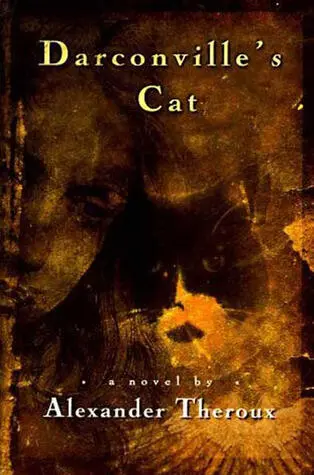
- Название:Darconville’s Cat
- Автор:
- Издательство:Holt Paperbacks
- Жанр:
- Год:1996
- ISBN:нет данных
- Рейтинг книги:3 / 5. Голосов: 2
-
Избранное:Добавить в избранное
- Отзывы:
-
Ваша оценка:
Darconville’s Cat: краткое содержание, описание и аннотация
Предлагаем к чтению аннотацию, описание, краткое содержание или предисловие (зависит от того, что написал сам автор книги «Darconville’s Cat»). Если вы не нашли необходимую информацию о книге — напишите в комментариях, мы постараемся отыскать её.
Darconville's Cat Its chapters embody a multiplicity of narrative forms, including a diary, a formal oration, an abecedarium, a sermon, a litany, a blank-verse play, poems, essays, parodies, and fables. It is an explosion of vocabulary, rich with comic invention and dark with infernal imagination.
Alexander Theroux restores words to life, invents others, liberates a language too long polluted by mutters and mumbles, anti-logic, and the inexact lunacies of the modern world where the possibility of communication itself is in question. An elegantly executed jailbreak from the ordinary,
is excessive; funny; uncompromising; a powerful epic, coming out of a tradition, yet contemporary, of both the sacred and the profane.
Darconville’s Cat — читать онлайн бесплатно полную книгу (весь текст) целиком
Ниже представлен текст книги, разбитый по страницам. Система сохранения места последней прочитанной страницы, позволяет с удобством читать онлайн бесплатно книгу «Darconville’s Cat», без необходимости каждый раз заново искать на чём Вы остановились. Поставьте закладку, и сможете в любой момент перейти на страницу, на которой закончили чтение.
Интервал:
Закладка:
It is no secret that this low-bred male concubine of Archelaus named Socrates (469–399 B.C.) had an extreme influence on philosophy. That is the central miracle of the man. Born on the 6th of Thargelion of the sculptor, Sophroniscus, and midwife, Phaenarete, he was ill-shaped, ridiculous in carriage, and habitually dressed like a craptoad, his general appearance, no doubt, best put somewhere between a wishnik and a Jewish candy-store proprietor. He was almost certainly a pedicator. Juvenal refers to “the foulest sewer of Socratic sodomy.” Firmicus speaks of “Socratic buggery.” It is of course the modern fashion to doubt the pederasty of the master of Hellenic sophrosyne, the “Christian before Christianity,” but even if we are overapt to apply our twentieth-century prejudices and prepossessions to the morality of ancient Greeks who would have specimened such squeamishness in Attic salt such a worldwide term as Socratic love can hardly be explained by the lucus-a-non-lucendo theory.
The man had no special education. He was an autodidact — and was very probably unable to read. A pedant, nevertheless, he knew that he knew nothing (Ap. 23 AB , Symp. 216 D ) which did not prevent him, however, from seeking the reaches of an Atopia that actually was never there. His dissatisfaction with natural philosophy is well-known, less so, perhaps, his utter rejection of natural science ( Xen . Mem. I, i, llff ., Arist . Met. XIII, 4 ). He claimed he heard voices — the classical smokescreen — and, with imperturbable serenity, explained he took his mission in life from a reply of the Delphic oracle: to set in man an inner unrest and bring him into embarrassment ( aporeis, Theaet. 149A ), his attempt to recoin current values developing into a kind of barren and allocritical eristic that took pleasure in the invention of clever but worthless fallacies, berced, every one of them, by his own vile insecurity and then sent out on a spin to brain the human race like a disselboom!
Poor in fortune, unlucky with women, hopelessly unfit for any office in the Republic, he spent most of his days working his trade (making claypots), bumsucking about for friends, and drinking neck to neck with anybody who’d listen to him. He craved the acceptance of society— especially women — and would go to any lengths to insinuate himself with them, even if the transvaluation of current thinking itself was required to do so. What then, specifically, did he transvalue? Pay attention, I will bequeath you a funny story if you prove to misunderstand the following argument. It is offered less for your edification than for my own sense of well-being. Say survival. I see your brain jailed by a Skuld.
Darconville laughed. It was iconoclastic, comic, absurd.
The philosophy of the West owes its origin chiefly to the Greeks of the late Hellenic period. Your average schoolboy will testify, correctly, to the fact that although a slight state of decline was evident in fifth-century Athens — the City That Loved Beauty — a wonderfully simple view of man still held: he was taken to be whole , with no distinction made between his visible and invisible aspects. The traditional Greek view would never have conceded that men and women could be valued on the strength of their so-called invisible or “psychological” characteristics as considered separate, say, from visible or bodily ones. (The classical Greek dramatists never brought into the amphitheatre characters with inexplicable psychological problems: aprioristic madness never went unexplained, and critical mental states, always given with sufficient evidence as to how they came about, were related to demonstrable tragedy.)
The general pre-Socratic view of life as they knew it, therefore, was monistic, Unitarian, whole. There is no dispute whatsoever about that And although the handwashing, departmentalized little scientists and seers of today now regard man as a psycho-physical twin of himself, a psychosome — some kind of metaphysical chest-of-drawers composed of soul, mind, and body — the early wholesome Greeks made no such arbitrary divisions. The “wholeness” of man! Can anyone disagree that it was a healthy and fully salvific view of what he aspired to be, shoring up identity and mocking the currently fashionable bit of legerdemain which condones and excuses, almost automatically, a score of revolting human excesses committed in the name of lofty intentions? The brainless incompetence we forgive! The philosophical idealism we cite lest we censure! To the pre-Socratics those tidy distinctions would have been dismissed as a counterproductive fragmentation which could only lead to the kind of society we have today, where, thanks to that little ill-born, thrusting Father of Abstract Definitions, forcible-feebles can now accede to high political office, the poor are twigged of their money in the name of religion, and screeching amazonians-in-pantsuits, shitfitsresses, and children-hating ballockscourers can legitimately go larking about the world with more complaints than Job and a bellyful of abortifacients all in pursuit of a freedom they can’t temper with responsibility and as an excuse for a higher liberation they’ve never deserved! Blindfolded, you can at least see the blindfold, can’t you? It’s only to witness what your wit won’t see.
A librarian walked by rolling a bookcarrier. Darconville looked up and, turning a page, went back to the mad polemic in front of him, amused and fascinated and disgusted.
The Greek expression for a good man— kalos kagathos —explied both good-looking and morally good, a notion at once attic, simple, and undevious, with the body and soul fully integrated, valued as one, unseparated in wholeness: boul or, say, sody. There were no pea-and-thimble tricks effected to propagate the careers of incompetents, liars, or faith-thumping dwales who spoke of what perversely they either couldn’t or wouldn’t do. Man’s integrity, as we use the term, is not unrelated to the etymological denotation it more strictly conveys. You work out the syllogism yourself. I’ve a philosopher to kill.
During the fifth century, under Pericles, the Greeks reached an order of highest perfection — in art, poetry, sculpture, architecture, medicine, history, drama, and science; it was plenitude, a paradise in terms of man’s effort that was the closest thing to the eye of God where the expression to kalos kagathos served: the union of the beautiful and the wise (so one translation might be), which gives birth to the good. Then sometime about 428 B.C. Socrates, patron saint of equivokes, fartwhooshed onto the scene with his little grab-bag of famous questions, the type of which, when asked, perversely became answers ( iezetazeis eautos kai tous allous Ap. 28E, 38A ). I look back to Maieuticville and see a self-absolving bore, an inkle-beggar with his pockets full of Crito’s money, a farting whaw-drover with ears like a question mark and more gall than bladder. The problem now was to ingratiate himself, advance, become accepted. He stole his method from Zeno of Elea. He hung around young and impressionable people. And he claimed that he had supernatural monitors and was open to some kind of divine pipeline, the source of which inspiration history might better trace to the dark den of his occasional companion-in-arms, the hetaira Diotema of Man-tinea, to whose symposia, one imagines, everyone was invited save other women and wives, possibly making of them— termagants ?
The silly revisionism bewildered Darconville. He shook his head over the compounded lunacies, wondering just where all this went. What nonsense! What nothings!
Socrates began to preach duality, and except for several contemporary quacks of disapproval — Aristophanes, among others, and now mine, thank you very much — he got away with it for two thousand years ! Think of it! He turned philosophical contemplation into enigma, called ignorance real wisdom, sabotaged tradition, ended no dialogue but in disillusionment, and yet all the while actually claimed that he knew nothing, taught nothing, learned nothing! Curiously, this didn’t stop him — or others. Unhappily, he had two apprentices — you know them as Xenophon and Plato, the Hellenic Mutt and Jeff — both of whom ingeniously saw fit to transmit to following generations the quintessence of what diat misinformed little bum-biter [ in the near margin someone had written the word “blasphemous” ] left behind, the which may be put in five philosophical headings:
Читать дальшеИнтервал:
Закладка:
Похожие книги на «Darconville’s Cat»
Представляем Вашему вниманию похожие книги на «Darconville’s Cat» списком для выбора. Мы отобрали схожую по названию и смыслу литературу в надежде предоставить читателям больше вариантов отыскать новые, интересные, ещё непрочитанные произведения.












Обсуждение, отзывы о книге «Darconville’s Cat» и просто собственные мнения читателей. Оставьте ваши комментарии, напишите, что Вы думаете о произведении, его смысле или главных героях. Укажите что конкретно понравилось, а что нет, и почему Вы так считаете.