Kingsley Amis - Dear Illusion - Selected Stories
Здесь есть возможность читать онлайн «Kingsley Amis - Dear Illusion - Selected Stories» весь текст электронной книги совершенно бесплатно (целиком полную версию без сокращений). В некоторых случаях можно слушать аудио, скачать через торрент в формате fb2 и присутствует краткое содержание. Год выпуска: 2015, Издательство: New York Review of Books, Жанр: Современная проза, на английском языке. Описание произведения, (предисловие) а так же отзывы посетителей доступны на портале библиотеки ЛибКат.
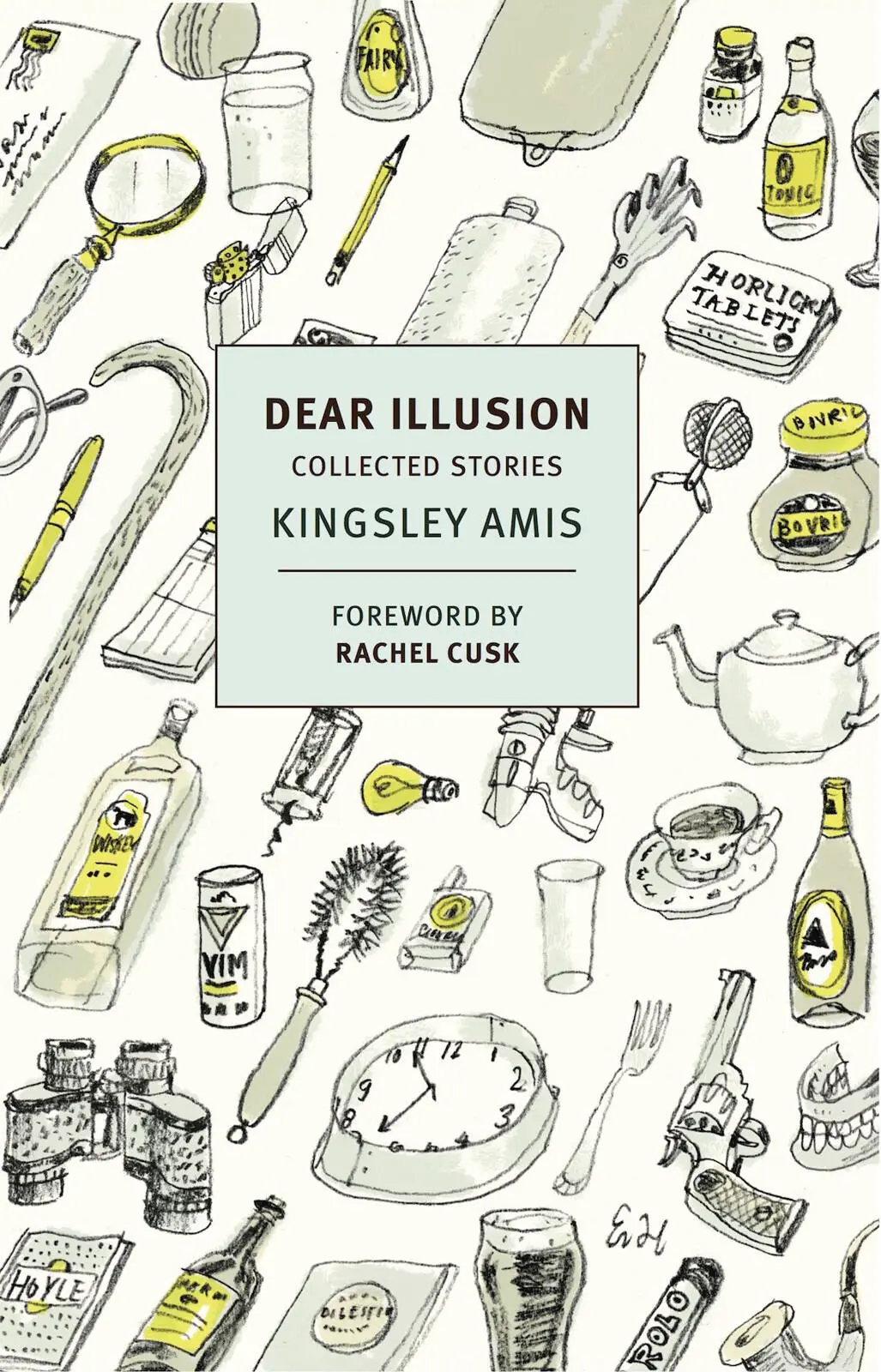
- Название:Dear Illusion: Selected Stories
- Автор:
- Издательство:New York Review of Books
- Жанр:
- Год:2015
- ISBN:нет данных
- Рейтинг книги:4 / 5. Голосов: 1
-
Избранное:Добавить в избранное
- Отзывы:
-
Ваша оценка:
Dear Illusion: Selected Stories: краткое содержание, описание и аннотация
Предлагаем к чтению аннотацию, описание, краткое содержание или предисловие (зависит от того, что написал сам автор книги «Dear Illusion: Selected Stories»). Если вы не нашли необходимую информацию о книге — напишите в комментариях, мы постараемся отыскать её.
Dear Illusion: Selected Stories — читать онлайн бесплатно полную книгу (весь текст) целиком
Ниже представлен текст книги, разбитый по страницам. Система сохранения места последней прочитанной страницы, позволяет с удобством читать онлайн бесплатно книгу «Dear Illusion: Selected Stories», без необходимости каждый раз заново искать на чём Вы остановились. Поставьте закладку, и сможете в любой момент перейти на страницу, на которой закончили чтение.
Интервал:
Закладка:
‘Not as far as I recall.’
‘Good, good. My name’s Pettigrew, Daniel R. Pettigrew. What’s yours?’
‘Mason. George Herbert Mason, if you want it in full.’
‘Well, I think that’s best, don’t you? George… Herbert… Mason.’ Pettigrew spoke as if committing the three short words to memory. ‘Now let’s have your telephone number.’
Again Mason might have reacted against Pettigrew’s demanding manner, but he said no more than, ‘You can find me in the book easily enough.’
‘No, there might be several… We mustn’t waste time. Please.’
‘Oh, very well; it’s public information, after all. Two-three-two, five—’
‘Hold on, you’re going too fast for me. Two… three… two…’
‘Five-four-five-four.’
‘What a stroke of luck. I ought to be able to remember that.’
‘Why don’t you write it down if it’s so important to you?’
At this, Pettigrew gave a knowing grin that faded into a look of disappointment. ‘Don’t you know that’s no use? Anyway: two-three-two, five-four-five-four. I might as well give you my number too. Seven—’
‘I don’t want your number, Mr Pettigrew,’ said Mason, sounding a little impatient, ‘and I must say I rather regret giving you mine.’
‘But you must take my number.’
‘Nonsense; you can’t make me.’
‘A phrase, then — let’s agree on a phrase to exchange in the morning.’
‘Would you mind telling me what all this is about?’
‘Please, our time’s running out.’
‘You keep saying that. This is getting—’
‘Any moment everything might change and I might find myself somewhere completely different, and so might you, I suppose, though I can’t help feeling it’s doubtful whether—’
‘Mr Pettigrew, either you explain yourself at once or I have you removed.’
‘All right,’ said Pettigrew, whose disappointed look had deepened, ‘but I’m afraid it won’t do any good. You see, when we started talking I thought you must be a real person, because of the way you—’
‘Spare me your infantile catch-phrases, for heaven’s sake. So I’m not a real person,’ cooed Mason offensively.
‘I don’t mean it like that, I mean it in the most literal way possible.’
‘Oh, God. Are you mad or drunk or what?’
‘Nothing like that. I’m asleep.’
‘Asleep?’ Mason’s nondescript face showed total incredulity.
‘Yes. As I was saying, at first I took you for another real person in the same situation as myself: sound asleep, dreaming, aware of the fact, and anxious to exchange names and telephone numbers and so forth with the object of getting in touch the next day and confirming the shared experience. That would prove something remarkable about the mind, wouldn’t it? — people communicating via their dreams. It’s a pity one so seldom realizes one’s dreaming: I’ve only been able to try the experiment four or five times in the last twenty years, and I’ve never had any success. Either I forget the details or I find there’s no such person, as in this case. But I’ll go on—’
‘You’re sick.’
‘Oh no. Of course it’s conceivable there is such a person as you. Unlikely, though, or you’d have recognized the true situation at once, I feel, instead of arguing against it like this. As I say, I may be wrong.’
‘It’s hopeful that you say that.’ Mason had calmed down, and lit a cigarette with deliberation. ‘I don’t know much about these things, but you can’t be too far gone if you admit you could be in error. Now let me just assure you that I didn’t come into existence five minutes ago inside your head. My name, as I told you, is George Herbert Mason. I’m forty-six years old, married, three children, job in the furniture business… Oh hell, giving you no more than an outline of my life so far would take all night, as it would in the case of anybody with an average memory. Let’s finish our drinks and go along to my house, and then we can—’
‘You’re just a man in my dream saying that,’ said Pettigrew loudly. ‘Two-three-two, five-four-five-four. I’ll call the number if it exists, but it won’t be you at the other end. Two-three-two—’
‘Why are you so agitated, Mr Pettigrew?’
‘Because of what’s going to happen to you at any moment.’
‘What… Is this a threat?’
Pettigrew was breathing fast. His finely drawn face began to coarsen, the pattern of his tweed jacket to become blurred. ‘The telephone!’ he shouted. ‘It must be later than I thought!’
‘Telephone?’ repeated Mason, blinking and screwing up his eyes as Pettigrew’s form continued to change.
‘The one at my bedside! I’m waking up!’
Mason grabbed the other by the arm, but that arm had lost the greater part of its outline, had become a vague patch of light already fading, and when Mason looked at the hand that had done the grabbing, his own hand, he saw with difficulty that it likewise no longer had fingers, or front or back, or skin, or anything at all.
MR BARRETT’S SECRET
I
It must have been in the January or February of the year 1845 that I first became aware of the connection of Elizabeth, my first child and eldest daughter, with the man Robert Browning. Had I had the least intimation of what was to follow, I should have forbidden its continuance in any form, and have prosecuted my interdiction with unswerving tenacity. Nevertheless, full knowledge of the future that awaited Elizabeth and myself would surely have led me to bless that divine provision whereby it is not given to us to see as far as the next tick of the clock.
A letter, addressed to Elizabeth in a strange hand, arrived by the early morning delivery at my house at 50 Wimpole Street, a circumstance in itself very far from unusual. More especially since the publication by Moxon of her Poems in two volumes the preceding August, my dearest Ba (to use her family pet-name) had grown used to receiving correspondence from persons unacquainted with her. Many came from America and other distant parts of the world; the letter in question had been posted in London.
In characterizing just now the style of the writing on the envelope, I used the word ‘strange’ advisedly. It was not only unfamiliar to me; it was peculiar, extraordinary, odd. And yet in its very singularity there was a principle I seemed to recognize from some distant part of my life, from long ago. Possibly, too, I was aware of an indefinable threat or menace lurking in it, remote but real; more likely, however, I am allowing later events to sophisticate those first memories.
Whatever I might have thought, then or afterwards, there was no doubt that Elizabeth was delighted with her letter. I had scarcely finished breakfast before I was urgently summoned to her room on the third floor of the house.
‘Dearest papa!’ she cried, rising from her sofa-bed to embrace me in lively fashion. ‘You will never guess what a marvellous gift I have had in the post this morning!’
‘You are bidden to take tea with our young Queen,’ I suggested, smiling.
‘It’s a trifle soon for such a thing, though doubtless that and much else will come in time. No, I am the recipient of a poem by Mr Robert Browning, a most beautiful and wondrous poem in which he exalts me to the status of a queen, but a queen of poetry and of the making of poetry. Oh, it’s such a poem, darling papa, so full of the loveliest affirmations of devotion, so eloquent, so rich in the spontaneous vitality you know I prize above everything.’
‘And this comes unprompted? As a spontaneous tribute?’ I asked.
‘Not quite, it’s true. You may remember that in my poem “Lady Geraldine’s Courtship” I referred to Mr Browning along with Mr Wordsworth and Mr Tennyson as a man whose writings place him next to the Gods.’
Читать дальшеИнтервал:
Закладка:
Похожие книги на «Dear Illusion: Selected Stories»
Представляем Вашему вниманию похожие книги на «Dear Illusion: Selected Stories» списком для выбора. Мы отобрали схожую по названию и смыслу литературу в надежде предоставить читателям больше вариантов отыскать новые, интересные, ещё непрочитанные произведения.











Обсуждение, отзывы о книге «Dear Illusion: Selected Stories» и просто собственные мнения читателей. Оставьте ваши комментарии, напишите, что Вы думаете о произведении, его смысле или главных героях. Укажите что конкретно понравилось, а что нет, и почему Вы так считаете.