Kingsley Amis - Dear Illusion - Selected Stories
Здесь есть возможность читать онлайн «Kingsley Amis - Dear Illusion - Selected Stories» весь текст электронной книги совершенно бесплатно (целиком полную версию без сокращений). В некоторых случаях можно слушать аудио, скачать через торрент в формате fb2 и присутствует краткое содержание. Год выпуска: 2015, Издательство: New York Review of Books, Жанр: Современная проза, на английском языке. Описание произведения, (предисловие) а так же отзывы посетителей доступны на портале библиотеки ЛибКат.
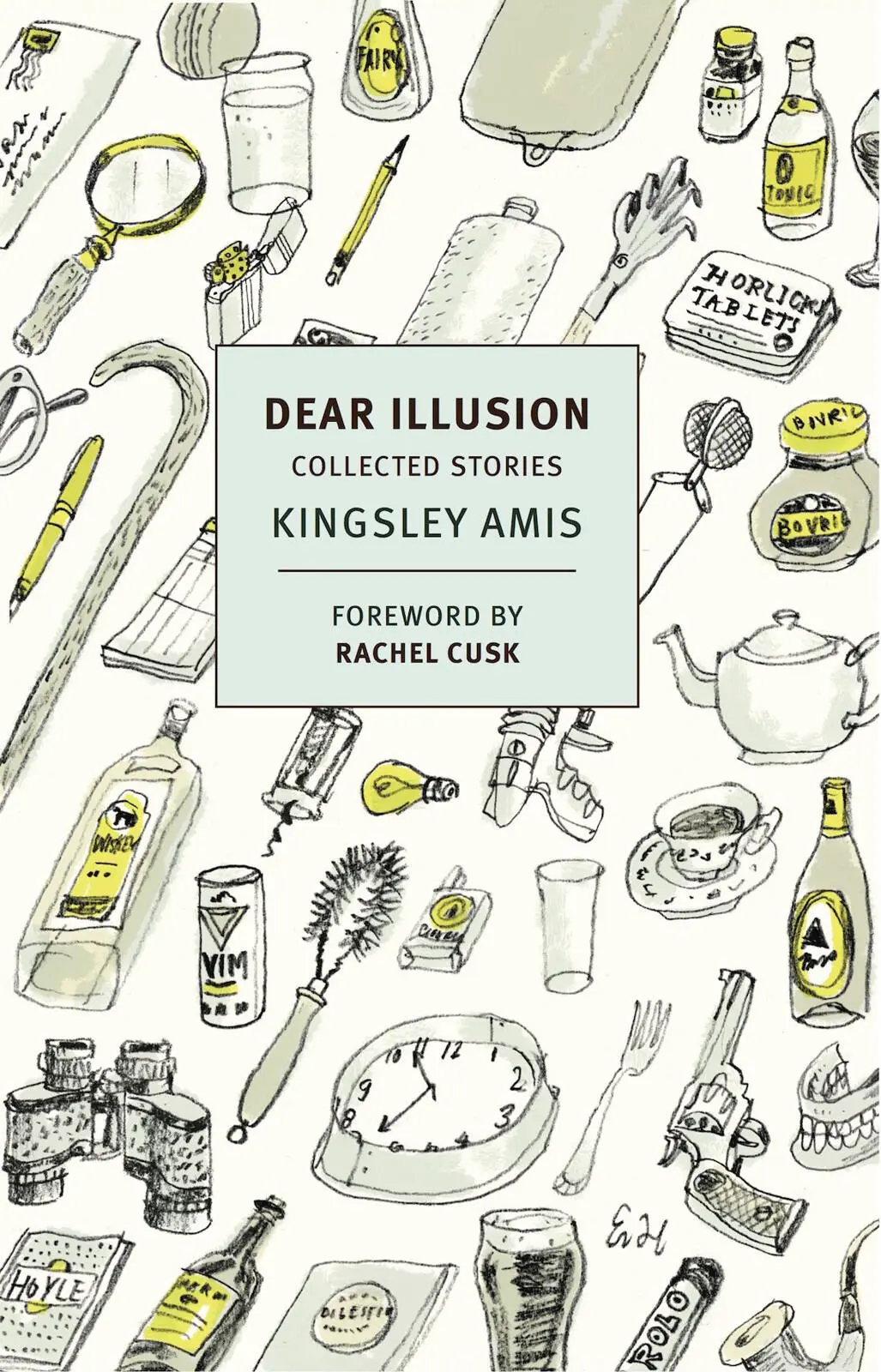
- Название:Dear Illusion: Selected Stories
- Автор:
- Издательство:New York Review of Books
- Жанр:
- Год:2015
- ISBN:нет данных
- Рейтинг книги:4 / 5. Голосов: 1
-
Избранное:Добавить в избранное
- Отзывы:
-
Ваша оценка:
Dear Illusion: Selected Stories: краткое содержание, описание и аннотация
Предлагаем к чтению аннотацию, описание, краткое содержание или предисловие (зависит от того, что написал сам автор книги «Dear Illusion: Selected Stories»). Если вы не нашли необходимую информацию о книге — напишите в комментариях, мы постараемся отыскать её.
Dear Illusion: Selected Stories — читать онлайн бесплатно полную книгу (весь текст) целиком
Ниже представлен текст книги, разбитый по страницам. Система сохранения места последней прочитанной страницы, позволяет с удобством читать онлайн бесплатно книгу «Dear Illusion: Selected Stories», без необходимости каждый раз заново искать на чём Вы остановились. Поставьте закладку, и сможете в любой момент перейти на страницу, на которой закончили чтение.
Интервал:
Закладка:
At first sight Scotland was no concern of mine. The Church was well enough established there, and Macbeth had shown himself well disposed to her in the dozen years of his rule. I had no means of controlling events. There was only one bishop of the Scots, at the unwalled city of St Andrews, and his influence was purely local. What monks there were had no power. Clearly, the key to control of the Scottish Church lay in the sovereign. If I could win some personal regard from Macbeth, I might be laying the foundations of something that might, again, prove useful in any future trouble with England. And that there would be trouble with England sooner or later, perhaps in my time, perhaps after many years, I had not the slightest doubt.
I hardly know what I had expected to encounter the noon following, certainly not the tall, fair-haired, blue-eyed figure in his late forties who was presented; I thought he might well have had a Norse ancestor as well as Norse neighbours. His companion, introduced by my usher as Captain Seaton, short, broad, heavily bearded, with a look of stupid ferocity, was much more my idea of a Scotchman. As the two knelt before me I bestowed on each a salutation appropriate to his rank.
So as not to overawe my visitors excessively I had received them in a small throne-room built two centuries before by my predecessor Agapetus II and not two storeys high, none the less worthy of its function with sumptuous new frescoes, sculptures in the round and jewelled appointments. The soldier, if that was what he was, kept his eyes straight in front as though fearful of taking in his surroundings; his master glanced here and there without disrespect, without astonishment either, his attention soon caught by the most unusual piece on view, a grotesque carved-oak Calvary the bishop of Rennes took out of some church there and sent me for my forty-seventh birthday, my first after being consecrated.
The king’s dress gave further mild surprise; not deer-skins and foot-rags but a rich gold-edged surcoat that would not have disgraced the Emperor Henry himself, an inner garment of dark-red silk, high Spanish shoes, a short, stout cross-hilted sword, plain but with some elegance in the workmanship, and below the throat a curiously shaped crucifix, evidently silver but of a pretty bluish tinge, which I promised myself I would have off him before he took his leave. What manner of tribal chieftain was it who wore these things?
As was my custom when receiving royalty, I had had my seneschal install near the dais and at right angles to it a heavy chair with a high and elaborately carved back representing scenes of martyrdom. Mounted on a shallow platform, it was in no sense a throne but it did elevate the monarch in occupation a sufficient distance above the commonalty. Here King Macbeth sat, well enough at his ease with his blue eyes reverentially lowered. Without much confidence in being understood I asked in simple Latin a question about his earlier visit to the City.
Unexpectedly once more, he replied in fluent and correct French, the language of my childhood, ‘I was desperately disappointed to be unable to pay my respects to your highness. I had to be content with distributing money to the poor of Rome.’ His accent was no worse than that of my late captors, indeed much resembled theirs.
‘Your majesty’s skill in the tongue is remarkable.’ No more so than his having discovered my own familiarity with it.
‘Thank you, Holy Father. I have been fortunately placed. It so happens that over the past two years or so I have sheltered at my court a number of French-speaking fugitives from England, and I sent myself to school with them. After all, this conversation, however memorable to me, would have been much restricted otherwise. My Latin is rudimentary, and I doubt if your highness’ Gaelic is much better.’
I laughed, partly in unconcealed appreciation of this speech. Those fugitives had of course come in the first place from Normandy, but after my recent experiences it would have been less than tactful to mention even the existence of that place. As for having learned French, he had not done so in order to be able to converse with me, whom he had been prepared to face three years before in ignorance of it and whom he had not expected to see at all this time. No, his conversational target had in the first place been Duke William, universally understood to have been promised the English throne by King Edward as soon as it fell vacant, and therefore a most interesting personage to any king of Scotland. But would William desire such a meeting?
‘Doubtless you made other visits on your journey here, your majesty?’
He was on the defensive at once. ‘Yes, Holy Father, one such, but it was of no importance, not even comparatively so.’
‘Nevertheless I trust enjoyable.’
‘I must ask your highness to pardon me,’ he said, blinking fiercely.
This time I suppressed a smile. It was as clear to me as from a full description that what he had visited or attempted to visit was indeed William’s court, and no less so that he had been rebuffed — unseen, I judged, for it took no more than a glance to show that here was someone to be reckoned with, not the refined soul he took himself for, a barbarian still, but a remarkable barbarian. I said smoothly, ‘We hear pleasing reports of the state of Scotland under your majesty’s stewardship.’
‘Your highness is too gracious. And you bring me to the object of this interview, or the secondary object, the first plainly being to be granted your blessing, Holy Father. For reasons that will appear, I had felt driven most urgently to come to Rome even when I took your highness to be absent. To find you present after all, to reach you, I see as a distinct mark of divine favour.’
An ardent blue-eyed stare went with this. I began to cough for a moment and shifted position on my throne. Talk of such matters has always unsettled me. It might have been a little sharply that I said, ‘Please go on, sir.’
But he hesitated for a moment before continuing, ‘I hope to be forgiven for making what must be an unusual request. It is that a clerk should be sent for to record the substance of what, if permitted, I shall say.’
I gave the necessary directions and waited.
‘I suppose you know little of Scotland, Holy Father. It is a remote and obscure place, its people wild, ignorant, credulous, superstitious, not brutal but childish. They have no notions of probability, of consistency, of what is real and what is fancied. My reign has not been untroubled and some of the events in it, and even more those attending its inception, were violent, confused and ambiguous. Not long after I am dead the generally accepted account of it, of my reign, is likely to deviate absurdly and irrecoverably from historical fact. A like process has already distorted the years of my predecessor’s rule. With your leave, with your help, Holy Father, I intend to set on record the truth of these matters and to have that record lodged in the bosom of the see of St Peter, where it will be safe for ever. This it was that brought me here. What I have to say may also attract your highness’ passing attention, for all Scotland’s distance from the centre of the world.’
That last stroke, accompanied by a different kind of glance, caused me to reflect that such men as this were not very common anywhere, not even in Rome. Just then a clerk appeared, a Benedictine, and on my nod settled himself at Macbeth’s left side. I spread a hand in invitation.
‘Some things are seen, some things are put out of sight. It is seen that old Malcolm II, King of Scots, fortunate, victorious, praised of bards, had no son to follow him, but that he ruled so long that by the time he died his grandsons were grown up. For the succession, it is seen that he favoured the eldest, Duncan. This, when he might have chosen the third in age, myself, or even the fourth and youngest, Thorfinn Sigurdson, son of the Norwegian earl of Orkney. By the ancient custom of our royal house the eldest prince has no firm right to succeed, and I had a better claim, a double claim, a claim not only through my own lineage but also through that of my wife Gruoch, granddaughter of King Kenneth III, whom old Malcolm had deposed and killed. Such a claim as hers is also admitted by our custom.
Читать дальшеИнтервал:
Закладка:
Похожие книги на «Dear Illusion: Selected Stories»
Представляем Вашему вниманию похожие книги на «Dear Illusion: Selected Stories» списком для выбора. Мы отобрали схожую по названию и смыслу литературу в надежде предоставить читателям больше вариантов отыскать новые, интересные, ещё непрочитанные произведения.











Обсуждение, отзывы о книге «Dear Illusion: Selected Stories» и просто собственные мнения читателей. Оставьте ваши комментарии, напишите, что Вы думаете о произведении, его смысле или главных героях. Укажите что конкретно понравилось, а что нет, и почему Вы так считаете.