Kingsley Amis - Dear Illusion - Selected Stories
Здесь есть возможность читать онлайн «Kingsley Amis - Dear Illusion - Selected Stories» весь текст электронной книги совершенно бесплатно (целиком полную версию без сокращений). В некоторых случаях можно слушать аудио, скачать через торрент в формате fb2 и присутствует краткое содержание. Год выпуска: 2015, Издательство: New York Review of Books, Жанр: Современная проза, на английском языке. Описание произведения, (предисловие) а так же отзывы посетителей доступны на портале библиотеки ЛибКат.
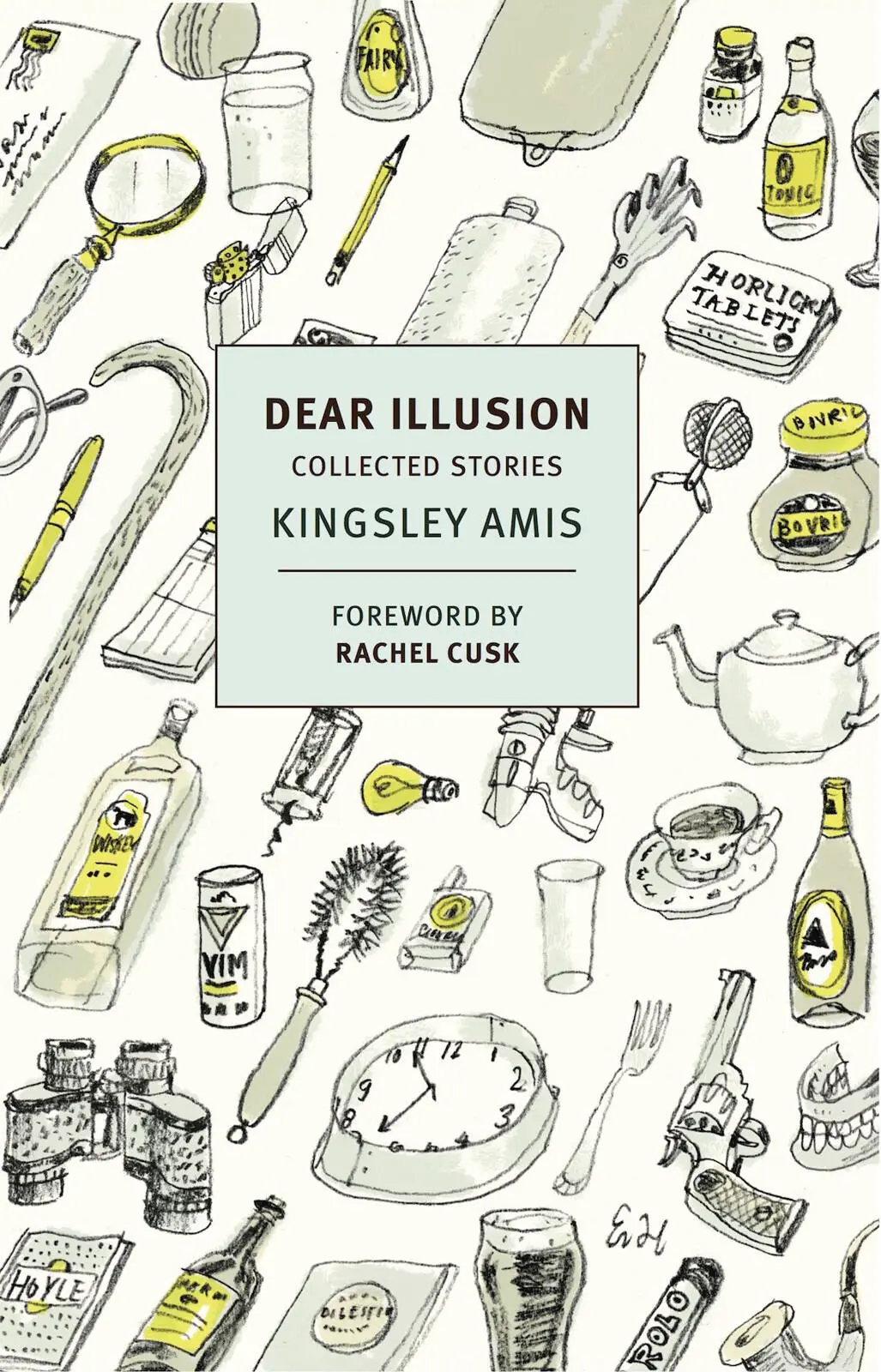
- Название:Dear Illusion: Selected Stories
- Автор:
- Издательство:New York Review of Books
- Жанр:
- Год:2015
- ISBN:нет данных
- Рейтинг книги:4 / 5. Голосов: 1
-
Избранное:Добавить в избранное
- Отзывы:
-
Ваша оценка:
Dear Illusion: Selected Stories: краткое содержание, описание и аннотация
Предлагаем к чтению аннотацию, описание, краткое содержание или предисловие (зависит от того, что написал сам автор книги «Dear Illusion: Selected Stories»). Если вы не нашли необходимую информацию о книге — напишите в комментариях, мы постараемся отыскать её.
Dear Illusion: Selected Stories — читать онлайн бесплатно полную книгу (весь текст) целиком
Ниже представлен текст книги, разбитый по страницам. Система сохранения места последней прочитанной страницы, позволяет с удобством читать онлайн бесплатно книгу «Dear Illusion: Selected Stories», без необходимости каждый раз заново искать на чём Вы остановились. Поставьте закладку, и сможете в любой момент перейти на страницу, на которой закончили чтение.
Интервал:
Закладка:
‘Yes. Thank you.’ I realized I had had a fat chance from the beginning. ‘I must have been mistaken. I mean you’re right, it isn’t a very good painting.’
‘If you want to know more about Aleku, I could show you the mausoleum after luncheon — you know, where he’s buried or is at rest.’
I thanked him and accepted, though I hardly expected there would be much to see, and he picked up a shallow pile of grey folders that evidently held what he considered most likely to be of interest to me. I thanked him again for his trouble; he said that as a result of years of diligent subject-indexing it had been no trouble at all. (Librarians are much the same everywhere, eh, old boy?) Then, opening one of the folders, he muttered a question about the state of my Hungarian, and I saw fit to call it rusty, which I hope you’ll take as a pardonable exaggeration, or rather as whatever the opposite of that is. (Understatement. I must pull my brains together.) Accordingly, Macneil had the kindness to run over the main points of what had been an address given before the inner college of St Ladislas’ at Peks by a certain Dr Bela Hadik in 1913.
The speaker’s main theme is apparently that the powers of the vampire and also its weaknesses, its limitations, can be rationally explained. On this view, the vampire is not in any sense dead, rather it has entered upon another kind of life, its activity confined to the hours of darkness but itself made potentially immortal and ageless. We are to remember that the victim of a vampire’s attack loses very little blood, and yet soon afterwards, perhaps after a second attack, perhaps not, is dead. Of what malady? Later he rises from the dead and functions once more — walks, talks, thinks, is capable of great physical exertion. In his turn the victim becomes the predator and himself imbibes blood, not much, and not often. For what purpose? Hardly for nutriment; no corporeal frame of that size could possibly subsist on such a meagre diet. Day-to-day sustenance must be provided by more conventional food.
The postulate is that somehow, perhaps through the vampire’s saliva, a peculiar element reaches the victim’s bloodstream and multiplies within it. During the period of supposed death, actually suspended animation, a number of changes take place which curtail freedom of movement but confer enhanced strength and capability of self-repair and, it has been said, certain abnormal powers of the mind, such as the ability to detect malign forces at a distance.
At this point, just to contribute something of my own, however obvious, I put in, ‘At any rate, the physical changes permit the creature to survive injuries that would kill an ordinary mortal and therefore, if he is to be destroyed, he must be damaged in ways no living being could withstand — impalement, decapitation, burning.’
‘Indeed,’ said Macneil, ‘and just as the vampire transforms normal blood, so he needs something from it. Whatever that something is, it tends to overheat the body, so that during the warmer, daylight hours there must be not only rest but refrigeration.’
‘For which purpose,’ I said, ‘a stone coffin packed with earth and laid in an underground vault would be as good as anything science could come up with till just the other day.’
He smiled at me again, but more pleasantly this time, like a schoolmaster at a pupil who has got it right for once. ‘Exactly, Mr Hillier. Well, I think you have the heart of it there.’
I said with a show of detachment, ‘Do you really believe any of this vampire stuff yourself?’
‘Yes,’ he said straight away.
‘Have you seen any of it?’
Now he hesitated before saying firmly, ‘No.’
‘Do you believe any of this ?’ I tapped the folder.
‘Maybe.’
‘Oh, it’s rather rot, don’t you think? I mean it leaves out so much. You said last night that exposure to the light of the sun was the most effective means of destroying a vampire — widely believed to be so, that is. Is that accounted for here?’
‘Not specifically.’ He spoke as if he perhaps wanted to have done with the conversation. ‘Further overheating of the body would no doubt result.’
I couldn’t resist saying, ‘To the tune of thousands of degrees Fahrenheit? If you’ll forgive me, Mr Macneil, your belief seems to be founded on a wish to believe.’
‘No doubt it does, Mr Hillier, but I’d like you to cast an eye on what I have here before you finally make up your mind on that point.’
‘What is it?’
‘Part of the only known statement on vampirism committed to paper by a self-confessed vampire,’ he said impressively, handing over a single yellowed sheet covered with brownish writing, and added, ‘The most secret document in this library. Even the countess doesn’t know it’s here.’
No doubt I should have inquired into the last part of that, but I was too eager to examine what I now had before me and allowed Macneil to withdraw, muttering as he went something about binding up a batch of pamphlets.
As I read, I began to wish more fervently than ever before that the advance of science had reached the point at which books and other printed or written material could be copied at the pressing of a switch, for instance by some development of the photographic process. This is 1925, though, not 1975, and I have had to do what I could with pen and ink. As you see, I started to transcribe the original, which is jolly simple Dacian, but not simple enough, I suspect, for those whose knowledge of the tongue is worse than rusty. Being simple it has lost little by being translated, though I should add here that the writer was obviously an educated man and that one or two words and expressions, together with some slight formalities of construction, suggest a date in the last century, most likely its second half.
Enclosure
Duminu wobisku. Preko wos ni par mizerikordi ni par pieti.
The Lord be with you. I ask you not for pity nor for mercy, but for your prayers. You who are not accursed, pray to Almighty God for my wicked soul. You who go out in the day, petition all-loving God for His justice towards a child of His who lives in loneliness and misery, who stays always in the same place and who never sees the sun. Plead with Him that I have no choice in the end but to take my loathsome refection, and to lie and dissemble, which I loathe almost as bitterly, and suborn others to do evil on my behalf, for if I do not I shall surely die at last, and there is no life so miserable that it is not to be preferred to death. Say all this to Him, for His will is that I cannot say it myself; why should one of my vile condition obtain such relief? Say to Him also that I trust in His goodness and expect His deliverance. On that day there shall come one who will.
Main letter
One who will do what? is no doubt the question you’re asking yourself. I certainly asked it, and must have done so aloud, for Macneil, at my side again to write in an addition to the vast catalogue, expressed his ignorance and added that (as I had surmised) the following sheet or sheets were lost. He went on to say that he considered it to be about fifty years old, or a little less, and that it had been in the library when he first came, but with no press-mark or entry and no information as to its origin, merely a half-indecipherable note about a hearing before a quaestor or investigatory magistrate. Finally he asked me what I thought of the document. I told him I didn’t know, which was and is no more than the truth. It might be a fake, it might be the ravings of a madman, but I can’t believe it’s either, but as to why, that again I don’t know. Something about the handwriting bothers me; I’ve made a tracing of the first few words which you’ll forgive me for not sending on.
Читать дальшеИнтервал:
Закладка:
Похожие книги на «Dear Illusion: Selected Stories»
Представляем Вашему вниманию похожие книги на «Dear Illusion: Selected Stories» списком для выбора. Мы отобрали схожую по названию и смыслу литературу в надежде предоставить читателям больше вариантов отыскать новые, интересные, ещё непрочитанные произведения.









Обсуждение, отзывы о книге «Dear Illusion: Selected Stories» и просто собственные мнения читателей. Оставьте ваши комментарии, напишите, что Вы думаете о произведении, его смысле или главных героях. Укажите что конкретно понравилось, а что нет, и почему Вы так считаете.