Kingsley Amis - Dear Illusion - Selected Stories
Здесь есть возможность читать онлайн «Kingsley Amis - Dear Illusion - Selected Stories» весь текст электронной книги совершенно бесплатно (целиком полную версию без сокращений). В некоторых случаях можно слушать аудио, скачать через торрент в формате fb2 и присутствует краткое содержание. Год выпуска: 2015, Издательство: New York Review of Books, Жанр: Современная проза, на английском языке. Описание произведения, (предисловие) а так же отзывы посетителей доступны на портале библиотеки ЛибКат.
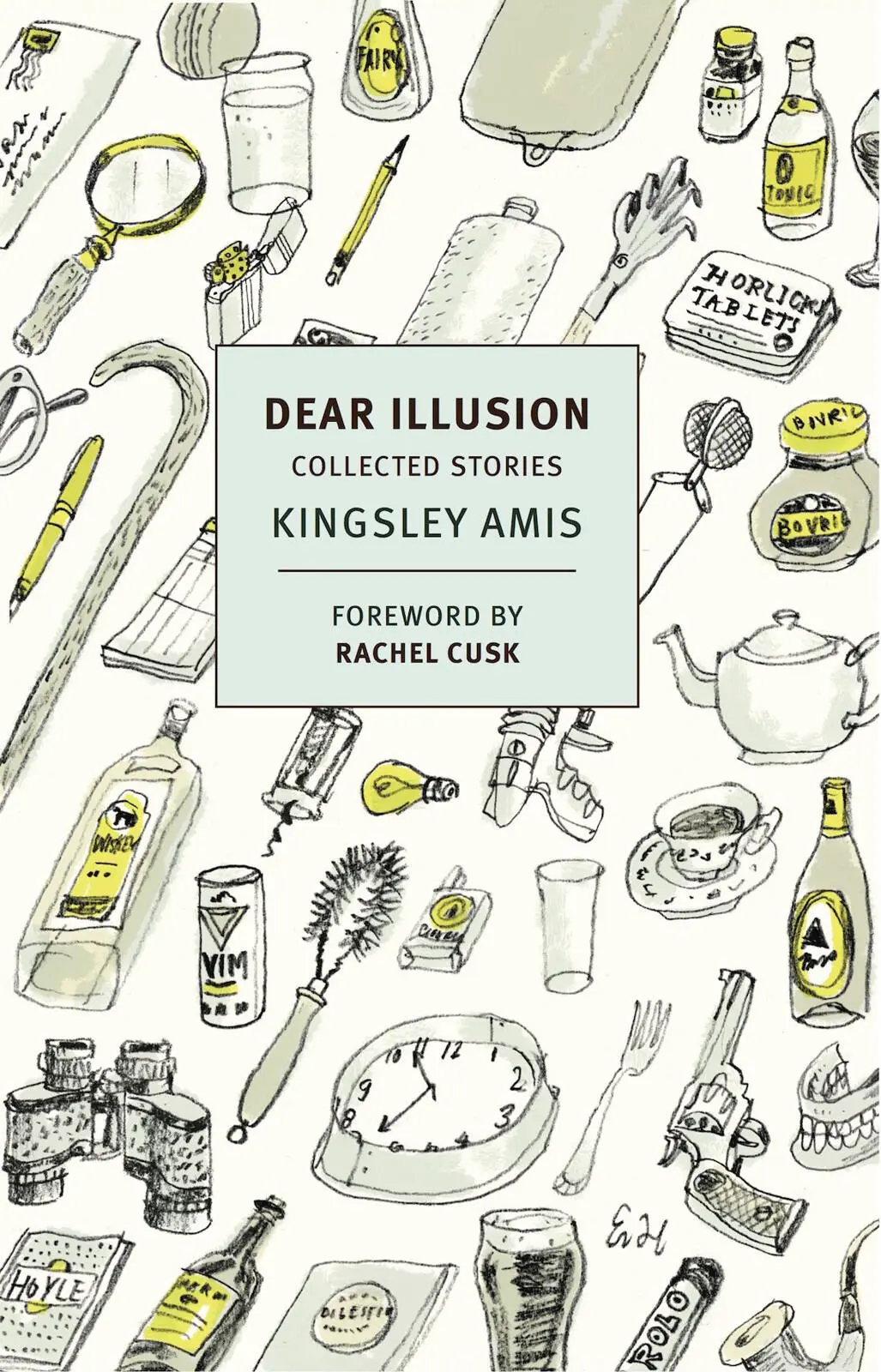
- Название:Dear Illusion: Selected Stories
- Автор:
- Издательство:New York Review of Books
- Жанр:
- Год:2015
- ISBN:нет данных
- Рейтинг книги:4 / 5. Голосов: 1
-
Избранное:Добавить в избранное
- Отзывы:
-
Ваша оценка:
Dear Illusion: Selected Stories: краткое содержание, описание и аннотация
Предлагаем к чтению аннотацию, описание, краткое содержание или предисловие (зависит от того, что написал сам автор книги «Dear Illusion: Selected Stories»). Если вы не нашли необходимую информацию о книге — напишите в комментариях, мы постараемся отыскать её.
Dear Illusion: Selected Stories — читать онлайн бесплатно полную книгу (весь текст) целиком
Ниже представлен текст книги, разбитый по страницам. Система сохранения места последней прочитанной страницы, позволяет с удобством читать онлайн бесплатно книгу «Dear Illusion: Selected Stories», без необходимости каждый раз заново искать на чём Вы остановились. Поставьте закладку, и сможете в любой момент перейти на страницу, на которой закончили чтение.
Интервал:
Закладка:
Naturally I didn’t reach this conclusion all at once; other things had a claim on my attention. Or rather… Old boy, I despair of conveying to you the brilliance of her eyes, the profusion of her glorious hair, the voluptuousness of her figure, anything about her in a way that will do it justice. I had fallen for her like a ton of bricks literally the moment I set eyes on her. At that stage I didn’t dare to wonder about her feelings for me. No use telling myself I shouldn’t be in my present state; it seems to me that, again literally, I had no choice. By the way, we’ve known each other long enough for me to be able to admit to you that I’ve made the lady sound less than sensational when writing to Connie. Verb. sap . No, I’m sorry, I shouldn’t try to be flippant about it. Casual adventures aren’t my style.
Well, the three of us dined in a modestly sized room that is clearly not the one in use on grand occasions; hardly a pigsty all the same. The vaulting overhead reminded me a little of that at the western end of the chapel at Matt’s, though any resemblance must surely be fortuitous. We went from a delicious potato soup to chicken konstanta (with plum sauce) and thence to fingers of cheese dipped in a harsh local mustard. Two wines were offered, the red vigorous enough, the white a little thin, I thought, but the countess evidently preferred it. The Scotchman did most of the talking, and most of what he said was on the subject of vampirism. I’ll just summarize those parts of his discourse which were wholly or partly new to me.
‘Many details of the vampire legend turn out to have no basis in fact — I mean of course no basis in recorded statements, the testimony of alleged witnesses and so forth. For instance it’s widely believed, even in parts of this country, that the creature casts no shadow, and no reflection in water or looking-glass. How could that be so? As is clear from its other attributes and activities, a vampire is flesh and blood, in however modified a form. Then the alleged protection given by a crucifix — nothing more than a sign of the Church’s attempt to Christianize the essentially pagan rituals used to ward off or destroy the vampire. Which brings up another question — why should the being have to be in its coffin for destruction to be effective? Benedek Valvazor himself was decapitated and annihilated on the roof of this very castle. A spike or nail hammered into the skull is also held to be effective. There are other methods which strike one as bizarre in the extreme; the Cretan islanders, for example, boil the vampire’s head in vinegar. It seems the only means generally found serviceable is exposure to direct sunlight. Causing total disintegration. Into dust.’
At this point in his remarks Macneil saw what I had that moment seen, that Countess Valvazor was looking distinctly uncomfortable, even unwell.
I said, ‘What’s the matter?’ I think I may have shouted a little in my anxiety.
‘It’s nothing,’ she said, and took a deep breath. ‘I guess I am a tiny bit squeamish after all.’ She managed a smile then. ‘And those were my ancestors you were talking about, darn it.’
‘Indeed,’ said Macneil. ‘How could I forget that? Countess, you haven’t touched your food.’ Here he too smiled, but in a very different, not altogether pleasant way. ‘Eat it up, now.’
She shrugged her shoulders and did as she was told. At the end of the meal, the servant Magda brought in Turkish coffee, devilish sweet and strong. An eau-de-vie of the country, made it seemed from greengages, was also produced, but all three of us declined, Macneil because, according to him, he was off to bed shortly, having had a long day and being faced with an early start in the morning. He added that he would be in the castle library and at my disposal from eight o’clock onwards. Before finally departing he cautioned me against staying up too late, on the grounds that, even at these comparatively modest altitudes, a visitor found he needed his sleep. His actual leave-taking was civil enough, but the impression he’d made on me was by no means unequivocally favourable. I tried to convey this tactfully to the countess, who took my point at once.
‘He has a great deal of authority around here,’ she said. ‘And as you saw we dine together. It must be hard for him to remember he’s only an employee.’
‘How did he acquire his authority?’ I asked her.
She hesitated. ‘He — how shall I put it? — he made himself useful to Baron Aleku.’
‘Baron Aleku?’ I said in surprise. ‘But he’s been dead for…’ Half-bemused by amorousness as I was, I couldn’t work it out.
‘Robert has been here since 1890; thirty-five years ago. He’s a clever man, a good organizer. But for him my life here would be impossible.’
‘I think I understand.’
‘Can’t we forget him?’ she asked softly.
In an instant I had no breath. All I could do was nod my head.
‘Would you like to see some of the rooms?’
‘Very much.’
The room we saw (though I saw little enough of it, at any rate at first) was the countess’s sitting-room. I gazed at the pretty curtains and covers and cushions and agreed in lethargic tones that they were beyond doubt pretty. For whatever reason, my companion seemed equally distracted. She listlessly indicated another portrait of her great-uncle, less striking than the one I had noticed in the hall, then a larger picture which did catch my attention. This was an outdoor scene showing what I identified as a funeral procession moving across a stretch of parkland towards a one-storey building of somewhat grotesque design, no doubt a place of entombment. The light might have been that of a rainy day at the end of winter. I learned from the plate that the funeral was that of Baron Aleku Valvazor in the year 1891. For a few moments, without any clear reason, I experienced a feeling of the most profound depression. I spoke before I thought.
‘Where did this happen?’
‘Here,’ said the countess with an inquiring look. ‘In the grounds just outside this window.’
‘And what I see there is some kind of… sepulchre.’
‘There are Valvazors in it that go back to the sixteenth century.’
I made a non-committal noise. My interest had subsided again.
‘The ceiling in this room is supposed to be very unusual.’
And then… My dear Charles, we should both of us have to be altogether different from what we are if I could tell you, even in outline, what happened then; you must use your own experience and your imagination. But this I will say, even to the loyal friend of Connie’s that I know you to be: it wasn’t so much that what happened then was better than any comparable experience of mine, it was more that there simply was no comparison. Afterwards, we agreed that in the very first instant of our meeting — but now, like an oaf, I’m once more on the point of embarrassing you. So, in the most strictly practical fashion, I’ll do no more than state flatly that Countess Valvazor is called Lukretia (the Dacian aristocracy, like the Rumanian, are fond of stressing their links with Ancient Rome), that she’s twenty-nine years old and, as you must know to appreciate what followed, that the setting was her bedchamber, a rather sombre room which she had done her best to cheer up with her gay cushions and rugs and so on.
It was late when I fell asleep. At once, or so it appeared, I entered on a series of vivid yet incomprehensible dreams. There were animals quite unlike any real or even legendary beast, and manufactured objects, large and small, of unguessable purpose. And the people, so many of them, so active, so unremittingly interested in me — what were they all doing? What was happening? Where and what were these places? Was I dying? At last a horrified voice that called in a strange tongue banished this troubling phantasmagoria: ‘Aleku, you devil, you hound of hell!’ — yes, Charles, ‘ tu kani d’infernu ’, those very words; I was wide awake in a split second.
Читать дальшеИнтервал:
Закладка:
Похожие книги на «Dear Illusion: Selected Stories»
Представляем Вашему вниманию похожие книги на «Dear Illusion: Selected Stories» списком для выбора. Мы отобрали схожую по названию и смыслу литературу в надежде предоставить читателям больше вариантов отыскать новые, интересные, ещё непрочитанные произведения.









Обсуждение, отзывы о книге «Dear Illusion: Selected Stories» и просто собственные мнения читателей. Оставьте ваши комментарии, напишите, что Вы думаете о произведении, его смысле или главных героях. Укажите что конкретно понравилось, а что нет, и почему Вы так считаете.