Kingsley Amis - Dear Illusion - Selected Stories
Здесь есть возможность читать онлайн «Kingsley Amis - Dear Illusion - Selected Stories» весь текст электронной книги совершенно бесплатно (целиком полную версию без сокращений). В некоторых случаях можно слушать аудио, скачать через торрент в формате fb2 и присутствует краткое содержание. Год выпуска: 2015, Издательство: New York Review of Books, Жанр: Современная проза, на английском языке. Описание произведения, (предисловие) а так же отзывы посетителей доступны на портале библиотеки ЛибКат.
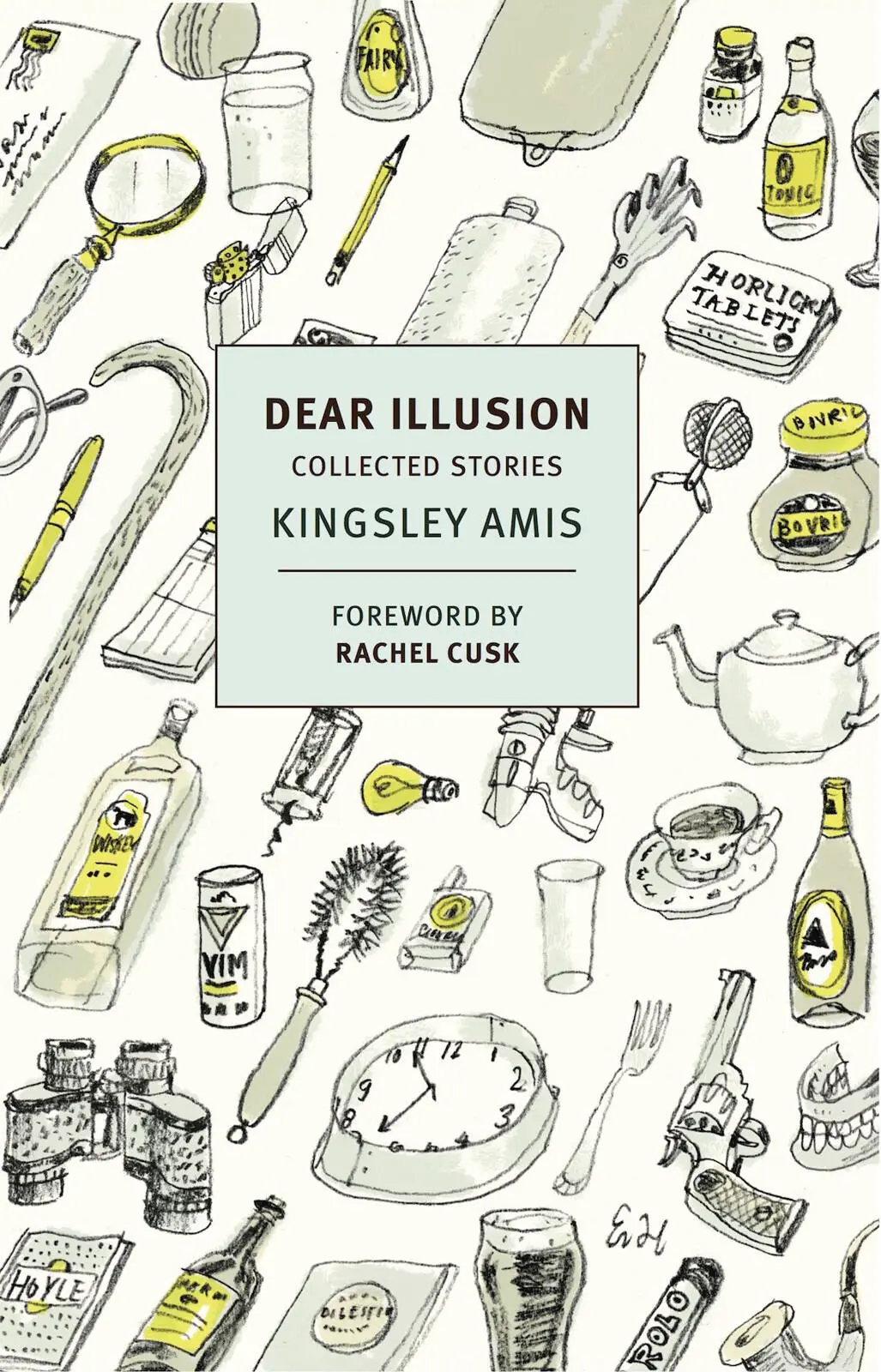
- Название:Dear Illusion: Selected Stories
- Автор:
- Издательство:New York Review of Books
- Жанр:
- Год:2015
- ISBN:нет данных
- Рейтинг книги:4 / 5. Голосов: 1
-
Избранное:Добавить в избранное
- Отзывы:
-
Ваша оценка:
Dear Illusion: Selected Stories: краткое содержание, описание и аннотация
Предлагаем к чтению аннотацию, описание, краткое содержание или предисловие (зависит от того, что написал сам автор книги «Dear Illusion: Selected Stories»). Если вы не нашли необходимую информацию о книге — напишите в комментариях, мы постараемся отыскать её.
Dear Illusion: Selected Stories — читать онлайн бесплатно полную книгу (весь текст) целиком
Ниже представлен текст книги, разбитый по страницам. Система сохранения места последней прочитанной страницы, позволяет с удобством читать онлайн бесплатно книгу «Dear Illusion: Selected Stories», без необходимости каждый раз заново искать на чём Вы остановились. Поставьте закладку, и сможете в любой момент перейти на страницу, на которой закончили чтение.
Интервал:
Закладка:
Jim was shaking hands with the last group of local people under the eye of the clergyman, whose manner now implied that he had been forced into his vestments as part of a practical joke and could see, for the moment, no dignified way of extricating himself. He looked bigger, too.
Alec felt impelled to speak to him: ‘Thank you for your address, Vicar, I thought it was most—’
‘Rector,’ the other said, moving off.
‘Right, let’s get on, Mac,’ Jim said. ‘Who are you going up with?’
There were only two cars to be seen, one with Bob in it, the other full of Giobertis. ‘Oh, don’t worry about me,’ Alec said rather wildly. ‘I can walk. How do I get to the—?’
‘Nonsense, hop in with me and Bob.’
‘No, that’s for the… I wouldn’t want to—’
‘Well then, go with Annette and Frank and the kids. These buses take five easily.’
‘In here, Uncle Mac,’ Annette called, and began making a place for him between herself and her husband. The two Gioberti girls occupied the folding seats: Sonia, a bespectacled blonde child of seven or eight with, so far as could be made out, a perfectly spherical head, and Elizabeth, a somewhat darker fourteen-year-old with a figure which, Alec supposed, many grown women would envy. As they moved off, she asked: ‘Where did you leave the car, Pop?’
Frank answered in his strong cockney accent: ‘Outside that hotel where we’re going to have lunch, the King’s Head or whatever it’s called. Tumbledown-looking joint.’
‘Why couldn’t we have gone up to the cemetery in our car?’
‘Because we’re going up in this one.’
‘Why? Ours is much more comfortable.’
‘I dare say it is, but we’re going up in this one and that’s an end of it, see?’
‘What are we going up to the cemetery for?’ Sonia asked.
‘To see Gran being buried.’
‘It won’t hurt her,’ Sonia stated.
‘Of course it won’t hurt her, she’s dead.’
‘What are we going up to see her being buried for?’
‘Because that’s what we do.’
‘Sonia, take your shoes off there,’ Annette said.
‘And shut up,’ Frank added.
‘How’s Christopher?’ Alec asked. ‘Let’s see, he must be nearly—’
‘He was four in June.’
‘Really? It seems only the other—’
‘Auntie Gina’s looking after him today,’ Elizabeth said with a hint of triumph. ‘Over at Camberwell.’
To forestall another invitation to silence from Frank, Alec looked out of the window. His eyes immediately fell on the little coffee shop with green check curtains where, whenever he came down for the weekend, he and Betty would spend an hour or so on the Saturday morning before strolling along to the King’s Head to meet Jim after his morning of local activities — work for the Ratepayers’ Association or the Golf Club committee — and relaxing over a couple of pink gins in the saloon bar, followed by lunch under the low beamed ceiling of the dining-room. It was at times like that that the Trio had really come into its own again, and for days and weeks afterwards there would be a lifting of the shadow that had fallen over Alec’s life since 1945. With the war over, the Duerdens had decided to stay on in this part of Buckinghamshire, where they had come in 1941 as a temporary measure to avoid the bombing, and not return after all to their house in Clapham. Since he could not reciprocate their hospitality, Alec had had to confine himself to staying with them only half a dozen times a year at the outside, and had seen them hardly more often for a meal or a theatre in London. He supposed he ought to be thankful that the Trio had survived as well as it had, that it had ever been able to recapture the spirit of its heyday, those twelve happiest years of his life between 1929 and 1941 when the Duerdens and he had occupied houses facing the Common, not four hundred yards apart.
Alec’s face was still turned towards the window, but he saw nothing of the neat residential area, its pavements decorated with a staked lime sapling every fifty feet, through which they were now passing. He was thinking of the moment when he had first named the Trio to himself. He and two or three other people (he forgot who) had taken their music round to the Duerdens’ one Sunday evening and, after the coffee and tomato sandwiches, Jim had asked him to have a shot at the accompaniment of a duet they had bought recently. He had sat down at the piano, which had an excellent tone for an upright, and played the thing for them at sight, something of a feat with such bold, dramatic writing, full of shifting trills in both hands. It was ‘Onaway, Awake, Beloved’, a far more interesting setting than that in Coleridge-Taylor’s Hiawatha , which he had always thought — secretly, for Betty delighted in it, and had met the composer once at a wedding in Croydon — a bit of a bore. Out of the corners of his eyes Alec had been able to see both Betty and Jim as they sang, and when, with his support, the two voices swept into he had felt his own blood leaping through him in a strange, painful rhythm, as if he had stumbled on a mysterious secret. And so he had; he had discovered that there could be a relationship between three people for which none of the ordinary words — friendship, love, understanding, intimacy — would quite do. When the song finished there had been enthusiastic applause from the others, even from ten-year-old Charlie, who was staying up late as a special treat, and Alec’s excitement had passed unnoticed.
Does not all the blood within me
Leap to meet thee, leap to meet thee,
As the springs to meet the sunshine,
In the moon when nights are brightest?
The car stopped outside the cemetery. Although Alec had walked along most of the roads in the area many times in the last twenty years, the exterior of this place, and its whole location, were totally unfamiliar to him.
‘Here we are,’ Frank said. ‘Want any help, Uncle Mac?’
‘No thank you.’
He got out and began walking towards the graveside, remembering that, outside his family and their circle, Betty was the only person who had ever called him ‘Alec’, and she only for a brief period, perhaps a year after their first meeting. Then she had slipped into calling him ‘Mac’ as everyone else did, or rather as Jim in particular did. With that fine tact of hers, the finer for being unselfconscious, she had made it clear that there was not to be even the slightest and most nominal acknowledgement of what she felt for Alec, just as he had never by a single word acknowledged what he felt for her. The idea that two people could fall in love instantly and irrevocably and never mention it, let alone do anything about it, would have seemed incomprehensible or lunatic to anybody but themselves, or rather, again, to anybody but themselves and Jim. For Jim had somehow made it clear to Alec that he knew, but without hurt or resentment; he knew, but he understood and forgave, and so made it possible for Alec to go on seeing them without losing his self-respect. It was silently agreed between the three of them that while she loved Jim no less, she loved Alec too with a different — he recoiled from the mental impertinence of wondering if it were a deeper — kind of love. Few women would have been capable of that, but love had been Betty’s gift.
Alec answered an imaginary question about what he had done with his life by saying to himself that he had loved a fine woman and known a true friend. The love came first, as love must. By repeating this slowly he succeeded for a time in shutting out the presence of those standing near him and all but the first phrase of the dreadful words the clergyman was saying. Then Alec started noticing the coffin lying in the grave. It had been lowered by means of green straps that recalled to him, in their colour and texture, the webbing belt Charlie Duerden had worn with his uniform when they lunched at Simpson’s together during one of the boy’s leaves. A handful of earth was thrown on to the coffin. Alec realized that he had been very afraid of the hollow noise this might make, but it was all right, the soil was dry and chalky, without noticeable clods, and when the spades got to work it could, from the sound, have been anything at all being buried. There were the beginnings of movement away from the graveside; Alec sighed and raised his head, and the whole scene shone brightly in his eyes: the people with their varied complexions and hair, the grass, the privet hedges, the vases of red and blue flowers on the graves, the great pair of cypresses by the entrance, all slightly over-coloured like a picture postcard. In the middle of it all Alec saw the clergyman, looked squarely at him for the first time since leaving the church, and saw that the clergyman, as earlier, was looking at him.
Читать дальшеИнтервал:
Закладка:
Похожие книги на «Dear Illusion: Selected Stories»
Представляем Вашему вниманию похожие книги на «Dear Illusion: Selected Stories» списком для выбора. Мы отобрали схожую по названию и смыслу литературу в надежде предоставить читателям больше вариантов отыскать новые, интересные, ещё непрочитанные произведения.











Обсуждение, отзывы о книге «Dear Illusion: Selected Stories» и просто собственные мнения читателей. Оставьте ваши комментарии, напишите, что Вы думаете о произведении, его смысле или главных героях. Укажите что конкретно понравилось, а что нет, и почему Вы так считаете.