Kingsley Amis - Dear Illusion - Selected Stories
Здесь есть возможность читать онлайн «Kingsley Amis - Dear Illusion - Selected Stories» весь текст электронной книги совершенно бесплатно (целиком полную версию без сокращений). В некоторых случаях можно слушать аудио, скачать через торрент в формате fb2 и присутствует краткое содержание. Год выпуска: 2015, Издательство: New York Review of Books, Жанр: Современная проза, на английском языке. Описание произведения, (предисловие) а так же отзывы посетителей доступны на портале библиотеки ЛибКат.
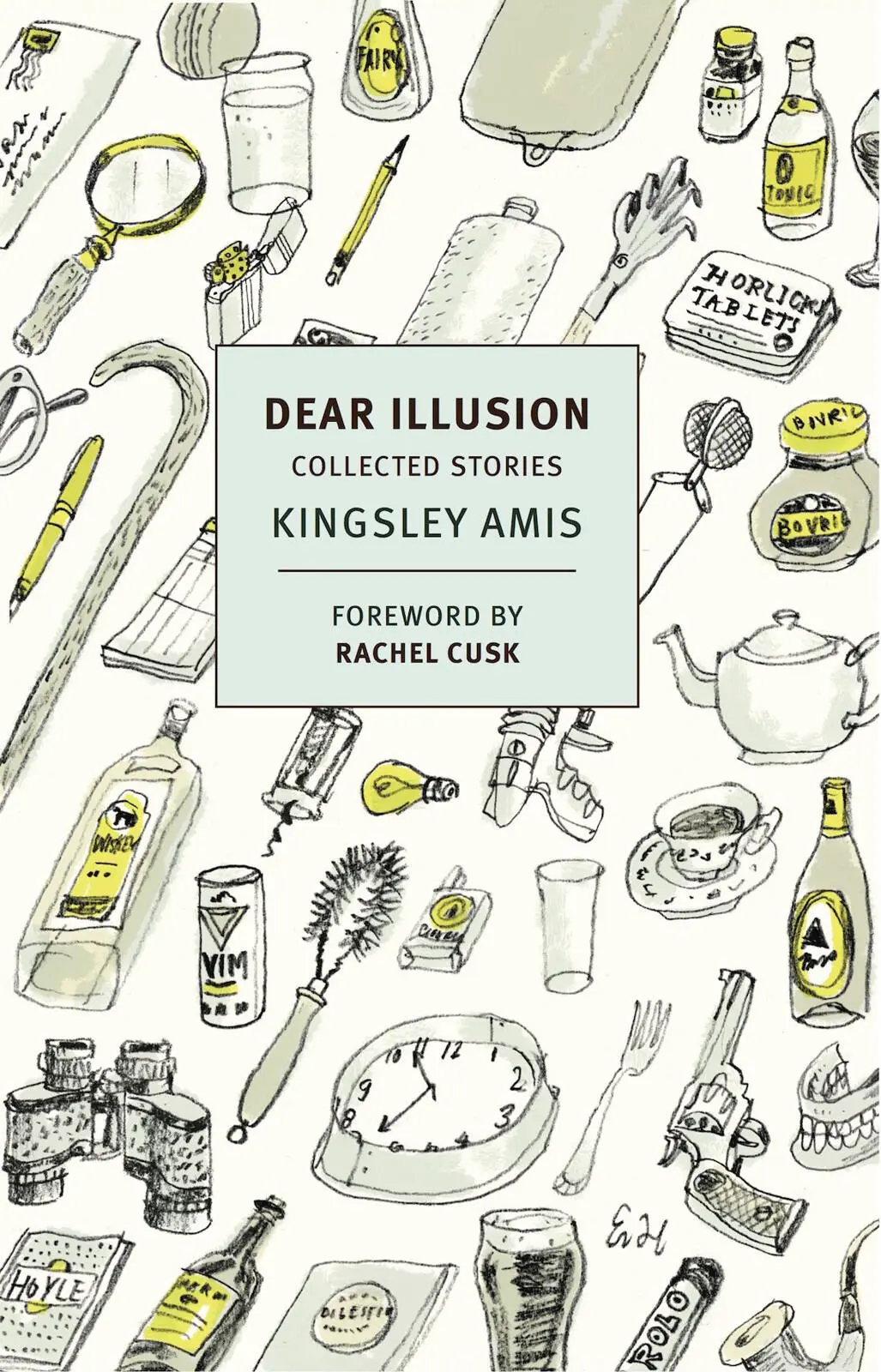
- Название:Dear Illusion: Selected Stories
- Автор:
- Издательство:New York Review of Books
- Жанр:
- Год:2015
- ISBN:нет данных
- Рейтинг книги:4 / 5. Голосов: 1
-
Избранное:Добавить в избранное
- Отзывы:
-
Ваша оценка:
Dear Illusion: Selected Stories: краткое содержание, описание и аннотация
Предлагаем к чтению аннотацию, описание, краткое содержание или предисловие (зависит от того, что написал сам автор книги «Dear Illusion: Selected Stories»). Если вы не нашли необходимую информацию о книге — напишите в комментариях, мы постараемся отыскать её.
Dear Illusion: Selected Stories — читать онлайн бесплатно полную книгу (весь текст) целиком
Ниже представлен текст книги, разбитый по страницам. Система сохранения места последней прочитанной страницы, позволяет с удобством читать онлайн бесплатно книгу «Dear Illusion: Selected Stories», без необходимости каждый раз заново искать на чём Вы остановились. Поставьте закладку, и сможете в любой момент перейти на страницу, на которой закончили чтение.
Интервал:
Закладка:
‘Yes.’
‘Still, there’s no use getting morbid. Actually I should think of the two of us you’ll last longest. You thin little wiry chaps take a devil of a lot of killing, in my experience. You’re a bit younger than me anyway, aren’t you?’
‘I was sixty-four in June.’
‘Not six months in it. We don’t live to much of an age in our family. Harry was the same age as me when he snuffed it, and then poor Dora was barely fifty, and now here’s Betty only sixty-seven; well, I say “only”, that’s not really old as things go nowadays, is it? Still, look at it another way and it’s a lot of years. You must have known her since, what, ’thirty-two or — three?’
‘The… I’m not sure of the date, but it was August Bank Holiday, 1929.’
‘Here, that’s pretty good card-index work, Mac. Well I’m blowed. How on earth do you remember it so exactly?’
‘It was the day of the mixed doubles tournament at that tennis club near Balham we all used to belong to.’ Alec began filling his pipe. ‘I got brought in to run the show at the last minute. Until the Friday I didn’t see how there could be a show, and what with the teas to arrange and one thing and another it’ll be a long time before I forget that day, believe me.’
‘Mm. It, er, turned out all right, did it?’
‘Yes, Betty and Jim got into the semi-finals. Nobody knew if they were any good or not, with them just moving into the district. But then they took the first set 6–1, and everyone could see… well, as soon as Betty had made her first couple of shots, really. Her backhand was very strong, unusual in a woman. I didn’t get a chance against them myself, because…’
As clearly as if he had just seen a photograph of it, Alec recalled one moment of that first day. Jim, his bald head gleaming in the sun, was standing up at the net; Betty had stepped forward from the baseline and, with as much control as power, was sending one of her backhand drives not more than an inch or two above the net and squarely between their two opponents, who formed the only blurred patches in the image. Although the farthest away, Betty’s figure was well defined, the dark hair in a loose bob, the sturdy forearms and calves, the straight nose that gave her face such distinction, even the thinning of the lips in concentration and effort. Some details were wrong — Betty’s pleated white skirt belonged not to that afternoon, Alec knew, but was part of a summer dress she had worn on a day trip to Brighton just before the war, and Jim had not been so bald so early. There was nothing to be done about it, though: while a part of his mind fumbled left-handedly to correct it, the picture stayed as it was. Just as well, perhaps, that it had not been given to human beings to visualize things at will.
Long before Alec was finally silent, Bob was glancing fitfully about, extending and shortening his body and neck like someone trying to see over a barrier that constantly varied in height. He was always having to have things: another round of drinks, the right time, a taxi, the menu, the bill, a word with old so-and-so before they settled down. While he twitched a nose rich in broken capillaries, he said inattentively: ‘Of course, you were pretty attached to her, weren’t you, Mac?’
‘Yes, I was.’
‘And so was she to you, old thing.’ The distance between Bob’s waist and chin grew sharply, as if a taxi-driver or possibly a racing tipster had flung himself down full length behind Alec’s seat. ‘She was always on about you, you know. Talking about you.’
‘Really?’
‘Oh yes. You had a lot of brains, according to her. Looked up to you, so she said. I’d like a miniature of brandy, please,’ he added over Alec’s shoulder. ‘Wait a minute. Better make it two.’
Alec began wondering how to decline the offer of a miniature of brandy. He need not have worried, because when they came Bob put them both carefully away in the pockets of the woven-soup suit. He then tried to pay for Alec’s coffee, but Alec prevented him.
‘Ah, we’re just coming in,’ Bob said: ‘there’s that pickle-factory place. Appalling stink when the wind’s in the right direction, makes you wonder what they put in the blessed stuff. How are you feeling, old chap?’
‘Me? I’m perfectly all right.’ The barrier in Alec’s head had given no sign of breaking down in the last five minutes, which meant it might just possibly stay in position for the next three hours, or however long it was going to be before he could decently leave. If he could hold out until then, the truth about him and Betty would never be known to any outsider, especially Bob. The thought of their secret being turned over by that parvenu mind, frivolous, hard-headed and puritanical in turn, and never the right one at the right time, was unendurable.
Bob had got up and was looking at his watch. ‘Good for you, Mac. Mm, late as per usual. I think we’d better go straight to the church. It might be the best thing in some ways.’
‘Will you sit, please,’ the clergyman directed. He was a bulky man of about fifty-five with white hair carefully combed and set. He had a thick voice, as if his throat were swollen. It went down a tone or two each time he told the congregation to change its posture. His way of doing this even when it was clearly unnecessary, and of giving every such syllable its full value, made up a good substitute for quite a long sentence about the decline of church-going, the consequent uncertainty and uneasiness felt by many people on such occasions as did bring them into the house of God, his own determination that there should be no confusion in his church about what some might think were small points of procedure, and the decline of church-going. Now, after making absolutely certain that everyone had done his bidding, he pronounced the dead woman’s name in the manner of an operator beginning to read back a telegram.
‘Elizabeth… Duerden,’ he said, ‘has brought us together here today by virtue of the fact that she has recently died. I need not tell you that the death of someone we love, or even the death of any human being, is the most serious and important event with which this life can confront us. I want for a short time, if I may, to look into this business of death, to suggest a little of what it is, and of what it is not. I believe that the loss which her… family has suffered is not absolute, that that thing exists which we so frequently name and seek and offer, so rarely define and obtain and give, that there is consolation, if only we know where to look for it. Where, then, are we to look?’
By now the man sounded as if he had been going on for hours and had more hours ahead of him. Some of the thickness, however, had left his voice when he continued: ‘In another age than ours, we should find it natural to look in the first place to the thought that to be separated from the ones we love by the death of the body is not final. We should derive our consolation from knowing that no parting is for ever, that all losses will, in God’s good time, be restored. But that would hardly do today, would it, thinking along those lines? It wouldn’t do much for most of us today.’
Something so close to vigour had entered the speaker’s tone in the last couple of sentences that they were like an interruption, from which he himself took a moment to recover. Then he went on as thickly as ever: ‘But God’s mercy has seen to it that we need not depend for our consolation upon any such belief. We find this out as soon as we can put aside something of our agony and shock and begin to ask ourselves what has happened. What has happened is manifestly that somebody has been taken from us and nothing will ever be the same again. But what has not happened? That person has not been eradicated from our hearts and minds, that person’s life has not been cancelled out like a row of figures in a sum, that person’s identity is not lost, and can never be lost… Elizabeth Duerden lives in those who knew her and loved her. The fact that she lived, and was Elizabeth Duerden and no one else, had a profound effect upon a number of people, a considerable effect upon many more people, a slight but never imperceptible effect upon innumerable people. There is nobody, there never has been anybody, of whom it can be said that the world would have been the same if they had never lived.’
Читать дальшеИнтервал:
Закладка:
Похожие книги на «Dear Illusion: Selected Stories»
Представляем Вашему вниманию похожие книги на «Dear Illusion: Selected Stories» списком для выбора. Мы отобрали схожую по названию и смыслу литературу в надежде предоставить читателям больше вариантов отыскать новые, интересные, ещё непрочитанные произведения.











Обсуждение, отзывы о книге «Dear Illusion: Selected Stories» и просто собственные мнения читателей. Оставьте ваши комментарии, напишите, что Вы думаете о произведении, его смысле или главных героях. Укажите что конкретно понравилось, а что нет, и почему Вы так считаете.