Clarice Lispector - Selected Cronicas
Здесь есть возможность читать онлайн «Clarice Lispector - Selected Cronicas» весь текст электронной книги совершенно бесплатно (целиком полную версию без сокращений). В некоторых случаях можно слушать аудио, скачать через торрент в формате fb2 и присутствует краткое содержание. Год выпуска: 1996, Издательство: New Directions, Жанр: Современная проза, на английском языке. Описание произведения, (предисловие) а так же отзывы посетителей доступны на портале библиотеки ЛибКат.
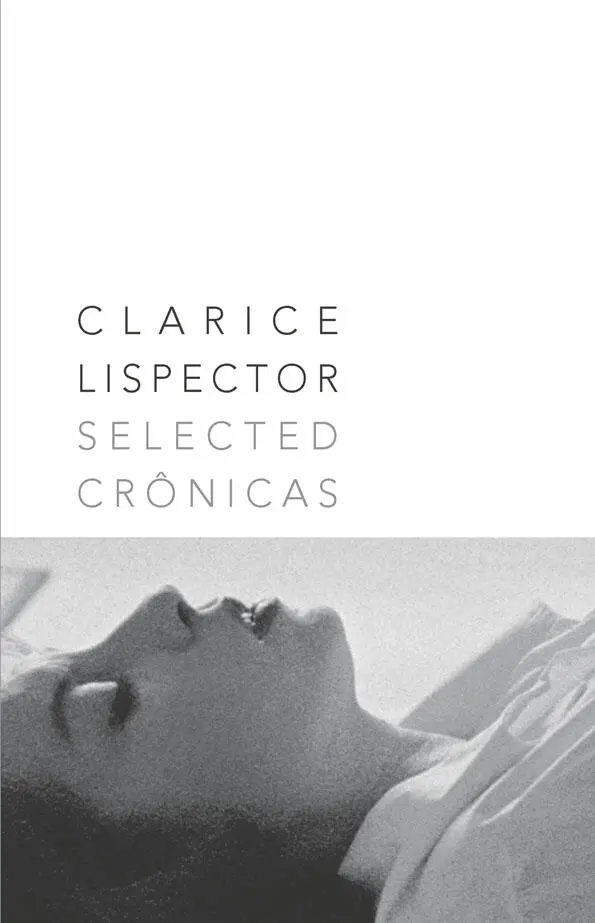
- Название:Selected Cronicas
- Автор:
- Издательство:New Directions
- Жанр:
- Год:1996
- ISBN:нет данных
- Рейтинг книги:4 / 5. Голосов: 1
-
Избранное:Добавить в избранное
- Отзывы:
-
Ваша оценка:
Selected Cronicas: краткое содержание, описание и аннотация
Предлагаем к чтению аннотацию, описание, краткое содержание или предисловие (зависит от того, что написал сам автор книги «Selected Cronicas»). Если вы не нашли необходимую информацию о книге — напишите в комментариях, мы постараемся отыскать её.
, is just as immediately stimulating today and ably reinforces her reputation as one of Brazil's greatest writers. Indeed, these columns should establish her as being among the era's most brilliant essayists. She is masterful, even reminiscent of Montaigne, in her ability to spin the mundane events of life into moments of clarity that reveal greater truths." —
Selected Cronicas — читать онлайн бесплатно полную книгу (весь текст) целиком
Ниже представлен текст книги, разбитый по страницам. Система сохранения места последней прочитанной страницы, позволяет с удобством читать онлайн бесплатно книгу «Selected Cronicas», без необходимости каждый раз заново искать на чём Вы остановились. Поставьте закладку, и сможете в любой момент перейти на страницу, на которой закончили чтение.
Интервал:
Закладка:
In a treatise on the subject, an expert on melancholia would claim to have passed off many an alley cat as sucking-pig. An expert in irascibility would say something unprintable.
I feel really ashamed when I refuse sucking-pig because I suspect it might be cat. (There is a proverb which says: Better to be cheated by a friend than to mistrust him.) This is the price of mistrust.
But truly, when I mistake a cat for a sucking-pig, the one who comes off worst is the person who offered it to me. The only mistake on my part was to have been gullible.
I am enjoying writing this. A number of sucking-pigs have been miaowing on the nearby roof-tops and now I have had my chance to miaow back. For cats, too, can be rabid.
WHAT IS ANGUISH?
A teenager asked me this difficult question. Much depends on the person suffering from anguish. Some people use this word freely, as if anguish somehow improved their status: that in itself is yet another form of anguish.
Anguish can also be having no hope in hope. Or conforming without resignation. Or refusing to confess even to oneself. Or never being oneself, should one ever know oneself. Anguish can be the misery of being alive. It can also be not having the courage to suffer anguish — and escape is yet another form of anguish. But anguish is part of life: all that lives, simply by being alive tends to recoil.
This same teenager asked me: Don’t you find there is a frightening emptiness in everything? Yes, there is. Meanwhile one waits for the heart to understand.
THE OBEDIENT (I)
What follows is straightforward, something to be related and forgotten.
But I have been imprudent enough to pause for a moment longer than I should have done and now find myself compromised. From the moment that I, too, put myself at risk — for I have identified myself with the couple I am about to speak of — from that moment it is no longer simply a fact to be related and for this reason words begin to fail me. By now I feel at quite a loss. The fact ceases to be a simple fact and its widening repercussions have become much more important.
Those repercussions have been delayed and suppressed far too long and it was almost inevitable they should eventually explode.
And now they have finally exploded on this Sunday afternoon, when there has been no rain for weeks and the dessicated beauty of flowers and fruits persists, arid and shining and empty. In the presence of this disquieting beauty I become solemn, as if standing before a tomb. But what has happened to the initial fact? It has merged with this aggressive Sunday. Unable to cope with this afternoon, I hesitate before also becoming aggressive or retreating slightly wounded. The initial fact is suspended in the sun-drenched dust of this scorching Sunday filled with solitude. Until, finally summoned to the telephone, I go rushing off gratefully to lick the hand of this person who loves me and frees me.
Chronologically, the situation was as follows: a man and a woman had been married for twenty-five years without any children.
The moment I discovered this I was intrigued. I was obliged to think, however irksome. And even if I were to say nothing more and end the story with this discovery, I should have already compromised myself with my most impenetrable thoughts. As if I had seen a pen-drawing against a white background, a man and a woman tied to each other. And my eyes are glued to this white background and find much to observe there, for every word has its shadow.
This man and this woman, who were extremely taciturn and had a mute, impassive expression, began — perhaps driven by that urge even experienced by people who look as if they are half-dead — began trying to live with greater intensity. In search of what? That destiny which precedes us? And to which we are fatally driven? But what destiny?
This attempt to live with greater intensity led them to weigh up what was or was not important. They did this in their own way: with a lack of know-how and experience and modesty. They were feeling their way about. Now that they had discovered this vice much too late in life, they tried independently to distinguish between the essential and the non-essential, not that they would ever have used the word essential, nor did they try to understand what was happening to them because such things had no meaning in their social milieu. It was as if they wanted to discover what was essential in order to live their lives accordingly. But nothing came of the vague, almost self-conscious effort they were making: the very plot of life forever escaped them. And it was only by summing up the day’s events that they could get any feeling of having lived, of somehow having lived despite themselves. But by then it was already night and they were putting on their slippers.
None of this really created a situation for the couple. That is to say, something that each of them might recount to themselves as they turned their backs on each other in bed, their eyes momentarily open and almost startled before they finally fell asleep. People so badly need to be able to tell themselves their own story. But they had nothing to tell. With a sigh of false comfort, they closed their eyes and fell into a troubled sleep. And when they weighed up their lives, they could not even include this attempt to live with greater intensity, or discount it as when dealing with one’s income tax. A weighing-up which they gradually began to engage in more and more frequently, without even the technical equipment of a terminology to match their thoughts. If this represented a situation, it was not exactly a situation with which one could ostensibly live.
But it did not simply happen like this. They were able to keep calm because ‘not to lead’, ‘not to invent’, ‘not to err’, was for them really much more than just a habit, it was a question of honour to which they were tacitly pledged. It would never have occurred to them to break that pledge. And offend God. Offend society? What society? Which God did they serve?
Their proud conviction stemmed from a noble awareness that they were two individual human beings amongst thousands like themselves. ‘To be an equal’ was the role they had been given, the task with which they had been entrusted. Both of them had been singled out for their respect for obedience and they solemnly responded with civic gratitude to the confidence that their equals had placed in them. They belonged to a caste. The role they fulfilled with pride and decorum was that of anonymous persons, of children of God, of members of a community.
Yet, perhaps because of the relentless passage of time, all this had started to become dull, dull, dull. Sometimes claustrophobic. (The man as well as the woman had already reached the critical age.) They would open the windows and comment that it was extremely hot. Without exactly living a life of boredom, it was as if no one ever sent them any news. Besides, boredom was part of this obedience to a life of honest sentiments.
THE OBEDIENT (II)
But since all of this was beyond their understanding, and they found so many things above their heads which, even if expressed in words, they would have failed to understand, all this began to look like irremediable life. A life to which they submitted in silence and with that somewhat wounded expression which is common amongst men of good will. It resembled that irremediable life for which God destined us. Or did He? Doubts began to creep in.
Life irremediable, but not concrete. In fact, it was an unattainable life of dreams. Sometimes, when they were speaking about someone who was eccentric, they would say, with the condescension one class shows towards another: ‘Ah, he takes life seriously, he leads the life of a poet.’ One could say, judging from the few words I heard the couple say, that they both led, leaving aside any extravagance, the life of a second-rate poet: a life which consisted only of dreams.
Читать дальшеИнтервал:
Закладка:
Похожие книги на «Selected Cronicas»
Представляем Вашему вниманию похожие книги на «Selected Cronicas» списком для выбора. Мы отобрали схожую по названию и смыслу литературу в надежде предоставить читателям больше вариантов отыскать новые, интересные, ещё непрочитанные произведения.





Обсуждение, отзывы о книге «Selected Cronicas» и просто собственные мнения читателей. Оставьте ваши комментарии, напишите, что Вы думаете о произведении, его смысле или главных героях. Укажите что конкретно понравилось, а что нет, и почему Вы так считаете.