Kenzaburo Oe - Death by Water
Здесь есть возможность читать онлайн «Kenzaburo Oe - Death by Water» весь текст электронной книги совершенно бесплатно (целиком полную версию без сокращений). В некоторых случаях можно слушать аудио, скачать через торрент в формате fb2 и присутствует краткое содержание. Год выпуска: 2015, ISBN: 2015, Издательство: Grove/Atlantic, Inc., Жанр: Современная проза, на английском языке. Описание произведения, (предисловие) а так же отзывы посетителей доступны на портале библиотеки ЛибКат.
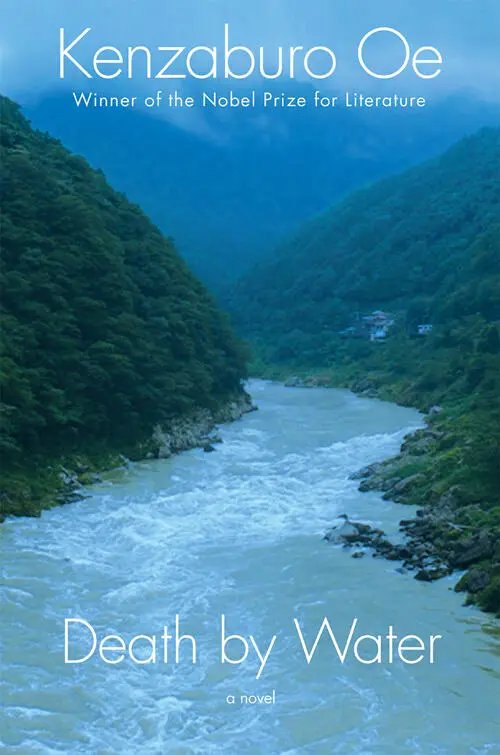
- Название:Death by Water
- Автор:
- Издательство:Grove/Atlantic, Inc.
- Жанр:
- Год:2015
- ISBN:9780802190871
- Рейтинг книги:3 / 5. Голосов: 1
-
Избранное:Добавить в избранное
- Отзывы:
-
Ваша оценка:
Death by Water: краткое содержание, описание и аннотация
Предлагаем к чтению аннотацию, описание, краткое содержание или предисловие (зависит от того, что написал сам автор книги «Death by Water»). Если вы не нашли необходимую информацию о книге — напишите в комментариях, мы постараемся отыскать её.
, his recurring protagonist and literary alter-ego returns to his hometown village in search of a red suitcase fabled to hold documents revealing the details of his father’s death during WWII: details that will serve as the foundation for his new, and final, novel.
Since his youth, renowned novelist Kogito Choko planned to fictionalize his father’s fatal drowning in order to fully process the loss. Stricken with guilt and regret over his failure to rescue his father, Choko has long been driven to discover why his father was boating on the river in a torrential storm. Though he remembers overhearing his father and a group of soldiers discussing an insurgent scheme to stage a suicide attack on Emperor Mikado, Choko cannot separate his memories from imagination and his family is hesitant to reveal the entire story. When the contents of the trunk turn out to offer little clarity, Choko abandons the novel in creative despair. Floundering as an artist, he’s haunted by fear that he may never write his tour de force. But when he collaborates with an avant-garde theater troupe dramatizing his early novels, Kogito is revitalized by revisiting his formative work and he finds the will to continue investigating his father’s demise.
Diving into the turbulent depths of legacy and mortality,
is an exquisite examination of resurfacing national and personal trauma, and the ways that storytelling can mend political, social, and familial rifts.
Death by Water — читать онлайн бесплатно полную книгу (весь текст) целиком
Ниже представлен текст книги, разбитый по страницам. Система сохранения места последней прочитанной страницы, позволяет с удобством читать онлайн бесплатно книгу «Death by Water», без необходимости каждый раз заново искать на чём Вы остановились. Поставьте закладку, и сможете в любой момент перейти на страницу, на которой закончили чтение.
Интервал:
Закладка:
The next morning I was awakened by the ringing of the telephone. When I ran downstairs to answer it (Akari was evidently still asleep), an unmistakably familiar voice on the other end said, “Hello, this is Daio.” Despite Asa’s warning, I was startled. Daio must have picked up on my reaction, because he immediately launched into an apologetic explanation about the circumstances surrounding his spurious “death.”
When the training camp was breaking up, he told me, his mischievous disciples apparently decided that it would be amusing to play an elaborate prank on Kogito Choko, and the resulting jape was somehow connected with a “pre-death wake” they had staged in Daio’s honor before the members of the group went their separate ways.
“I’m already in the neighborhood, down by the river,” Daio went on. “I’ll wander around here for half an hour or so before heading to the Forest House. I’ve been there once before, when Asa invited me to a meeting of the drama group, so I know the way. She gave me a key as well.” “Thank you for calling,” I said. “If you had just appeared at the door with no advance notice, I might have thought I was seeing a ghost. On the other hand, my list of friends and acquaintances includes more and more dead people these days, so it might have seemed perfectly natural …”
“Asa said I should drop by as soon as possible after you arrived,” Daio said. “By the way, I gather you went through quite an ordeal with the turtle my disciples sent you as a joke. For quite some time now, reading has been my only pleasure; I read all your books as soon as they come out, so I know you wrote about that epic struggle in The Changeling. Speaking of turtles, there’s a much easier way to kill them, you know. You just put the creature on the cutting board, belly up, and when it sticks out its neck and starts thrashing around, trying to turn over, bam! You chop off its head, easy as pie. But hey — I guess even an erudite person like you has a few gaps in his knowledge!”
Half an hour later I came downstairs again and found Daio waiting in the great room. On the south side of the spacious room, between some professional lighting equipment and a pair of giant speakers, there were an oblong table and two chairs.
Daio was perched on one of those chairs, and I noticed that my opened trunk had been neatly placed on the floor of the makeshift stage in front of the large plate-glass window overlooking the back garden. I left the luggage strewn around the room when I went to bed, and Daio had apparently tidied it up without being asked. The sofa had been cleared off, too, evidently for Akari and me to use when we came downstairs. I couldn’t help thinking, This must be how it feels to have a butler, or a valet : a luxurious perk I had only read about in British novels.
Daio got up from his chair and gestured for me to take a seat on the couch. Then he shot a glance toward the stairs, clearly hoping to see Akari on his way down. I recalled that in the seemingly solemn letter his prankish training-camp disciples sent me they had used the term “one-legged and one-eyed” (which is often employed, both in period fiction and anime, to describe swordsmen with mythical powers) in reference to their leader. Just as I remembered, Daio was missing an arm, and one of his sleeves was neatly pinned up in the usual way.
“Hello, Kogito. It’s been a while,” he said, openly giving me the once-over. “I can’t help thinking that if your father had lived to enjoy his old age, he would have looked a lot like you do now — aside from your bad posture, of course. Your father always thought you would grow up to be an interesting chap, and you seem to have turned out just as he hoped.”
“Actually, I think the term he used was ‘joker,’ rather than ‘interesting chap,” I said lightly.
“No, but seriously, you really are an interesting guy,” Daio insisted. “And that isn’t the same as being a joker, or a jester, or whatever. As a child you were always searching for obscure characters in your father’s dictionary — you were kind of like an insect collector, only with kanji. I remember one time when your father was happily expounding on the meaning of some word or other and you interrupted, saying, ‘That’s not what it says in the dictionary!’ Then you added, a bit more kindly, that the print was extremely tiny and it was a rather complicated character, so your father had probably just misread it. And when he fished out his magnifying glass and examined the word in question, sure enough: you were right.”
It was actually a rather proud memory for me. At the time my father was only fifty years old, but because of a combination of wartime privations and the remoteness of our mountain village he was malnourished, and he probably had the eyesight of a much older man. As a result he would occasionally misread something, especially when the print was very small. I was obsessed with finding unusual kanji, so I used to spend hours poring over the index of my father’s big dictionary. That’s why I was able to suss out his mistakes on more than one occasion. I even made a point of memorizing potentially problematic characters, and whenever I came across one that I thought my father might be likely to misread at some point, I would be filled with youthful excitement.
Perhaps the most memorable example involved Shinobu Origuchi’s explanatory comments regarding his most famous novel, The Book of the Dead. Those remarks took the form of an essay titled “The Motif of the Mountain-Crossing Buddha,” which was published several years later. The passage in question was a description of how, in olden days, pilgrims used to flock to Shitennoji (the Temple of the Four Heavenly Kings) to watch the sun set over the western gate — a view popularly considered to be a preview of the heavenly paradise known as the Pure Land. Some of the most fervent believers would actually seek to take a shortcut to the Pure Land by drowning themselves in the Inland Sea or whatever body of water happened to be nearby.
When my father read this passage, he mistook 淼淼(a duplicated-kanji compound meaning “an endless expanse of water,” entirely composed of 水, the character for water) for a similar-looking compound: 森森, which consists of repetitions of 木, the character for “tree,” and is used to describe tall trees growing densely in a forest.
One day while my father was hard at work at our family business, inspecting the bundles of dried, bleached-out paperbush bark for any untidy scraps that might have adhered to them (he did this by turning the large bundles with a specially designed cargo hook), he started talking to my mother about the Origuchi book he had been reading. She was sitting next to him, busy with her own tasks.
“‘A dense forest of ocean waves’ is a rather intriguing turn of phrase,” he remarked. “Around here they say when someone passes away, that person’s spirit rises through the air and returns to the forest, isn’t that right? To the people who descend into the depths of the forest from the heights of the sky, the leaves of the trees might appear to resemble waves in the sea. So there really could be a thick forest of waves, figuratively speaking.”
My father was referring to the local belief that when people from our area die their souls return to the upper tier of the forest above the valley. In our family, the belief was fostered not by my father (who originally came from another part of the country) but by my grandmother and my mother, both of whom used to volunteer at the local shrine. My father tended to be quite taciturn and it was unusual for him to start a conversation in such a way, so it must have made my mother very happy.
I happened to be standing nearby, and their exchange made me prick up my ears. Because of my obsessive penchant for perusing the index of the kanji dictionary I was familiar with both of the characters in question, and when I ran to check the Origuchi book my hunch that my father had misread the compound was confirmed.
Читать дальшеИнтервал:
Закладка:
Похожие книги на «Death by Water»
Представляем Вашему вниманию похожие книги на «Death by Water» списком для выбора. Мы отобрали схожую по названию и смыслу литературу в надежде предоставить читателям больше вариантов отыскать новые, интересные, ещё непрочитанные произведения.




Обсуждение, отзывы о книге «Death by Water» и просто собственные мнения читателей. Оставьте ваши комментарии, напишите, что Вы думаете о произведении, его смысле или главных героях. Укажите что конкретно понравилось, а что нет, и почему Вы так считаете.