Bill Morris - Motor City Burning
Здесь есть возможность читать онлайн «Bill Morris - Motor City Burning» весь текст электронной книги совершенно бесплатно (целиком полную версию без сокращений). В некоторых случаях можно слушать аудио, скачать через торрент в формате fb2 и присутствует краткое содержание. Год выпуска: 2014, Издательство: Pegasus, Жанр: Современная проза, на английском языке. Описание произведения, (предисловие) а так же отзывы посетителей доступны на портале библиотеки ЛибКат.
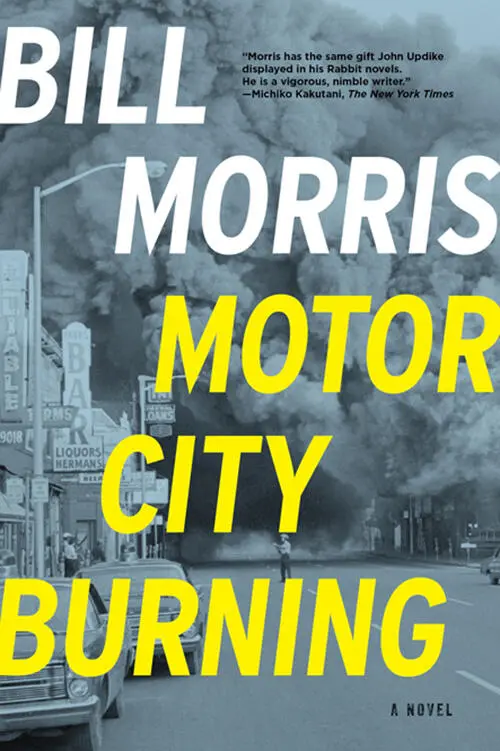
- Название:Motor City Burning
- Автор:
- Издательство:Pegasus
- Жанр:
- Год:2014
- ISBN:нет данных
- Рейтинг книги:3 / 5. Голосов: 1
-
Избранное:Добавить в избранное
- Отзывы:
-
Ваша оценка:
Motor City Burning: краткое содержание, описание и аннотация
Предлагаем к чтению аннотацию, описание, краткое содержание или предисловие (зависит от того, что написал сам автор книги «Motor City Burning»). Если вы не нашли необходимую информацию о книге — напишите в комментариях, мы постараемся отыскать её.
The surprise return of his Vietnam veteran brother in the spring of 1967 gives Willie a chance to drive a load of smuggled guns to the Motor City — and make enough money to jump-start his stalled dream of writing his movement memoir. There, at Tiger Stadium on Opening Day of the 1968 baseball season — postponed two days in deference to the funeral of Martin Luther King, Jr. — Willie learns some terrifying news: the Detroit police are still investigating the last unsolved murder from the bloody, apocalyptic riot of the previous summer, and a white cop named Frank Doyle will not rest until the case is solved. And Willie is his prime suspect.
Motor City Burning — читать онлайн бесплатно полную книгу (весь текст) целиком
Ниже представлен текст книги, разбитый по страницам. Система сохранения места последней прочитанной страницы, позволяет с удобством читать онлайн бесплатно книгу «Motor City Burning», без необходимости каждый раз заново искать на чём Вы остановились. Поставьте закладку, и сможете в любой момент перейти на страницу, на которой закончили чтение.
Интервал:
Закладка:
“You think your momma’s right about that, about passin on lessons?”
“Yeah, I do.”
“Sounds like you two pretty close.”
“A lot closer’n me and my father. My mother’s so damn smart — but she’s not one of those educated Negroes who makes a-gain rhyme with rain, if you know what I mean.”
She giggled, a blaze of teeth. “I know zactly what you mean. My daddy, he use to sell insurance, he says a-gain. And instead of e- leet he says ee -lite. So you writin down what you been through?”
He took a deep breath. “I started to write it down, but. . ”
Gently, almost whispering, she said, “But what? You can tell me.”
“I’m not all the way sure. I couldn’t seem to get it together in Alabama, so I came up here thinking the change of scenery would help. But it didn’t. Then the riot happened and everything changed.”
“The riot didn’t change nothin you ax me.”
“Oh yes it did. It changed plenty.”
“Like what? Name one thing.”
He looked away. This was as far as he was willing — as far as he dared — to go. Octavia patted his hand. “Thas okay, baby.” He could tell he’d disappointed her, and he desperately wanted to repair the damage. But before he could think of anything to say, she stood up. “Don’t go nowhere. I need to freshen up real quick. Be right back.”
Like everyone in the place he watched her walk to the back of the room, her high heels clicking like castanets on the tile floor. Her blue dress was packed just right, and the way she moved announced that she knew that every eye in the place was all over her and she didn’t mind one bit.
Y’all were some bus-ridin fools, weren’t you?
Her words made him realize something that was so obvious he’d never stopped to consider it before — just how big a part buses had played in his journey. Buses could be the thread that tied his book together. The Montgomery bus boycott was the dawn of his realization that there was a momentous struggle taking shape just beyond the fringes of his tiny world. Then there was that bus ride to Nashville to help with the sit-ins. Then the bus ride to Raleigh, North Carolina, for the first meeting of Snick. The Freedom Rides. The burning bus outside Anniston. That grim bus ride back from the 1964 Democratic convention in Atlantic City. And he was still riding the bus because he was afraid to let his Buick be seen on the streets of Detroit. I’ll probably ride a bus to my own funeral, he thought with a mirthless chuckle.
“What’s so funny, Alabama?”
Clyde had glided up with a pool stick in one hand and an empty beer glass in the other. He motioned for the bartender to give them both a refill.
“Nothing, Clyde. Just thinking bout something Octavia said.”
“You quicker’n I thought, homes. She just whispered on my ear you the most interestin cat she met in a blue moon.”
“She didn’t say that.”
“She sho nuff did. What kinda lies you been tellin her?”
“Oh, just some of the stuff we did down South.”
“Well keep it up. It’s workin.” He took his beer and went back to the pool table.
Watching the bubbles rise in his beer glass, Willie saw the ending of his book. It was perfect — that grim Greyhound bus ride from Atlantic City back to Montgomery after the 1964 Democratic convention. They’d registered 17,000 black voters in Mississippi that summer, and the Mississippi Freedom Democratic Party sent sixty-eight delegates to Atlantic City, determined to have them seated in place of the regular party’s all-white state delegation. But Lyndon Johnson, that great friend of the Negro, offered the Freedom Party two measly seats for fear of alienating his fellow white Southerners and losing the White House. After Johnson’s brutal arm-twisting carried the day, Willie rode home in that tomb-like bus realizing he was finished. They had jumped through all of Mr. Charlie’s hoops and they came away with two delegates. It had taken Willie four years of playing by the rules to realize the game was rigged, always had been, always would be. In Montgomery he bought a ticket to Tuskegee, and when he got home he closed his door and sat down to write his story. For a while it worked, and then it didn’t. And so he came to Detroit.
“You ready?”
Octavia had touched up her lipstick. When she smiled, the lips disappeared and those buck teeth reappeared. She motioned toward the exit. “Come on, let’s go.”
“Where we going?”
“For a drive. I love Sunday drives.”
He left his untouched beer on the bar and said goodbye to Louis and Clyde and found himself following her out of the Seven Seas, every leering, jealous eyeball nailed to them, everyone wondering how a yokel like that managed to snag such a sweet piece of tail. Willie could practically hear the men groaning and the women sighing with relief.
The sun was low in the sky but painfully bright after the bar’s dim interior. Squinting, Willie watched Octavia sashay toward the cars parked at the curb. Passing drivers slowed to get a look. One honked his horn.
Her car was an immaculate white Austin-Healey convertible with wire wheels, its top rolled back. The dashboard was made of burnished wood. When he hurried to open the driver’s door, she blinked at him. “Why, thank you, Willie. Ain’t you the gentleman.”
Her surprise surprised him. Didn’t other men treat her like a lady? He watched her swing her legs deftly under the wooden steering wheel, watched her shimmy her hips till she was settled into the snug bucket seat. When she kicked off her shoes so she could work the pedals, Willie flashed on that car ride with barefoot Blythe Murphy.
“Where to?” she said, blipping the engine as he slipped into the passenger seat. It felt like his ass was three inches from the pavement, yet he could stretch his long legs straight out. Amazing how much room there was in such a tiny car.
“It’s your town,” he said.
She headed out Woodward, weaving between cars, even taking on some of the gear heads who pulled alongside them at red lights, revving the engines of their muscle cars, challenging her to drag race. She beat them all. It was obvious she loved the attention.
She turned left on McNichols, 6 Mile. They passed near Uncle Bob’s new house, passed the University of Detroit. Willie found himself succumbing to her laughter and the engine’s purr, to the way the world whipped past faster and faster as they sliced through the hot afternoon. Soon they crossed the Lodge Freeway and the Rouge River and were leaving the city, entering Redford Township and Livonia, leafy suburbs Willie had never heard of. Amazing. You blinked your eyes and Detroit became a gritty memory.
When they were free of the city Octavia reached across and popped open the glove box, revealing an eight-track player. She pushed in the tape that was in the slot. Otis Redding was singing again: You got to, you got to, try a little tendernesssssss. .
They rode almost all the way to Ann Arbor, not saying much, listening to Otis, then Smokey and the Miracles, Al Green, Curtis Mayfield, Aretha. Willie felt no need for talk. He was content to be in motion, going nowhere just for the sake of going, and going there with her.
When the sun touched the treetops Octavia down-shifted and turned onto the Ann Arbor Trail, which ran along a chain of lakes and ponds and carried them away from the sunset, back toward the city. As soon as they passed the Detroit City Limits sign, Octavia lit a cigarette and dragged on it fiercely. She said, “I don’t know how much Clyde’s tole you bout me.”
“Not much. He said you were a client of his.”
“Yeah, he helped me out of a jam a couple years back.”
He waited, hoping to hear more about Clyde and the jam. When she didn’t offer anything, he said, “So what’s it like working at Motown?”
Читать дальшеИнтервал:
Закладка:
Похожие книги на «Motor City Burning»
Представляем Вашему вниманию похожие книги на «Motor City Burning» списком для выбора. Мы отобрали схожую по названию и смыслу литературу в надежде предоставить читателям больше вариантов отыскать новые, интересные, ещё непрочитанные произведения.






Обсуждение, отзывы о книге «Motor City Burning» и просто собственные мнения читателей. Оставьте ваши комментарии, напишите, что Вы думаете о произведении, его смысле или главных героях. Укажите что конкретно понравилось, а что нет, и почему Вы так считаете.