Bill Morris - Motor City Burning
Здесь есть возможность читать онлайн «Bill Morris - Motor City Burning» весь текст электронной книги совершенно бесплатно (целиком полную версию без сокращений). В некоторых случаях можно слушать аудио, скачать через торрент в формате fb2 и присутствует краткое содержание. Год выпуска: 2014, Издательство: Pegasus, Жанр: Современная проза, на английском языке. Описание произведения, (предисловие) а так же отзывы посетителей доступны на портале библиотеки ЛибКат.
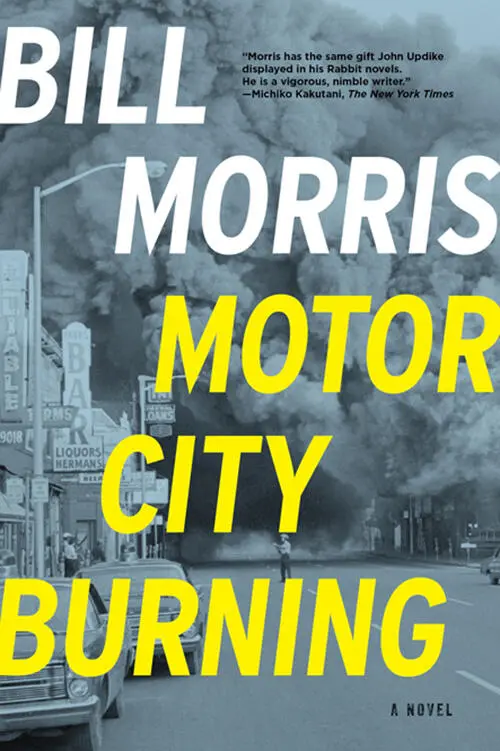
- Название:Motor City Burning
- Автор:
- Издательство:Pegasus
- Жанр:
- Год:2014
- ISBN:нет данных
- Рейтинг книги:3 / 5. Голосов: 1
-
Избранное:Добавить в избранное
- Отзывы:
-
Ваша оценка:
Motor City Burning: краткое содержание, описание и аннотация
Предлагаем к чтению аннотацию, описание, краткое содержание или предисловие (зависит от того, что написал сам автор книги «Motor City Burning»). Если вы не нашли необходимую информацию о книге — напишите в комментариях, мы постараемся отыскать её.
The surprise return of his Vietnam veteran brother in the spring of 1967 gives Willie a chance to drive a load of smuggled guns to the Motor City — and make enough money to jump-start his stalled dream of writing his movement memoir. There, at Tiger Stadium on Opening Day of the 1968 baseball season — postponed two days in deference to the funeral of Martin Luther King, Jr. — Willie learns some terrifying news: the Detroit police are still investigating the last unsolved murder from the bloody, apocalyptic riot of the previous summer, and a white cop named Frank Doyle will not rest until the case is solved. And Willie is his prime suspect.
Motor City Burning — читать онлайн бесплатно полную книгу (весь текст) целиком
Ниже представлен текст книги, разбитый по страницам. Система сохранения места последней прочитанной страницы, позволяет с удобством читать онлайн бесплатно книгу «Motor City Burning», без необходимости каждый раз заново искать на чём Вы остановились. Поставьте закладку, и сможете в любой момент перейти на страницу, на которой закончили чтение.
Интервал:
Закладка:
Doyle said, “Notice how everyone on these walls is looking down, everyone except the overseers and the foremen? That’s the one thing Rivera got right. My father wound up just like that, could barely lift his head enough to look you in the eye. The older he got, the more he shrank. I think he would’ve disappeared completely if he’d lived much longer.”
“You come here a lot?”
“Every chance I get.”
“I don’t understand. If you hate these frescoes so much, if they make you so angry, why do you keep coming back? You some kind of masochist?”
“No, I come here for two reasons. Because I do think the frescoes are beautiful, and because I never want to forget what the Henry Fords of this world do to men like my father, the way they get rich by grinding human beings into dust. The prettiest art in the world can’t hide that fact.”
“I’m no head shrinker, but it sounds to me like you’re as mad at Rivera as you are at Henry Ford.”
He chuckled. “I never thought of it that way, but I guess I do blame Rivera. Henry was just doing what industrialists do — the same way fish swim and birds fly. I’m inclined to give the devil his due. The man was an anti-Semite and a crank, but he was also a genius and at least he was pure about being evil. But Rivera — what a fraud.”
“Did you know he was all gung-ho for the Mexican revolution — but he was nowhere near Mexico while it was happening. He was in Paris.”
“I didn’t know that, but I’m not surprised.”
“Know how much he got paid for this job?”
“Five grand?”
“Try twenty. A small fortune in 1932.”
“Where’d the money come from?”
“Edsel Ford’s bottomless pockets.” She pointed at a little man in a suit and tie in the bottom right corner of the large mural on the south wall. “That’s Edsel, Henry’s son. When the murals were unveiled to the public in ’33, a lot of people in Detroit thought they should be white-washed — they thought the nudes were pornographic and the vaccination panels were sacrilegious. But old Edsel stood his ground, and the murals survived. And look at that small panel just below Edsel. It shows Rouge workers getting paid from the company’s armored truck and crossing the Miller Road overpass to the employee parking lots. That’s the famous overpass where Walter Reuther and his union organizers wound up getting stomped by Harry Bennett’s goons in ’38.”
“The Battle of the Overpass. My father was working there when it happened. He said the union guys had it coming. He actually bought the company line that the organizers were a bunch of Jews and Commies. He thought Harry Bennett was a great man, and of course he thought old Henry walked on water.”
“Who turned you on to this place?”
“My mother brought my brother and me here every chance she got. She loved it all — the medieval armor, the Morris Louis paintings, these frescoes.”
“Was your mother an artist?”
“No, she was a housewife with a high school education who loved to cook and loved beautiful things. But she wasn’t a snob. Much as she loved Rivera, she worshiped Frank Sinatra. Her favorite thing in the world was cooking while listening to Old Blue Eyes. Her name was Dolores — her maiden name was Carbucci — and when Sinatra would sing I was made to serenade Dolores, serenade her chorus after chorus , my mother would squeal, ‘Listen, Frankie, he’s singing about me!’” Doyle smiled at the memory. “You want to hear a little secret?”
“Absolutely.”
“You may not believe this, but my mother actually named me after Sinatra. My full name’s Francis Albert, same as his.”
“Did your father come here a lot too?”
“Yeah, he used to spend hours in here on Saturday afternoons, just staring at these walls. He said the frescoes made him feel like what he did during the week was worthwhile, gave his work dignity. The poor deluded bastard. He actually bought the bill of goods Ford and Rivera were selling.”
“Well, at least these frescoes made his life more bearable. That’s something.” Like father, like son, she was thinking.
“Yeah, I suppose so. Whatever gets you through the day.”
They lapsed back into silence. After a while she said, “First Chopin, now Diego Rivera and Frank Sinatra. What’s the next surprise, Francis Albert Doyle?”
“Why shouldn’t I know a few things about music and art? Like I said before, I hate all the assumptions people make about each other — cops can’t love art, artists can’t commit crimes, black guys can’t be brain surgeons, white guys can’t play basketball.”
“Can you?”
“Can I what?”
“Play basketball?”
“Once upon a time. I led the city in rebounding my junior year.”
“What about your senior year?”
“I blew out my left knee during the Catholic Central game — along with my shot at a scholarship to Michigan. I can predict rain now better than the weatherman on Channel 7.”
“Anybody can do that.”
They laughed. Then she tugged him to his feet and said, “Come on, let’s go outside and get some fresh air.”
They sat on the museum’s white marble steps and looked across Woodward at the Public Library, its mass and elegance, another monumental building that had always made Doyle proud to be a Detroiter. He put his arm around her shoulder and they watched the traffic flowing up and down Woodward, watched the sun sink toward the library. There was no need to talk.
A big red convertible sailed past, three black guys in it with the radio blasting, sending music trailing in its wake like smoke: Sittin here restin my bones — and this loneliness won’t leave me alone. .
“Looks like fun,” Doyle said.
“What looks like fun?”
“Riding around on a sunny afternoon in a convertible listening to Otis Redding.”
“I’m having fun sitting here listening to you.”
“Yeah, same here. This is nice.”
“I loved hearing your stories about your mother and father coming here, and your job at Chevy Gear & Axle, and how your father died. I wish you’d been open like that last night.”
“Last night?”
“When you started to tell me about that lady in Alabama, on the way to my place. Beulah something.”
“Jesus Christ. I told you about Beulah Bledsoe?”
“You started to — you said she was making you hate yourself. When I asked why, you clammed up. It reminded me of that night when we were at the Drome and you saw that guy from work, that detective, in the men’s room. Boy, when you shut down you really shut down. You let me in so close and then, I don’t know, you just slam the door in my face. And then all of a sudden you’re so far away. Detached, like. I gotta tell you, it’s awful.”
“Detachment’s what keeps homicide cops alive. What am I supposed to do? Come in at three in the morning and tell you how pathetic those two stiffs looked in that lake of blood outside the Driftwood Lounge? No, it’s better to keep the two worlds separate. My partner’s always telling me there’s no way around it and there never will be.”
“You believe him?”
“I’m afraid I do.”
She knew it was unwise, but she said, “So who’s this Beulah Bledsoe?”
“You don’t want to know.”
“Yes, I do.”
“Well I don’t want to talk about her.”
“Why not? You sure wanted to talk about her last night.”
“That was John Jameson talking.”
“In vino veritas.”
“I’ve never believed that shit.”
“I’ve always believed it.”
“Well, I can’t tell you about Beulah Bledsoe.”
“How come?”
“Because she’s part of an ongoing investigation. I’m not allowed to talk about her. I’m sorry, but that’s just the way it works.”
Читать дальшеИнтервал:
Закладка:
Похожие книги на «Motor City Burning»
Представляем Вашему вниманию похожие книги на «Motor City Burning» списком для выбора. Мы отобрали схожую по названию и смыслу литературу в надежде предоставить читателям больше вариантов отыскать новые, интересные, ещё непрочитанные произведения.






Обсуждение, отзывы о книге «Motor City Burning» и просто собственные мнения читателей. Оставьте ваши комментарии, напишите, что Вы думаете о произведении, его смысле или главных героях. Укажите что конкретно понравилось, а что нет, и почему Вы так считаете.