Bill Morris - Motor City Burning
Здесь есть возможность читать онлайн «Bill Morris - Motor City Burning» весь текст электронной книги совершенно бесплатно (целиком полную версию без сокращений). В некоторых случаях можно слушать аудио, скачать через торрент в формате fb2 и присутствует краткое содержание. Год выпуска: 2014, Издательство: Pegasus, Жанр: Современная проза, на английском языке. Описание произведения, (предисловие) а так же отзывы посетителей доступны на портале библиотеки ЛибКат.
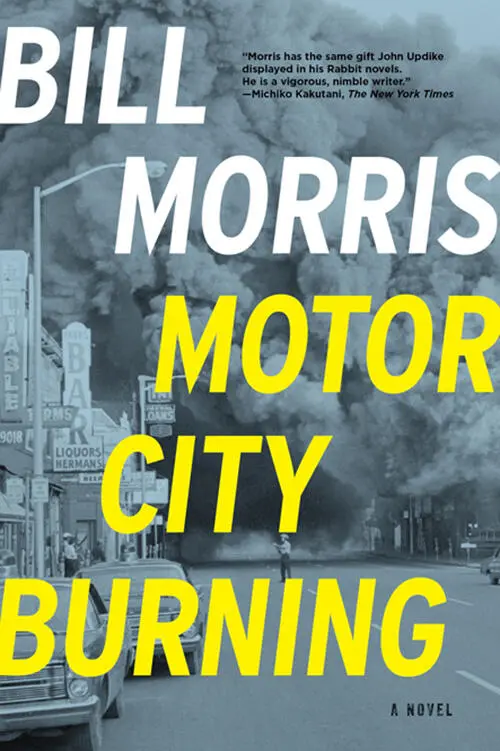
- Название:Motor City Burning
- Автор:
- Издательство:Pegasus
- Жанр:
- Год:2014
- ISBN:нет данных
- Рейтинг книги:3 / 5. Голосов: 1
-
Избранное:Добавить в избранное
- Отзывы:
-
Ваша оценка:
Motor City Burning: краткое содержание, описание и аннотация
Предлагаем к чтению аннотацию, описание, краткое содержание или предисловие (зависит от того, что написал сам автор книги «Motor City Burning»). Если вы не нашли необходимую информацию о книге — напишите в комментариях, мы постараемся отыскать её.
The surprise return of his Vietnam veteran brother in the spring of 1967 gives Willie a chance to drive a load of smuggled guns to the Motor City — and make enough money to jump-start his stalled dream of writing his movement memoir. There, at Tiger Stadium on Opening Day of the 1968 baseball season — postponed two days in deference to the funeral of Martin Luther King, Jr. — Willie learns some terrifying news: the Detroit police are still investigating the last unsolved murder from the bloody, apocalyptic riot of the previous summer, and a white cop named Frank Doyle will not rest until the case is solved. And Willie is his prime suspect.
Motor City Burning — читать онлайн бесплатно полную книгу (весь текст) целиком
Ниже представлен текст книги, разбитый по страницам. Система сохранения места последней прочитанной страницы, позволяет с удобством читать онлайн бесплатно книгу «Motor City Burning», без необходимости каждый раз заново искать на чём Вы остановились. Поставьте закладку, и сможете в любой момент перейти на страницу, на которой закончили чтение.
Интервал:
Закладка:
“Turn that up!” Louis suddenly cried.
Clyde had cut over to Woodward and they were passing between those two blocks of chiseled ice, the Public Library and the Institute of Arts, just as Otis Redding was bending into the whistling part on “Dock of the Bay.” Suddenly Willie was whistling along with Otis and Louis and Clyde, whistling as hard as he knew how, whistling until Edgar Vaughan and Kindu finally left him in peace. He even managed to forget the close call when that white cop had pulled him over right after he left Kindu’s apartment.
Clyde docked the Buick in front of a place called the Seven Seas. As he climbed out, Willie looked across the street and was surprised to see his very first home-away-from-home in the Motor City, the Algiers Motel, where his brother had nearly become a statistic. Only then did Willie notice the sign. The familiar neon palm tree was still there, but they’d changed the name. The Algiers Motel was now the Desert Inn. Willie laughed out loud at this, at the vanity of believing it was possible to erase a disgrace by changing its name.
“The fuck you laughin at?” Louis asked, following Willie’s gaze across the street.
“That’s where my brother and I stayed when we first got to town last spring.”
“Why’s that so funny?”
“They changed the name.”
“I seen that. Place is a shit hole no matter what they call it. You wasn’t staying there during the riot, was you?”
“No, I’d moved out by then. Me and my brother both.”
“Lucky for you, son. Come on. Clyde wants to introduce you to somebody.”
16
CECELIA CRONIN WAS STANDING IN HER BEDROOM DOORWAY drinking her third cup of coffee when Doyle’s eyes finally popped open. It was past noon. From the way he looked around the room, sort of panicky, she could tell he didn’t know where he was.
She said, “Coffee? Aspirin? Gun?”
He turned his head slowly, surprised to see her standing there. He said “Hi” in a small voice, like it hurt to talk.
“Can I get you anything?”
“Aspirin,” he croaked. “Water.”
She brought him a glass of ice water and three aspirins and sat on the edge of the bed. Propped on one elbow, he swallowed the aspirins and thanked her. “Whew,” he said, handing her the glass and returning his head gingerly to the pillow. “What ran over me?”
“Stroh’s and John Jameson. I’ve never seen anything like it. You were fine one minute — telling me a hilarious story about a phone conversation you had with some redneck cop in Alabama — and the next minute two busboys were helping me pour you into my car.”
“So you drove me here from the Riverboat?”
“I wasn’t about to let you drive.”
“And this is. . your bedroom?”
“Correct.”
“Jesus. I’m sorry. . ”
“No need to apologize. You do a great southern accent. But there’s something I gotta tell you, Detective Doyle.”
He frowned.
“You snore like a chainsaw when you’re drunk. I finally had to go sleep on the sofa.” She laughed and brushed the hair off his forehead. His frown disappeared. “You poor thing. You think a Bloody Mary might help?”
“You got any Vernor’s?”
Half an hour later Doyle was halfway through his second can of Vernor’s ginger ale and his first cup of coffee, sitting at the glass-topped table in the dining nook with his back to the big blue sky. He had no interest in how pretty Windsor, Ontario, looked this morning.
After he got down a soft-boiled egg and two pieces of toast, Cecelia said, “You got plans for the day?”
“I was thinking I might swing by Detroit Receiving for a blood transfusion.”
“I’ve got a better idea.”

An hour later they were on a bench in the Garden Court at the Institute of Arts, gazing wordlessly at Diego Rivera’s “Detroit Industry” frescoes. Frank was lying on his back, using Cecelia’s left thigh as a pillow. He looked content lying there, like he might actually survive this day.
They were surrounded on all four sides by frescoes that depicted the entire cycle of human life in the industrial age, from the germination of a cell to the brutal act of turning minerals into machines. The cycle began with an infant (or was it a fetus?) cradled in the bulb of a plant, and there were female nudes holding fruit and sheaves of wheat, then airplanes and birds, boats and fish mushrooming into immense portraits of how man uses the natural world to feed his technology: animals whose blood is turned into serum for vaccines, minerals being heated and poured to make poison gas and V-8 engines, a world of blast furnaces and paint ovens and smokestacks, a roaring inferno where men stamp, hone, deburr, hammer and curse cars into being.
They studied the frescoes for a long time without speaking. It was Doyle who broke the silence. “You never told me — how’d your paper about the Cubists turn out?”
“Pretty well, actually.”
“Did you mention Rivera?”
“Just briefly. The time he spent in Paris with Picasso and Juan Gris. Mainly I concentrated on Orozco and Siquieros. But I’ve got bigger news.”
“Oh?”
“My thesis proposal just got accepted. I’m going to write about the Monuments Men, you know, the Roberts Commission, the guys who cataloged and returned artwork the Nazis looted during the war.”
“There was a ton of stuff, wasn’t there?”
“The Nazis looted so much art that they had to store it in caves and mines.”
“How’d you get into that?”
“My thesis advisor was on the Roberts Commission before he came to teach at Wayne State. While he was doing some provenance research he learned that a Monet in this museum’s permanent collection had been looted by the Nazis. He saw to it that it got returned to its rightful owners, a Jewish family in France. It was the first time an American museum’s ever done that.”
“Good for the D.I.A. That’s very cool.”
“I think so too. I’ve decided to go into provenance research after I get my degree. My advisor believes it’s going to be the wave of the future.”
They were quiet again, gazing at the frescoes, neither of them feeling pressure to make small talk. Again it was Doyle who broke the silence. “You know this whole thing’s a lie, don’t you?”
“What is?”
He waved at the frescoes. “Those beautiful earth tones. Those workers who look like dancers. All that noble toil. It’s all bullshit!”
Several people turned in their direction.
“Down boy,” Cecelia said, stroking his hair.
He lowered his voice. “In a real car plant all the men are thick and muscular and everything’s black and white and gray, even the people. Especially the people. It was like we were being covered with metal shavings, turned from black men and white men into gray men. The only color I remember was orange. Usually the sparks were white, but every once in a while they were orange for some reason. I remember thinking those orange sparks were the most beautiful thing I’d ever seen. Probably because everything else was so ugly.”
“You worked on the line?”
He told her about his brief career attaching leaf springs at Chevy Gear & Axle the summer after his junior year of high school. On his third day he saw a defective drop forge slice off a man’s left hand cleanly at the wrist. The blood came out like water out of a garden hose. Fifteen minutes later, after a cursory inspection by some foremen, another man was running the forge. Doyle walked out of the place and never went back. Then he told Cecelia about how his father’s forty-two-year career at the Rouge came to an abrupt end six weeks before his retirement — the meatloaf sandwich, the heart attack.
Читать дальшеИнтервал:
Закладка:
Похожие книги на «Motor City Burning»
Представляем Вашему вниманию похожие книги на «Motor City Burning» списком для выбора. Мы отобрали схожую по названию и смыслу литературу в надежде предоставить читателям больше вариантов отыскать новые, интересные, ещё непрочитанные произведения.





Обсуждение, отзывы о книге «Motor City Burning» и просто собственные мнения читателей. Оставьте ваши комментарии, напишите, что Вы думаете о произведении, его смысле или главных героях. Укажите что конкретно понравилось, а что нет, и почему Вы так считаете.