Bill Morris - Motor City Burning
Здесь есть возможность читать онлайн «Bill Morris - Motor City Burning» весь текст электронной книги совершенно бесплатно (целиком полную версию без сокращений). В некоторых случаях можно слушать аудио, скачать через торрент в формате fb2 и присутствует краткое содержание. Год выпуска: 2014, Издательство: Pegasus, Жанр: Современная проза, на английском языке. Описание произведения, (предисловие) а так же отзывы посетителей доступны на портале библиотеки ЛибКат.
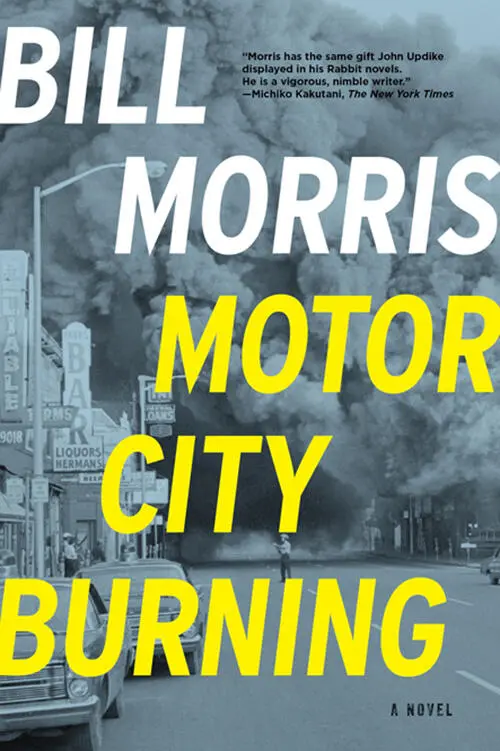
- Название:Motor City Burning
- Автор:
- Издательство:Pegasus
- Жанр:
- Год:2014
- ISBN:нет данных
- Рейтинг книги:3 / 5. Голосов: 1
-
Избранное:Добавить в избранное
- Отзывы:
-
Ваша оценка:
Motor City Burning: краткое содержание, описание и аннотация
Предлагаем к чтению аннотацию, описание, краткое содержание или предисловие (зависит от того, что написал сам автор книги «Motor City Burning»). Если вы не нашли необходимую информацию о книге — напишите в комментариях, мы постараемся отыскать её.
The surprise return of his Vietnam veteran brother in the spring of 1967 gives Willie a chance to drive a load of smuggled guns to the Motor City — and make enough money to jump-start his stalled dream of writing his movement memoir. There, at Tiger Stadium on Opening Day of the 1968 baseball season — postponed two days in deference to the funeral of Martin Luther King, Jr. — Willie learns some terrifying news: the Detroit police are still investigating the last unsolved murder from the bloody, apocalyptic riot of the previous summer, and a white cop named Frank Doyle will not rest until the case is solved. And Willie is his prime suspect.
Motor City Burning — читать онлайн бесплатно полную книгу (весь текст) целиком
Ниже представлен текст книги, разбитый по страницам. Система сохранения места последней прочитанной страницы, позволяет с удобством читать онлайн бесплатно книгу «Motor City Burning», без необходимости каждый раз заново искать на чём Вы остановились. Поставьте закладку, и сможете в любой момент перейти на страницу, на которой закончили чтение.
Интервал:
Закладка:
“I’m fine as wine. Why?”
“You acted like you seen a ghost when them po-lice pulled up.”
“Something like that.”
“What is it?”
“I know that white cop.”
“Where from?”
“Some other time,” he said, even though he had already decided there wasn’t going to be another time.
“You in some kinda trouble with the po-lice?”
“A hick like me?” He tried to laugh as he climbed out of the car. He was angry at himself for having such thin skin, but he couldn’t help it. He was fed up with being talked down to by all these smug northern niggers who hadn’t seen a fraction of the things he’d seen. They were the ones who still had a lot to learn, and in that moment he made a vow that he would teach them.
“Thanks for lettin me run my mouth, Willie. I really needed that. Maybe we’ll go for a ride again next Sunday.”
“May be.”
“And next time you do the talkin.”
“Sounds good.”
“You think you might call me sometime? I’d love to hear more a your stories bout Mississippi.”
“Sure.”
She was smiling again as she wrote her phone number on a matchbook. “You promise you’ll call?”
“I promise.”
“I’m usually home by nine in the evening, but don’t call too late. I go to bed early. They work us like dogs.” She handed him the matchbook and dropped the car into gear. It squealed away from the curb, leaving behind nothing but a smudge of burnt rubber and a long blue ribbon of smoke.
He didn’t even wave goodbye because just then he saw a blue-and-white making the turn onto Pallister by the Larrow Arms. The last thing he wanted to do was let that honky cop find out where he stayed.
It would never end, he thought as he hurried up the front steps and let himself into the building. At least his Buick had a fresh coat of Earl Scheib’s finest black paint and tomorrow, if all went well at Murphy’s, it would disappear once and for all.
He hugged the wall in the foyer while the cop car eased past. His heart was going like a jackhammer again, and it didn’t stop even after the cop car made a left onto Poe and disappeared.
PART THREE. WORLD CHAMPIONS
18
MONDAY MORNING AND CHICK MURPHY WAS IN HIS MURDEROUS mood. Blythe had tied on one of her fifty-megaton loads after the Tigers’ game Saturday night, insisting they stop at the club for dinner, then ordering unnecessary nightcaps, getting loud and sloppy, flirting with the help, even with some of the colored guys, for chrissakes. Then she refused to get out of the car when they got home. It was way past midnight when Chick finally wrestled her into bed.
She still hadn’t emerged from her bedroom by noon on Sunday so he went back to Oakland Hills to hit some golf balls and take a swim. After lunch he wound up playing gin rummy in the men’s grill with a bunch of young huns from the G.M. Tech Center. They called themselves “stylists” but he thought they were a bunch of eggheads because they spoke a language he barely understood, sprinkled with big words like “co-efficient of drag.” They were all college boys — art students, at that — which meant they had no idea what it was like to stand out there at the corner of 9 Mile and Mack in all natures of Michigan weather, in sheets of snow and razor-toothed spring rains, under the egg-yolk August sun that turned the outdoors into a steam bath and, despite that weather, to stand out there under the snapping pennants and plaster a thousand-watt smile on your face and tell lies until you sold a fucking car, preferably a plush new fully loaded Buick, to some poor sap who could no more afford it than he could afford a trip to the moon. That was where G.M.A.C. came in — Alfred Sloan’s genius idea that you could amp up sales and profits by lending money to your customers and then charging them a grand-larceny interest rate. Most of those art school boys from the Tech Center didn’t even know what G.M.A.C. stood for — that to the bluesuits on West Grand Boulevard the initials meant General Motors Acceptance Corporation, while to trench warriors like Chick Murphy they meant Give Me A Chance.
His joyless Sunday at the club ended late in the afternoon when someone in the men’s grill switched the TV from the PGA golf tournament to the Olympics in Mexico City. When the American national anthem started playing, Chick looked up from his cards and saw three men on the awards stand with medals draped around their necks. Suddenly two of the men, Americans, both Negroes, bowed their heads and raised their gloved fists in the black-power salute. Chick said, “What the fuck. .” and felt himself rising from his chair, felt his right hand groping for the nearest object, which was an empty Michelob bottle. Chick Murphy, a former Marine, had lost his left pinkie to frostbite during the savage fighting at Chosin Reservoir in Korea, and he loved his country. Without thinking, he hurled the beer bottle at the TV screen. There was an explosion, a shower of glass, smoke. Then he was storming out of the room to applause and laughter and howling. The black waiters and busboys lounging by the door got the hell out of his way.
So by the time he walked out his front door on Monday morning he was locked into his murderous mood. It got worse when he noticed a pair of Blythe’s high heels under a rose bush by the driveway. Rain had ruined them, a pair of sixty-fucking-dollar burgundy suede pumps from Saks. Why had she left a pair of expensive shoes out in the rain?
The only thing that lifted Chick’s spirits on that gummy Monday morning was the sound of his radio spot coming out of the Electra’s dashboard as he cut across the northern suburbs toward the dealership:
Stay on the right track
To 9 Mile and Mack.
A Chick Murphy Buick’s gonna
Make your money back.
Ole Chick Murphy’s got some buyers
BUYERS!
Who come from many miles a-waaaaaaay.
You’ll save yourself a lot of dollars
DOLLARS!
By driving out his way to-daaaaaaay!
Hearing that radio spot never failed to give Chick a boost. He considered it a work of genius. He wrote the lyrics himself on an Oakland Hills cocktail napkin late one Sunday night after a Lions football game and half a dozen brain dimmers. Edgar Hudson, the waiter with the bottomless baritone and the quick laugh, had helped with the tune. The guy had a great singing voice. The jingle was catchy and unforgettable, destined to stay with you like a gold-digging wife. Chick had a hunch it had sold more Buicks than all the lies he’d ever told at the corner of 9 Mile and Mack.
As he pulled onto the lot now, his commercial gave way to the familiar voice of J.P. McCarthy, who was talking with Mickey Stanley about the double Stanley hit in the bottom of the ninth yesterday that brought the Tigers from behind — again — to beat the Indians. This good news did nothing to dispel Chick’s mood. It was his very best car-selling mood, a blend of cold rage and false bravado that told him the world owed it to him to buy a truckload of Buicks. He once sold thirteen cars in a single day while in his murderous mood. Those customers didn’t have a prayer.
In his paneled office, surrounded by all the celebrity golf photos and model cars and autographed baseballs, Chick studied the second-quarter sales figures. He realized one reason sales had fallen off in ’68 was that the riot buyers had dried up. These were the city dwellers, usually black guys, who showed up at the dealership last summer and fall wearing sherbet-colored slacks and pointy alligator loafers, their pockets full of cash from all the fur coats and guns and booze and jewelry they’d looted during the riot and then fenced for a tenth of its value. They came in waves, in battered cars, in taxis, on buses, just poured out Mack through Grosse Pointe, all the way out here to St. Clair Shores because the word was out on the street that Murphy’s made the best price on a Buick. And every last one of them absolutely had to have a new Deuce and a Quarter. Much as Chick hated to see these flashy assholes turn his hometown into a gigantic ashtray, he was a businessman and he knew better than to look a gift horse in the mouth. Sadly, he now realized, all that riot money was gone. The only thing Murphy Buick had to show for it was banner third and fourth quarters in 1967—followed by a sharp drop-off in the first and second quarters of ’68.
Читать дальшеИнтервал:
Закладка:
Похожие книги на «Motor City Burning»
Представляем Вашему вниманию похожие книги на «Motor City Burning» списком для выбора. Мы отобрали схожую по названию и смыслу литературу в надежде предоставить читателям больше вариантов отыскать новые, интересные, ещё непрочитанные произведения.




Обсуждение, отзывы о книге «Motor City Burning» и просто собственные мнения читателей. Оставьте ваши комментарии, напишите, что Вы думаете о произведении, его смысле или главных героях. Укажите что конкретно понравилось, а что нет, и почему Вы так считаете.