Bill Morris - Motor City Burning
Здесь есть возможность читать онлайн «Bill Morris - Motor City Burning» весь текст электронной книги совершенно бесплатно (целиком полную версию без сокращений). В некоторых случаях можно слушать аудио, скачать через торрент в формате fb2 и присутствует краткое содержание. Год выпуска: 2014, Издательство: Pegasus, Жанр: Современная проза, на английском языке. Описание произведения, (предисловие) а так же отзывы посетителей доступны на портале библиотеки ЛибКат.
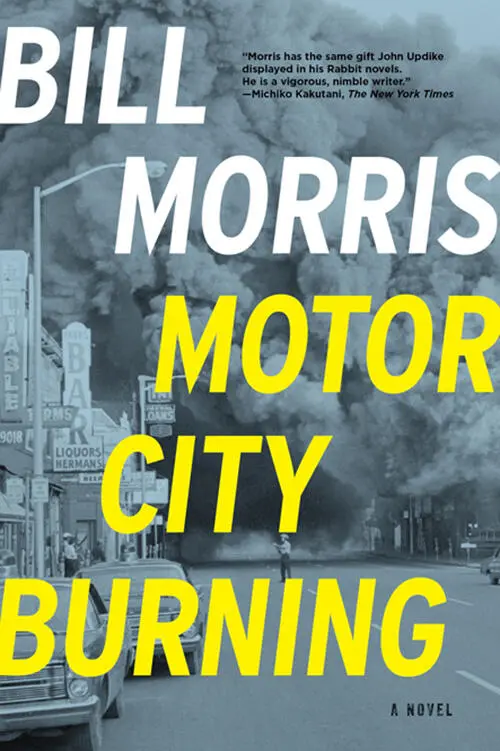
- Название:Motor City Burning
- Автор:
- Издательство:Pegasus
- Жанр:
- Год:2014
- ISBN:нет данных
- Рейтинг книги:3 / 5. Голосов: 1
-
Избранное:Добавить в избранное
- Отзывы:
-
Ваша оценка:
Motor City Burning: краткое содержание, описание и аннотация
Предлагаем к чтению аннотацию, описание, краткое содержание или предисловие (зависит от того, что написал сам автор книги «Motor City Burning»). Если вы не нашли необходимую информацию о книге — напишите в комментариях, мы постараемся отыскать её.
The surprise return of his Vietnam veteran brother in the spring of 1967 gives Willie a chance to drive a load of smuggled guns to the Motor City — and make enough money to jump-start his stalled dream of writing his movement memoir. There, at Tiger Stadium on Opening Day of the 1968 baseball season — postponed two days in deference to the funeral of Martin Luther King, Jr. — Willie learns some terrifying news: the Detroit police are still investigating the last unsolved murder from the bloody, apocalyptic riot of the previous summer, and a white cop named Frank Doyle will not rest until the case is solved. And Willie is his prime suspect.
Motor City Burning — читать онлайн бесплатно полную книгу (весь текст) целиком
Ниже представлен текст книги, разбитый по страницам. Система сохранения места последней прочитанной страницы, позволяет с удобством читать онлайн бесплатно книгу «Motor City Burning», без необходимости каждый раз заново искать на чём Вы остановились. Поставьте закладку, и сможете в любой момент перейти на страницу, на которой закончили чтение.
Интервал:
Закладка:
“You don’t know Chick Murphy. I’m just keeping my head down. So. Willie’s due in at four, which means he’ll be showing up any minute. He’s always early. Like I say—”
“He still driving that big old pink-and-black Buick?”
“I’ll tell you something. Just between you and I, Detective—”
“Frank.”
“—between you and I, Frank, I make a point of not knowing what my employees drive or how they got hold of the keys. To be honest with you, I don’t know how busboys and waiters and bartenders can afford to drive some of the cars parked out on our employee lot, and I don’t ask. The less I know, the better. I’m sure you understand.”
“Sure.” What Doyle understood was that bartenders drive what they steal. “You happen to have a picture of Willie handy?”
“I should.” Without removing his wingtips from the desk, Kowalski dug in a drawer and produced a job application with a black-and-white photograph stapled to it. Doyle took one look at Willie Bledsoe’s face and immediately thought of Jerry Czapski’s description of the driver of the cherry Buick they’d pulled over at the corner of Wildemere and Tuxedo back in the spring of ’67: smooth skin, not too dark, handsome enough kid. The young man staring at the camera fit the description. Solid jaw, trim Afro, full lips that curled up at the corners in a permanent smile. Doyle couldn’t read that smile. Was it cockiness? Only after studying the picture for a full minute did Doyle notice the most obvious thing of all: the flaw: the scar that ran through the upper lip, near the left corner of the mouth. It was the result of a badly botched sewing job, and he tried to guess what could have caused such a nasty wound. A windshield? A knife? A nightstick? This, he told himself, was a worthy adversary. He said, “Good-looking kid.”
“And smart too,” Kowalski said, checking his watch. “It’s almost three-thirty. He’ll be showing up any minute if you want to talk to him.”
“No, I think I’d rather just hang around in the parking lot for a while if you don’t mind.”
“Be my guest. The employees park in the far lot, up by Maple Road.”
“And one small favor, Dick. Don’t let anyone know I stopped by.”
“Sure thing.”
Ten minutes later Doyle was sitting at the wheel of his Pontiac reading the tea leaves of the Tigers’ box score in the Free Press . He looked up as an enormous sky-blue convertible turned off Maple and eased into the employee lot. When Willie Bledsoe climbed out, Doyle put his newspaper down. What the hell happened to the pink-and-black Buick?
Willie was lean, well over six feet tall, and he was wearing a charcoal-gray sport shirt and light gray slacks, creases like razors, hip but not flashy. His black loafers gleamed. His tortoise-shell sunglasses had little gold screws at the corners. If bartenders drive what they steal, Doyle thought, then maybe busboys drive — and wear — what they steal. Over his shoulder Willie carried a white jacket and a pair of tuxedo pants in a dry-cleaning bag. The man looked as sweet as Marvin Gaye, way too cool to be working for The Man out here in the burbs.
Doyle watched him glide across the parking lot. He had a fluid walk, smooth and rhythmic. He moved to music only he could hear. Doyle watched him until he disappeared into the service entrance in the clubhouse basement.
When he was gone, Doyle walked over to the blue convertible and squatted behind the back bumper. The Society of Automotive Engineers serial number on the taillight contained the numeral 67, which meant this Electra 225 was a 1967 model, just a year old. The dealership’s decal was on the trunk lid: Murphy Buick — Stay on the Right Track to 9 Mile and Mack! Chick Murphy, the suspicious car dealer with a wandering lush for a wife.
Driving east toward St. Clair Shores, Doyle had a warm feeling. If Willie Bledsoe had swapped his ’54 Buick for the blue convertible, it was a sure sign he was trying to get rid of incriminating evidence. Doyle liked having an adversary who took precautions. And he absolutely loved the moment when he first laid eyes on a suspect, when an abstraction became flesh and it was suddenly possible to imagine sitting across the Formica table from another human being in the yellow room, going through the familiar dance, the dance Doyle loved so much because he did it so well.

Chain-smoking, rattling breath mints across his teeth and talking like a machine gun, Chick Murphy couldn’t seem to get it through his skull that Doyle had not come here to buy a car but to gather information in a criminal investigation. Murphy was on some kind of automatic pilot, like a wind-up doll. Doyle noticed his left pinkie was missing and his knuckles were laced with scar tissue and there were little gaps in his yellow eyebrows. The man had punched and he’d been punched, Doyle thought. No wonder Dick Kowalski was afraid of the guy.
“Whaddaya say we take her for a quick spin up the lake?” Chick Murphy said, spanking the hood of a yellow Electra 225 with a white vinyl top.
“Some other time,” Doyle said. “I’d rather have a look at the paperwork on the car Willie Bledsoe traded in.”
Chick Murphy led the way inside to the finance office. His fingertips drummed the desktop while Doyle went over the papers on the 1954 Buick Century that had been sold last week to a man named Ernest Roquemore from Wyandotte. There was a new state law that required car dealers to list the odometer reading on every used car they offered for sale, and the ’54 Buick’s mileage caught Doyle’s eye. “A fourteen-year-old car with less than twenty-five thousand miles on it? You believe that?”
“If that’s what’s on the odometer, that’s what I put on the paperwork,” Chick Murphy said. “It’s the law.”
“The paperwork doesn’t say anything about how he acquired the car.”
“No, but the title was in his name. That’s all I care about. He did tell me the car was a gift, or somesuch shit.”
Doyle remembered his conversation with Beulah Bledsoe. Her saying the car was a gift to Willie from some Navy buddy of his brother’s. Still studying the paperwork, he said, “The car was black? Solid black?”
“Blacker’n the ace of spades. I gave him some shit about driving around in a hearse. It had a cheap paintjob on it.”
“Did he paint it?”
“Don’t know. Didn’t ask.”
“So do you think he turned the odometer back?”
“I did at first. Not anymore.”
“Why not?”
“Because my mechanics did a compression check — and they tell me the mileage is real. I was a little pissed at myself for doubting the kid. I’m convinced he doesn’t have a dishonest bone in his body.”
“You sure about that?”
“Look, Detective, you learn to size people up pretty fast in this business. I can tell you most people’s life story five minutes after I meet them.”
“Tell me mine.”
“I’d say you’re single, played sports, never been to college, and you work too hard, drink a little more than you need to. Probably went to Catholic schools. That suit — you’re obviously a clothes horse. And I’m guessing you’re a skirt chaser.”
“Not bad.” In fact, he was right on all counts except one. Doyle didn’t have time to chase skirts anymore. He made a mental note to call Cecelia, let her know he was still alive.
“Look,” Chick Murphy said, “I’m sure about Willie Bledsoe the same way I’m sure that Deuce I showed you is white over yellow with a vinyl top. He’s not the type to turn back an odometer. Or gamble. Or steal. Or screw another guy’s wife.”
The guy called the car a Deuce. Simply talking about a black man made him talk like a black man. Well, Doyle thought, everyone makes errors of judgment, even street-smart Buick dealers. “So, Mr. Murphy, if you don’t think Bledsoe has it in him to turn back an odometer or screw another guy’s wife, then I guess it’s safe to assume you don’t think he has it in him to commit murder.”
Читать дальшеИнтервал:
Закладка:
Похожие книги на «Motor City Burning»
Представляем Вашему вниманию похожие книги на «Motor City Burning» списком для выбора. Мы отобрали схожую по названию и смыслу литературу в надежде предоставить читателям больше вариантов отыскать новые, интересные, ещё непрочитанные произведения.





Обсуждение, отзывы о книге «Motor City Burning» и просто собственные мнения читателей. Оставьте ваши комментарии, напишите, что Вы думаете о произведении, его смысле или главных героях. Укажите что конкретно понравилось, а что нет, и почему Вы так считаете.