Carlos Fuentes - Terra Nostra
Здесь есть возможность читать онлайн «Carlos Fuentes - Terra Nostra» весь текст электронной книги совершенно бесплатно (целиком полную версию без сокращений). В некоторых случаях можно слушать аудио, скачать через торрент в формате fb2 и присутствует краткое содержание. Год выпуска: 1987, Издательство: Farrar, Straus and Giroux, Жанр: Современная проза, на английском языке. Описание произведения, (предисловие) а так же отзывы посетителей доступны на портале библиотеки ЛибКат.
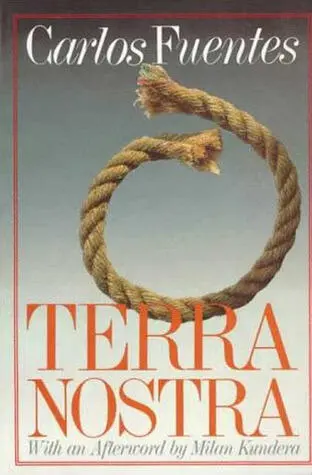
- Название:Terra Nostra
- Автор:
- Издательство:Farrar, Straus and Giroux
- Жанр:
- Год:1987
- ISBN:нет данных
- Рейтинг книги:3 / 5. Голосов: 1
-
Избранное:Добавить в избранное
- Отзывы:
-
Ваша оценка:
Terra Nostra: краткое содержание, описание и аннотация
Предлагаем к чтению аннотацию, описание, краткое содержание или предисловие (зависит от того, что написал сам автор книги «Terra Nostra»). Если вы не нашли необходимую информацию о книге — напишите в комментариях, мы постараемся отыскать её.
Terra Nostra — читать онлайн бесплатно полную книгу (весь текст) целиком
Ниже представлен текст книги, разбитый по страницам. Система сохранения места последней прочитанной страницы, позволяет с удобством читать онлайн бесплатно книгу «Terra Nostra», без необходимости каждый раз заново искать на чём Вы остановились. Поставьте закладку, и сможете в любой момент перейти на страницу, на которой закончили чтение.
Интервал:
Закладка:
“There is a greater divinity, if you will forgive me, Señor, and that power is called money. And the law of that god is that after debts are contracted, they must be paid. Señor: your coffers are empty.”
“What, then, is being used to pay the servants of this palace? The construction? The workmen?”
“Precisely, Sire; there is nothing left with which to pay them. This is what I urgently needed to tell you, once the ceremonies for the dead had been concluded. I did not want to bother you before that. Now it is my duty to inform you that the construction of the crypts for your ancestors, and the costly transportation of all the corpses here, have consumed everything that remained.”
“But the riches within the palace; the iron railings forged in Cuenca, the balustrades from Zaragoza, the Italian marbles, the Florentine bronzes, the Flemish candelabra…”
“All still owed; nothing has been paid; your credit is great, but the moment for payment has arrived.”
“What? Why are you holding my testament? What is that new paper?”
“A detailed listing of what is owed: debts with smiths, shipowners, butchers, carpenters, bakers, salt merchants, weavers, fullers, dyers, shoemakers — and look here, one of them is complaining that the youth who accompanied your mother forced him to eat the leather of his shoes; he asks indemnification for it; one must pay for such willful behavior — harness makers, drapers, vintners, brewers, barbers, doctors, tavern keepers, tailors, silk merchants … Should I continue, Señor?”
“But, Guzmán, everything used to be produced here in the castle…”
“There is no one now but the workmen constructing the palace and those of the religious orders, who serve death. There is honor. There is no money.”
“And what do you propose, Guzmán?”
Guzmán walked to the entrance to the bedchamber; he parted the curtain separating it from the chapel. A stooped old man was standing behind the curtain. A short fur cape protected him against the cold of the early morning and the long night’s vigil in the stone chapel; but the cape did not warm the rock crystal of his carved, avaricious features, or the blue snow of his eyes.
A cap of marten skins covered his head; his long, knotted fingers toyed with a silver medallion hanging upon his emaciated chest; his black breeches clung loosely to spindly legs. His toothless mouth was distorted into an obsequious smile; this old javel bowed before El Señor, professed his fealty, and thanked him for the honor of being received; he had waited many hours, all night, in that icy chapel, with no companion but the dead; it was a most sumptuous chapel, what had the balustrades, the marbles, the paintings, the sepulchers themselves, cost?; a fortune, doubtlessly, a fortune; the quality of the workmanship, the cost of the transport, then the installation, which was also very costly, no doubt …
No, he wasn’t complaining about the wait; he had observed, he had seen; he had admired the great construction; no one except the royal servants knew what it was like inside; curiosity was high, as great as the fame of this interminable palace; and he had special reason to appreciate this place and he wasn’t complaining of the fatiguing trip he had undertaken from Seville so that he might know it, so he might offer his service to El Señor and also know the place where his daughter, the rare fruit of a late marriage, was preparing to take her vows; strange girls, those of today, Señor, and his girl — instead of taking advantage of everything an aged father close to death and made rich by commerce and the moneylending arts could offer her — preferred to cloister herself in this palace; surely the old adage was right: when an old man has a daughter, if he’s lucky, she’ll pay him heed, but if she’s inclined to madness, she’s very mad indeed; and add to that fact that she’s a Sevillian, then if she turns out all right, she’s one in a million; well, the blood is tired, and the child of an old man is early an orphan; tired the blood, yes, but not the mind, especially if throughout a lifetime that mind has been sharpened, day in and day out, by the clever dealings demanded by the merchant’s trade and by the evil called usury, which in truth is not an evil at all but an act of charity; but in any case, experience is the best teacher, and as a merchant I just go on my way, you know, not too much loss, not too much pay, though if I do say so, I’ve had a sharp nose when it comes to detecting when the price of metals is going up and when the price of salt is going down, and dealing accordingly with my colleagues on the Baltic and the Adriatic, for the merchant who doesn’t know his lore closes his store; invest a little here, withdraw a little there, the coin of a miser is money that’s wiser … a marvelous word, money, Señor; money … fondle it, sow it, and watch it grow, fertilized by commerce and manufacture, into a tree with great spreading branches, mining, maritime transport, the administration of lands, and loans to princes in need of funds for war, exploration … and the construction of palaces.
Ah, this palace should be completed, didn’t El Señor think so? it would be a shame to leave it half done, just a shell, looking as if the curses of Heaven had rained down upon it; it was El Señor’s lifework, wasn’t it, and it was for this he would be remembered in centuries to come; it was to erect this palace that he’d devastated the ancient Castilian orchard, turned it to dust, had removed peasants from their lands and shepherds from their hills, and put them to work as laborers in exchange for wages, very well, very well, and there’s nothing I can teach you on this subject, Señor, you’re aware that there’s no reason the products necessarily should belong to the man who produces them, what good do they do him without the legs of someone to carry his produce to market for him, and the hands of a lender who can provide in case of a bad harvest, a storm, an accident, or overspending? We’ve been damned, Señor, and nevertheless I insist our mission is one of charity. And we’ve not always been well paid. In my long life I have known grandees of these Spanish lands who out of pure madness for luxury and honor and appearances have after plowing their lands planted them with silver, as if the metal could sprout and yield new fruit; I have known them to cook with candles of precious wax in order to impress their own scullions, and impress themselves; I have known them at the end of a celebration to order thirty horses to be burned alive, for the pure pleasure of the wasteful spectacle that allows them to believe they are above the common mortal. And the worst is that they have at times murdered the moneylenders who come to their aid. You see, then, Señor, the demands and dangers of my miserable office.
In any case, let every whore ply her trade and every ruffian turn his deal, the products must belong to those who encourage their production, transform them, increase their value greatly, didn’t El Señor agree? times have changed, the codes of yesteryear no longer have their old following, their old value; it used to be that illness and hunger caused men to cherish hopes of the world beyond, but now a man can work, Señor, dedicate his life to hard labor, and harvest his fruits right here on earth, and in spite of low origins, know the favors of merit, if not those of blood: money makes a man whole and when he has bread his suffering is diminished: I live, Exalted Señor, from what I earn and from the money I change; that will not impede me from serving you and from sustaining with my tired old bones a power based on inherited rank. Do not judge me harsly; new times, new ways; the interdictions of our faith, which have dealt so harshly with my office, belong to a destroyed and sick and hungry world, Señor, to a stagnant world; the sinful stigma cast upon the practice of usury by Christians forced Jews to fulfill this necessary function; but if you persecute the Jews, who will fulfill it? and will an act of necessary charity be condemned when pure Christians like myself practice it, Señor? Then my occupation must be accepted as a sign of a strengthened and salutary faith which promises two Paradises: one here and one beyond, one now and one later: is this not an admirable promise? And finally, one must consider that my sins, if they are sins, are compensated and perhaps even pardoned by the fact that my sweet daughter, my only heir, to whom, naturally, I shall leave all my money, is preparing in this very palace for her permanent vows and her marriage with Christ.
Читать дальшеИнтервал:
Закладка:
Похожие книги на «Terra Nostra»
Представляем Вашему вниманию похожие книги на «Terra Nostra» списком для выбора. Мы отобрали схожую по названию и смыслу литературу в надежде предоставить читателям больше вариантов отыскать новые, интересные, ещё непрочитанные произведения.





Обсуждение, отзывы о книге «Terra Nostra» и просто собственные мнения читателей. Оставьте ваши комментарии, напишите, что Вы думаете о произведении, его смысле или главных героях. Укажите что конкретно понравилось, а что нет, и почему Вы так считаете.