Carlos Fuentes - Terra Nostra
Здесь есть возможность читать онлайн «Carlos Fuentes - Terra Nostra» весь текст электронной книги совершенно бесплатно (целиком полную версию без сокращений). В некоторых случаях можно слушать аудио, скачать через торрент в формате fb2 и присутствует краткое содержание. Год выпуска: 1987, Издательство: Farrar, Straus and Giroux, Жанр: Современная проза, на английском языке. Описание произведения, (предисловие) а так же отзывы посетителей доступны на портале библиотеки ЛибКат.
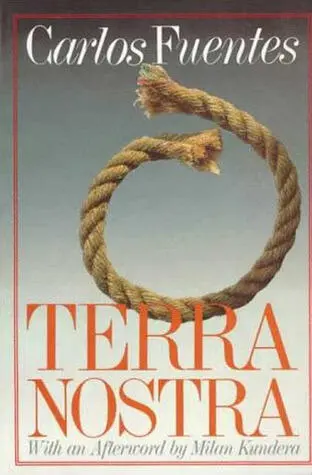
- Название:Terra Nostra
- Автор:
- Издательство:Farrar, Straus and Giroux
- Жанр:
- Год:1987
- ISBN:нет данных
- Рейтинг книги:3 / 5. Голосов: 1
-
Избранное:Добавить в избранное
- Отзывы:
-
Ваша оценка:
Terra Nostra: краткое содержание, описание и аннотация
Предлагаем к чтению аннотацию, описание, краткое содержание или предисловие (зависит от того, что написал сам автор книги «Terra Nostra»). Если вы не нашли необходимую информацию о книге — напишите в комментариях, мы постараемся отыскать её.
Terra Nostra — читать онлайн бесплатно полную книгу (весь текст) целиком
Ниже представлен текст книги, разбитый по страницам. Система сохранения места последней прочитанной страницы, позволяет с удобством читать онлайн бесплатно книгу «Terra Nostra», без необходимости каждый раз заново искать на чём Вы остановились. Поставьте закладку, и сможете в любой момент перейти на страницу, на которой закончили чтение.
Интервал:
Закладка:
I sought, in that dusk, my guide: Venus, the light twin to shadow and the shadow twin to light. Venus, its own twin. I had sailed for the new world, on old Pedro’s ship, guided by the morning star. I feared, Sire, that having embarked at the dawn, I would find in the dawn the final port of my destiny in these lands, thus closing a perfect, implacable circle: son of light, having arrived at the hour of light, condemned to light. But I had already seen that my other destiny, my other possibility, was no less fatal: having arrived by night, I was identified with shadow. If I had learned anything in this land, it was that nothing was more feared than the death of the sun. Nothing more feared, then, than the executioner of the sun: son of shadow, having arrived at the hour of shadow, condemned to shadow. I felt myself a prisoner of the perfect circles of a double destiny: day and night, light and shadow. But my soul sought indecision, chance, an opening toward the continuity of life that for me is linear. And who in this world, having achieved the final perfection of closing a circle, would grant me the grace of one night more of life? Having set sail at dawn, having arrived by day, and thus having appeared as the creator of the sun; or having left at dusk, having arrived by night, and so appearing to be the executioner of the sun? Fatal world, new world, where my incomprehensible man-presence was understood only in the light of superhuman forces: the terror of the night would be crushed forever between the two perfect halves of the light; the blessing of the day would be crushed forever between the two perfect halves of the shadow. There was no other final escape for this new world, Sire, and its inhabitants were prepared to honor equally light, if it triumphed, or the shadows, if they conquered. Who would grant me the grace of one hour more of life, the rupture of the miracle, the repetition of uncertainty? Thus I was prisoner of an anguishing contradiction, the most terrible of all: I owed my life to death; I would owe my death to life. The miraculous is exceptional. It must be preserved. Only the perfection of a unique instant may preserve it. That perfection is death.
Pondering these mysteries, I reached the foot of the volcano with the first shadows, and my feet touched cold rock and icy ashes, and in the distance I could see lighted fires on the mountainsides, as if compensating for the coldness of what once had been a boiling basin.
Here and there, I could see where small bonfires were being lighted, and beside them, here and there, a few old men whose fox-like profiles could be distinguished in the dim glow; they were cutting pieces of paper, trimming them and binding them together, and one ancient would take a motionless body, bind its legs, and dress and bind it with the paper, and further along, another old man would pour water over the head of another motionless body, and all about me I could see this ceremony being repeated, those lifeless bodies being shrouded in cloth and paper, and tightly bound, and I noted that around each bonfire were scattered yellow flowers with long green stalks, and youths carrying doors on their backs were approaching some deep holes dug in the ashes; they placed the doors over the holes, and then groups of women wept and strewed dried yellow flowers over those doors, and amid the women’s weeping could be heard plaintive voices saying: “Know the door of your house, and use that door to come out and visit us, for we have wept long for you. Come out a little while, come out a little while.”
And as I climbed the mountainside, more fires were lighted, and I was aware of moaning voices and increased activity. I accepted what my eyes told me; every bonfire marked the site of a dead person, an ancient tomb revisited or a recently dug sepulcher, and the groups gathered about each body, buried or still unburied, were engaged in various scrupulously observed rites: for one they placed in the winding sheets a little jug filled with water; between the waxen hands of another they secured a strand of limp cotton thread tied to the neck of a small, nervous, reddish-colored dog with bright eyes and a sharp snout; further along, they were burning piles of clothing; beyond that, jewels were being thrown into a fire, and old men were singing softly, sadly: Oh, son, you have known and suffered the travail of this life; and in taking you away our lord has been served, for life in this world knows no permanence and our life is brief, like a man who warms himself in the sun; and the women echoed in chorus, moaning: you went to that darkest of all places where there is neither light nor windows, and you will never again have to return here or leave there; do not be troubled by the childlessness and poverty in which you leave us; be strong, son, do not be bowed down by sadness; we have come here to visit you and to console you with these few words; and the ancients again began to sing, we are now the fathers, the ancients, for our lord has taken away those who were older and more ancient, those who knew better how to speak consoling words for those who mourn …
And above these words spoken all about me as I climbed towards the white cone of the volcano, among the mourners indifferent to my task, ululated one high, shrill lament, a flame of words that lay like a protective mantle over the funereal ceremony of that night: “It is not true that we lived, it is not true that we came to endure upon this earth.”
I was thankful, Sire, for the darkness, and for their indifference: here the living had voice and eyes only for death, and my painful journey toward the peak in no way disturbed their suffering; they gave no thought to the passing of my shadow amid their sorrow.
I left lamentation and fires behind me; one by one the fires were dying out, abandoning me to a night of mysterious shadow, for although the eternal snows of the volcano must be nearby, a warm lethargy was nevertheless rising from the depths of the ash in whose sandy blackness I was struggling, laboriously lifting one foot after the other, sinking up to my ankles in the extinct fire. How distant, Sire, seemed then the wild volcanos of the islands and bays of Mare Nostrum that in its waters find a mirror to their tremors and a solace for their ruins, while here, in the land of the navel of the moon, the volcanos were extinct, and their mirror was a desolation reflecting that of the moon itself: black desert on land, white dust in the heavens.
I looked up, seeking the moon, desiring its company as I penetrated into the darkness of this night; but there was nothing shining in the sky; a tapestry of black clouds obscured my guide, the evening star; I feared to lose my way, although I was guided by the rising ground. And then, Sire, as if my thoughts possessed powers of convocation, before me, from behind a rock, appeared a man with a great light upon his back.
I stopped, doubting my senses, for that luminous man appeared and disappeared among the volcanic rocks, sowing light and shadow in his passing; and when finally he came toward me, I saw that he was an old man with a great conch shell upon his back, and the light was coming from the shell, illuminating his old man’s face, lean and white, so old he seemed to be a skull shining in the night; and behind him I heard shouting and running, and young warriors darted by, hunting an invisible animal in the night, and shooting lighted arrows; and these arrows found their mark in the darkness, and the darkness wounded by the arrows had a form and was bleeding, although its form was but that of the shadows. Sire: I recognized the terrible animal I had seen in the ancient mother’s hut, the same shadowy shape, wounded, howling, digging with its back-turned paws in the volcanic ash; the animal would dig, and the old man with the conch shell on his back would laugh, and as the animal tried to bury the light cast by the old man’s shell, the old man would run and hide himself again among the rocks, and the animal would howl, enraged, searching for the rays of elusive light, wounded by the fiery arrows of the nocturnal hunters, and then the air was filled with invisible darts descending from the sky, wailing sadly and cursing, and as I looked toward that hail of darts I saw they possessed faces like skulls, not that they were truly skulls, but the mark of sadness and malediction upon their features gave them the appearance of death’s-heads, and I knew that these were the skulls of women; damned, sad voices; and the fearsome aggregate of the old man with the shell on his back, and the warriors hunting by night the animal of the shadows, and the skull of the weeping, cursing women was the proclamation of all the actions that seemed to happen simultaneously on this black side of the volcano.
Читать дальшеИнтервал:
Закладка:
Похожие книги на «Terra Nostra»
Представляем Вашему вниманию похожие книги на «Terra Nostra» списком для выбора. Мы отобрали схожую по названию и смыслу литературу в надежде предоставить читателям больше вариантов отыскать новые, интересные, ещё непрочитанные произведения.




Обсуждение, отзывы о книге «Terra Nostra» и просто собственные мнения читателей. Оставьте ваши комментарии, напишите, что Вы думаете о произведении, его смысле или главных героях. Укажите что конкретно понравилось, а что нет, и почему Вы так считаете.