Kathleen Spivack - Unspeakable Things
Здесь есть возможность читать онлайн «Kathleen Spivack - Unspeakable Things» весь текст электронной книги совершенно бесплатно (целиком полную версию без сокращений). В некоторых случаях можно слушать аудио, скачать через торрент в формате fb2 и присутствует краткое содержание. Год выпуска: 2016, Издательство: Knopf, Жанр: Современная проза, на английском языке. Описание произведения, (предисловие) а так же отзывы посетителей доступны на портале библиотеки ЛибКат.
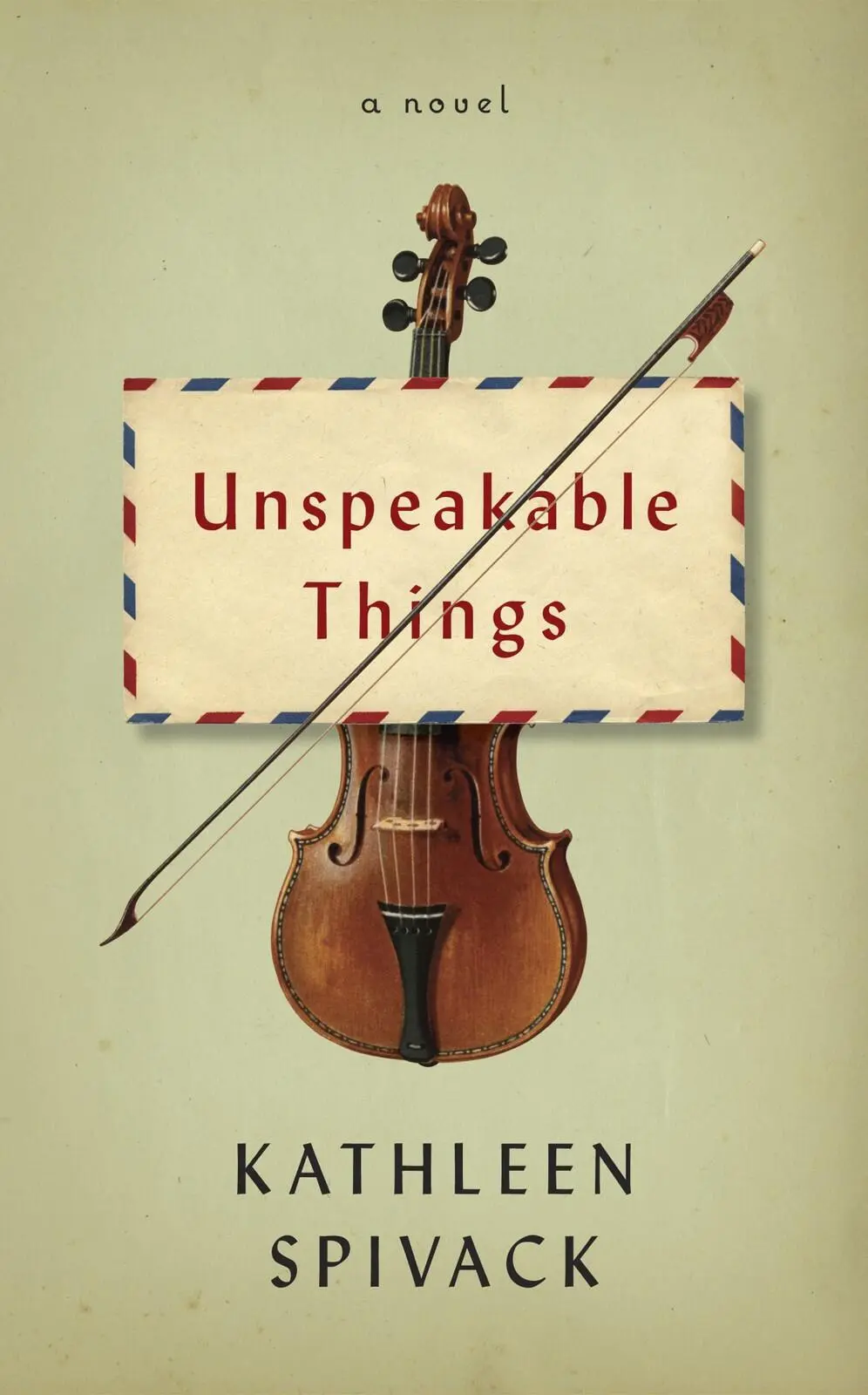
- Название:Unspeakable Things
- Автор:
- Издательство:Knopf
- Жанр:
- Год:2016
- ISBN:нет данных
- Рейтинг книги:4 / 5. Голосов: 1
-
Избранное:Добавить в избранное
- Отзывы:
-
Ваша оценка:
Unspeakable Things: краткое содержание, описание и аннотация
Предлагаем к чтению аннотацию, описание, краткое содержание или предисловие (зависит от того, что написал сам автор книги «Unspeakable Things»). Если вы не нашли необходимую информацию о книге — напишите в комментариях, мы постараемся отыскать её.
and
. A strange, haunting novel about survival and love in all its forms; about sexual awakenings and dark secrets; about European refugee intellectuals who have fled Hitler’s armies with their dreams intact and who have come to an elusive new (American) “can do, will do” world they cannot seem to find. A novel steeped in surreal storytelling and beautiful music that transports its half-broken souls — and us — to another realm of the senses.
The setting: the early 1940s, New York — city of refuge, city of hope, with the specter of a red-hot Europe at war.
At the novel’s center: Anna (known as the Rat), an exotic Hungarian countess with the face of an angel, beautiful eyes, and a seraphic smile, with a passionate intelligence, an exquisite ugliness, and the power to enchant. . Her second cousin Herbert, a former minor Austrian civil servant who believes in Esperanto and the international rights of man, wheeling and dealing in New York, powerful in the social sphere yet under the thumb of his wife, Adeline. . Michael, their missing homosexual son. . Felix, a German pediatrician who dabbles in genetic engineering, practicing from his Upper East Side office with his little dachshund, Schatzie, by his side. . The Tolstoi String Quartet, four men and their instruments, who for twenty years lived as one, playing the great concert halls of Europe, escaping to New York with their money sewn into the silk linings of their instrument cases. .
And watching them all: Herbert’s eight-year-old granddaughter, Maria, who understands from the furtive fear of her mother, and the huddled penury of their lives, and the sense of being in hiding, even in New York, that life is a test of courage and silence, Maria witnessing the family’s strange comings and goings, being regaled at night, when most are asleep, with the intoxicating, thrilling stories of their secret pasts. . of lives lived in Saint Petersburg. . of husbands being sent to the front and large, dangerous debts owed to the Tsar of imperial Russia, of late-night visits by coach to the palace of the Romanovs to beg for mercy and avoid execution. . and at the heart of the stories, told through the long nights with no dawn in sight, the strange, electrifying tale of a pact made in desperation with the private adviser to the Tsar and Tsarina — the mystic faith healer Grigory Rasputin (Russian for “debauched one”), a pact of “companionship” between Anna (the Rat) and the scheming Siberian peasant — turned — holy man, called the Devil by some, the self-proclaimed “only true Christ,” meeting night after night in Rasputin’s apartments, and the spellbinding, unspeakable things done there in the name of penance and pleasure. .
Unspeakable Things — читать онлайн бесплатно полную книгу (весь текст) целиком
Ниже представлен текст книги, разбитый по страницам. Система сохранения места последней прочитанной страницы, позволяет с удобством читать онлайн бесплатно книгу «Unspeakable Things», без необходимости каждый раз заново искать на чём Вы остановились. Поставьте закладку, и сможете в любой момент перейти на страницу, на которой закончили чтение.
Интервал:
Закладка:
The government-ordered tuning was effective at inciting mob violence. People went berserk more easily, and no one knew why. Soon all of Germanic-conquered Europe was screwed to a higher pitch. Beneath the perception of hearing, the tuning raised the level of crowd anxiety and patriotism. It was a do-something tuning. Inspired by this new level of sound, crowds went wild. People could be easily persuaded now. Political speeches rose to a shriller tone, and the music did, too. An immense collective destruction rose uneasily at the sound of military bands, the warlike sounds of triumph and anxiety. Later, European orchestras would tune their instruments even higher, some to 444 and beyond.
The members of the Tolstoi Quartet had never been made aware of Goebbels’s edict regarding the new tuning, and even so, they would have ignored it. But the new fingers were restive. The Nazi 440 they were accustomed to made the old tuning sound a little flat to them. Each time the little fingers inched their way a bit above the normal note according to the old tuning, the Tolstoi musicians whacked them again with their heavy horsehair and Pernambuco bows.
After a while, the pinkies were forced to play melodically with the others. Hitched like oxen forever joined to the rest of the hand, the new fingers became sullen and sluggish. They drooped, were less eager to dominate all the notes and the other fingers. They feigned sleep and finally refused to move at all, falling asleep during passages where they were called up to excel, lulled into laziness by the more interior sound of the old tuning. They buckled and lay down on the job.
“Work for a living!” the men cried, flogging their fingers unmercifully. Sore at night, resentful and full of self-pity, the pinkies finally learned. And so they went back to work.
When the pinkies started to behave again, the men allowed them a tiny smear of liverwurst on their knuckles. But it would take a lot of smears of liverwurst to retrain those hands to play as one. And a long time to get the little fingers out of their reflexive Wagnerian obsession and back into harness with good old Mozart.
Chapter 26 OBEY
“Adeline.” Herbert took the thin hands of his ailing wife in his. “Wake up. I have news.” Beside her bed, David watched, as if from a distance, his mother and father.
Adeline stirred, as if to avoid the two men. Perhaps she had been dreaming. “Open your eyes, my dearest,” Herbert coaxed.
The frail woman moved her head again, as if in protest against this harsh presence, this intrusive light that tingled at her eyelids. She moved her thin hands.
“Look,” Herbert said, awed. “She is practicing.”
“Mother…,” David began timidly. But he was frightened of her, this old woman with the savage ability to wound.
“My little girl.” Herbert seized her hands in his and kissed them. Adeline withdrew her hands and regarded him suspiciously. If she squinted, she could make him out to be a total stranger, an intrusive one. Not the one she had loved best. No, not that one.
“You did this!” she hissed to him, malevolent as a goose, indicating with her fierce gaze the entire women’s ward. “Look at me. I am nothing!”
In despair, she sank again into her sallow reverie. But her fingers plucked on, practicing the piano on the top of the folded sheet.
“Stop that, my darling.” Herbert again took her two hands in his. “I have something to tell you.”
She did not respond. “Something remarkable. Something marvelous,” Herbert coaxed. “A surprise for you.”
David turned away, impatient. He hated his father’s cloying way of humoring his mother, who, for as long as he could remember, had always been impossible. What hypocrisy, their formal relation. “I grew up without love,” he thought for a moment, and tears sprang to his reddened, exhausted eyes. He was condemned to care for these two mad old people forever.
“So when am I going to get my turn to live?” he demanded of the silent, invisible Michael. “It’s your fault, leaving me with them like this. ‘When?’ I ask.” The spirit of Michael said nothing, curled slyly around the steam pipes.
Herbert was still leaning over Adeline’s bedside, whispering soft, crooning words of love and encouragement, and Adeline shook them away. “No,” she said to Herbert impatiently. “Leave me alone to sleep.”
David sighed, forced once again to witness his elderly parents in their approach-avoidance dance. “Papa, get to the point,” he interjected impatiently.
The two old people hardly noticed him, so intent were they on playing their script. “Look,” said Herbert finally, cupping Adeline’s chin in his hand. “David’s here.”
“David?” Adeline’s wondering gaze fell on him. Did she see him at all?
The ghost of Michael smiled in its sly way and slithered closer.
“I’m so tired of your suffering,” David said to his dead brother. “That eternal suffering. Always. Where is the place for me in this family? You’ve taken all the air. Oh,” thought David, exasperated, “just as you always have. It was always you. Michael the gifted, the special, the sensitive! How I have hated you.”
“Brother, I forgive you, for you know not what….” Michael wreathed himself closer to his family in a sanctimonious, ingratiating way.
David tried to get a hold of himself. “I forgive you, too,” he thought, feeling guilty at once for the fact of his ruddy survival.
He thought of his younger brother. “How could you be so different from me? Mama’s favorite. You should have been the same. But Mama divided us.” The steam pipes hissed in the bare room. In the nearby beds, troubled old women tossed and muttered.
Now the spirit of Michael wreathed itself about the body of David. “That is true, my brother. We were different. Now you are alive, and you must live for me just the same.”
Together, the brothers, one dead, one alive, regarded their aged parents, the tableau they made on the bed. “Take care of them for me,” said Michael.
David brushed away the smoke that was his brother and tears sprang to his eyes. “My brother,” he whispered, overcome by tenderness. “It was always you I loved best.” He thought of the golden-haired boy who had been Michael.
Michael ruffled David’s thinning hair. A gust of heat — or was it a current of air? — from the pipes caressed David’s neck.
Adeline opened her eyes and stared at her grown son beside her. This time, her eyes were lucid, focused. “David. What are you doing here at this time of day?” she asked accusingly. “Why aren’t you at work?” Adeline turned to Herbert. “Why isn’t he at work?” Then turning back to David, she asked harshly, “And how are Ilse and the children?”
“Fine, Mama. Just fine. Maria’s at the top of her class, and Philip will be starting kindergarten soon.”
Adeline fell back on the pillow again and allowed her eyes to fog. “That wife of yours, is she still working as hard? She ought to be home with your children. The woman has no sense.” Her hands resumed their plucking.
“I’ll tell her,” David muttered.
Herbert shot him a glance. Then, as if barely tolerating this interruption by his elder son, Herbert leaned forward and began again. “Listen to me.”
Adeline said nothing, but it was clear in her grouchy demeanor that she was temporarily in truce mode.
“Are you ready, my darling? Because I have brought some special visitors to see you today.”
“No visitors!” Adeline hissed, turning her aristocratic head away from her husband. But it was too late. “Why do you always bother me?”
“Too late,” cried Herbert, the magic maker. He sprang to his feet and twirled twice on his toes, then extended a raggedy arm toward the doorway. “Come in, my good fellows.”
Читать дальшеИнтервал:
Закладка:
Похожие книги на «Unspeakable Things»
Представляем Вашему вниманию похожие книги на «Unspeakable Things» списком для выбора. Мы отобрали схожую по названию и смыслу литературу в надежде предоставить читателям больше вариантов отыскать новые, интересные, ещё непрочитанные произведения.









Обсуждение, отзывы о книге «Unspeakable Things» и просто собственные мнения читателей. Оставьте ваши комментарии, напишите, что Вы думаете о произведении, его смысле или главных героях. Укажите что конкретно понравилось, а что нет, и почему Вы так считаете.