Kathleen Spivack - Unspeakable Things
Здесь есть возможность читать онлайн «Kathleen Spivack - Unspeakable Things» весь текст электронной книги совершенно бесплатно (целиком полную версию без сокращений). В некоторых случаях можно слушать аудио, скачать через торрент в формате fb2 и присутствует краткое содержание. Год выпуска: 2016, Издательство: Knopf, Жанр: Современная проза, на английском языке. Описание произведения, (предисловие) а так же отзывы посетителей доступны на портале библиотеки ЛибКат.
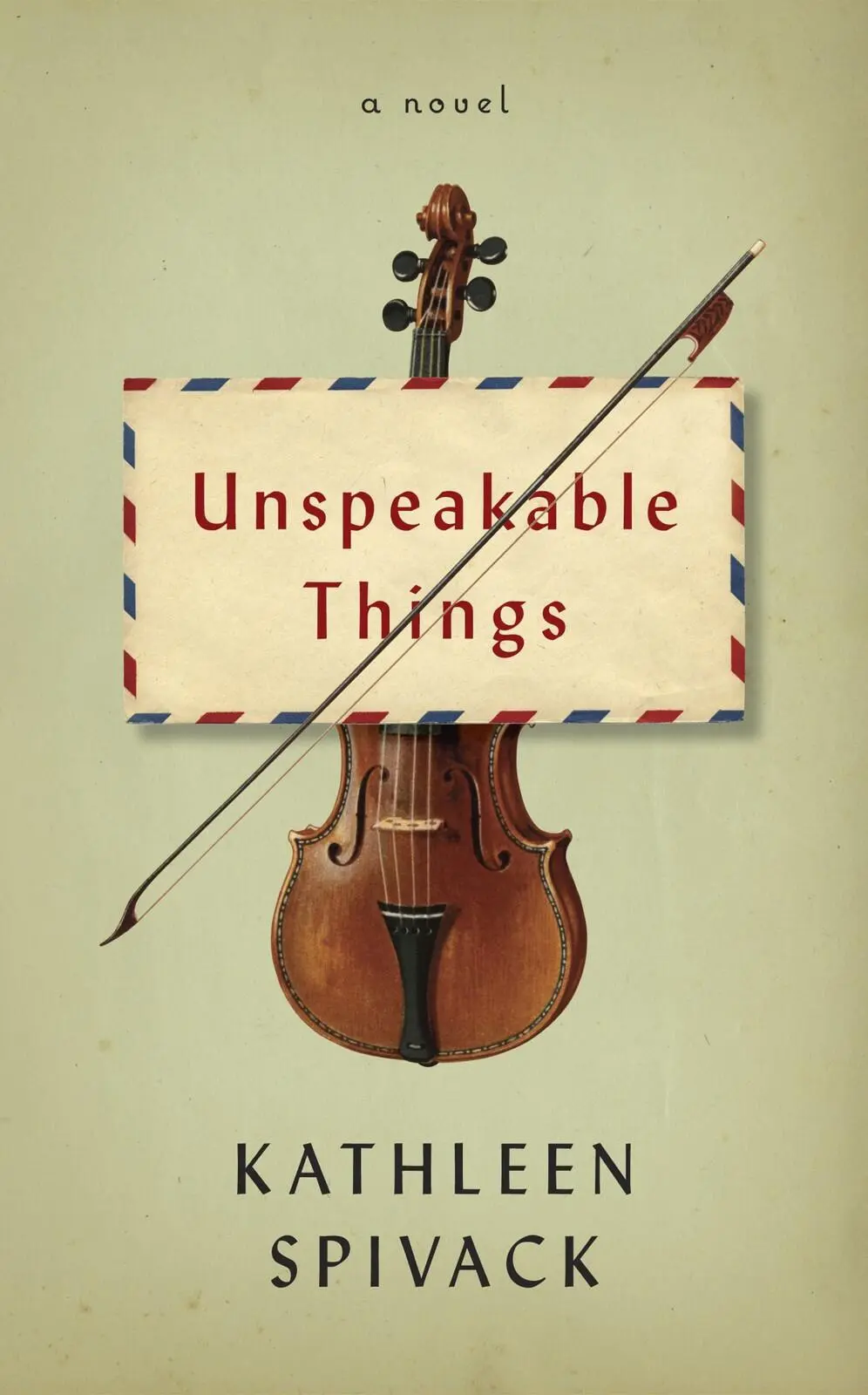
- Название:Unspeakable Things
- Автор:
- Издательство:Knopf
- Жанр:
- Год:2016
- ISBN:нет данных
- Рейтинг книги:4 / 5. Голосов: 1
-
Избранное:Добавить в избранное
- Отзывы:
-
Ваша оценка:
Unspeakable Things: краткое содержание, описание и аннотация
Предлагаем к чтению аннотацию, описание, краткое содержание или предисловие (зависит от того, что написал сам автор книги «Unspeakable Things»). Если вы не нашли необходимую информацию о книге — напишите в комментариях, мы постараемся отыскать её.
and
. A strange, haunting novel about survival and love in all its forms; about sexual awakenings and dark secrets; about European refugee intellectuals who have fled Hitler’s armies with their dreams intact and who have come to an elusive new (American) “can do, will do” world they cannot seem to find. A novel steeped in surreal storytelling and beautiful music that transports its half-broken souls — and us — to another realm of the senses.
The setting: the early 1940s, New York — city of refuge, city of hope, with the specter of a red-hot Europe at war.
At the novel’s center: Anna (known as the Rat), an exotic Hungarian countess with the face of an angel, beautiful eyes, and a seraphic smile, with a passionate intelligence, an exquisite ugliness, and the power to enchant. . Her second cousin Herbert, a former minor Austrian civil servant who believes in Esperanto and the international rights of man, wheeling and dealing in New York, powerful in the social sphere yet under the thumb of his wife, Adeline. . Michael, their missing homosexual son. . Felix, a German pediatrician who dabbles in genetic engineering, practicing from his Upper East Side office with his little dachshund, Schatzie, by his side. . The Tolstoi String Quartet, four men and their instruments, who for twenty years lived as one, playing the great concert halls of Europe, escaping to New York with their money sewn into the silk linings of their instrument cases. .
And watching them all: Herbert’s eight-year-old granddaughter, Maria, who understands from the furtive fear of her mother, and the huddled penury of their lives, and the sense of being in hiding, even in New York, that life is a test of courage and silence, Maria witnessing the family’s strange comings and goings, being regaled at night, when most are asleep, with the intoxicating, thrilling stories of their secret pasts. . of lives lived in Saint Petersburg. . of husbands being sent to the front and large, dangerous debts owed to the Tsar of imperial Russia, of late-night visits by coach to the palace of the Romanovs to beg for mercy and avoid execution. . and at the heart of the stories, told through the long nights with no dawn in sight, the strange, electrifying tale of a pact made in desperation with the private adviser to the Tsar and Tsarina — the mystic faith healer Grigory Rasputin (Russian for “debauched one”), a pact of “companionship” between Anna (the Rat) and the scheming Siberian peasant — turned — holy man, called the Devil by some, the self-proclaimed “only true Christ,” meeting night after night in Rasputin’s apartments, and the spellbinding, unspeakable things done there in the name of penance and pleasure. .
Unspeakable Things — читать онлайн бесплатно полную книгу (весь текст) целиком
Ниже представлен текст книги, разбитый по страницам. Система сохранения места последней прочитанной страницы, позволяет с удобством читать онлайн бесплатно книгу «Unspeakable Things», без необходимости каждый раз заново искать на чём Вы остановились. Поставьте закладку, и сможете в любой момент перейти на страницу, на которой закончили чтение.
Интервал:
Закладка:
“My children, we have work to do!” he called gaily down to the two moving men who now, near the final turn of the landing, set the trunk down on one end and took a breath. “It is a new day!” cackled Felix.
“Oh yeah?” The men regarded the little doctor sourly. Felix’s monocle glittered in the early-morning daylight, and his bushy hair stood on end, making an aureole around his head like the illustrations in the German children’s book Struwwelpeter. “What is he so happy about?” They looked at each other.
“A fine morning, gentlemen,” said Felix, stumbling down the stairs after them. Felix struggled under the weight he was carrying. In his small suitcase, he had managed to reserve a special place for his photograph of the Führer, and his own personal specimen, the bit from his own sex. Otherwise, the bag was filled with his journal observations and notes, a few personal grooming items such as his mustache comb, and that was all. Under the other arm, he held his heavily sleeping dachshund. “Wait for me,” he panted.
“Forward!” The merchant ship Calypso was ready down at the docks, with instructions to carry its secret, most important passenger to Venezuela. A laboratory and a job were already waiting for him. On board, Joe Riley, the young captain, waited. In the port of La Guaira, the beautiful one-legged whore, Carmelita, was also waiting hungrily for Joe. The parrot on his shoulder, Sugar, took an instant dislike to Felix, and as he walked onto the deck, Sugar, squawking, hurtled out and grabbed him by the nose.
But Felix was now safely on the boat and out of the harbor, turning from time to time to gaze back at the receding skyline of New York with mingled pleasure and regret. Then he allowed himself to look fully forward, to the horizon, toward which the boat was steaming. Felix finally put Schatzie, still in her rug, on the deck near his feet and lit a cigar. He leaned on the rail. For a brief time, at least, he could relax.
Three hours later, when David and his men from the federal government, carrying their solemn warrant of arrest for espionage, came to Felix’s apartment, they did not even have to break open the door. David sounded the bell a couple of times. Then he tried the handle. The door swung open, welcoming them inside. Above, the somber faces of little children watched them enter, impassive. “To Uncle Felix with gratitude.” The apartment was hushed.
“Anybody here?” But there was no one, no answer. “This the place?”
“Yes,” said David.
But just as David had suspected — in fact, as he had halfway hoped — Felix was no longer there. David felt a mixture of exasperation and relief. He rubbed his grainy eyes. Cold morning light leaked all over the place, revealing the shabby carpet and curtains. Felix’s office was tidy, the instruments carefully laid out beside the sterilizer, and the examining table with a fresh sheet on it. All was impeccable.
David went to Felix’s desk and halfheartedly opened and shut the drawers. He was hoping to find nothing. And his hopes were rewarded. “This is it, gentlemen,” he said. He wanted to go home, home to Ilse and the children, back to that little room where he could at least lay his head down for a moment and take a few hours’ repose. But he could not ask for that. His personal life he kept secret from the men with whom he worked. Of course there was a dossier on him; he knew that. But as long as things were not spoken aloud, David could keep his family alive. Somewhere, he was important, needed, and the core of a family. Somewhere in the world — in fact, right here in New York, across town, if anyone cared to know it. “Oh, hurry up!” he thought, as the agents opened and shut each drawer again.
David walked into what had served as Felix’s kitchen and blinked. A large jar stood on the counter. From it rose a briny smell, and a glow. Within it, now totally silent, curved and imploring, lay the meek little fingers of the Tolstoi Quartet. David looked, first at the jar and then away for a moment, clearing his vision to look again more closely. The fingers lay without sound. On the counter, there was also a large crinkled envelope. David took it. “Whistle the first few lines of the Mozart — you will know which one — and these boys will find their way to their rightful owners. Sorry for all the trouble. Heil Hitler.” Felix had scribbled this in Esperanto.
From the mess of brine and glass shards on the floor at his feet, in a great heave and shudder, a small dachshund staggered up, groveling and licking at David’s shoes. “Schatzie!” said David, thinking he recognized the dog. The dog he called Schatzie snuffled and snorted, wiggling the entire back half of her body in ecstatic greeting. The dog shook off the glass shards from her short hair. And it was then that David saw that this dog, now wagging her behind most enthusiastically as she begged to be loved, to be picked up, gathered in, and taken home to a family, had a slight but visible deviation that made it impossible to call her Schatzie. The dog, a Schatzie replica in almost all respects, differed in a most important one. This dog, now thumping unmistakably in greeting, had two tails. Two tails! Yes, two perfect tails.
David recoiled from the dog. Then, in one gesture, saying, “All right, all right,” he patted the dog and bent down and picked it up. “All right.” The fingers began to drum a strange rhythm on the glass.
David felt in his bones the beginnings of relaxation. All he wanted was summer, which he knew was coming, and then, for his family, a quiet place with a garden. In his mind, he saw himself teaching little Philip to play chess. Music filled the dream space where he watched this scene, his father aging, watching this with him. Then David watched himself also aging, sitting in the garden with his wife and children, then Maria growing up, then Philip.
He put his arm around his wife, who sat with a basket of apples, which she was peeling, while the wind blew its autumn leaves about the garden. There was music coming from the house behind them. Ilse looked at her husband lovingly. He tightened his arm around her; no need to say a word. Maria and Philip married; their children played in the garden. David and Ilse were old now, peaceful. The War had ended long ago. And at their feet in that autumn garden, an old dog watched them and laid its head on its paws. The old dog, the family dog. Thump, thump, a soft brushing sound that accompanied them always, hardly noticed, so constant was it through their lives. The sound of two tails, two happy tails wagging in unison. “Yes, Mitzie. Dear Mitzie,” they crooned to the dog.
Thump, thump. Swishing through life.
Chapter 25 THE LIVERWURST SOLUTION
Before leaving, David picked up the smoky lab jar that held the fingers and queasily closed it. The liquid was oily and the fingers started to circle. He put the jar in his briefcase and walked to midtown. That afternoon, he waited at the Automat. “Enjoy the dance,” David said to the jar. “It might be your last.” The fingers gyrated madly in their amniotic brew.
David waited a long time in front of a curdled cup of coffee. He knew that the members of the Tolstoi Quartet, informed by his father, would come to him. Finally, by late afternoon, curious and pulled by news they could only half understand, the musicians arrived. “We expected your father, Herr Hofrat.” They looked at David suspiciously.
Their eyes were furtive yet hopeful. Shabby and unwashed, clutching their instruments, the Quartet seated themselves at the scratched Formica table. The chairs protested as the men pulled them in. “So, my boy, have you brought news for us?”
David unscrewed the lid of the large jar and placed it on the table. Furious green fumes rose up. The men peered at David and then at the jar and its contents. They looked at one another, while David nodded encouragement. One by one, they slid their damaged hands into the open jar. The life-giving fluid was noxious, pea green and bilious. It rose up to meet each violation of its surface, and lapped, carnivorous, to catch each hand.
Читать дальшеИнтервал:
Закладка:
Похожие книги на «Unspeakable Things»
Представляем Вашему вниманию похожие книги на «Unspeakable Things» списком для выбора. Мы отобрали схожую по названию и смыслу литературу в надежде предоставить читателям больше вариантов отыскать новые, интересные, ещё непрочитанные произведения.










Обсуждение, отзывы о книге «Unspeakable Things» и просто собственные мнения читателей. Оставьте ваши комментарии, напишите, что Вы думаете о произведении, его смысле или главных героях. Укажите что конкретно понравилось, а что нет, и почему Вы так считаете.