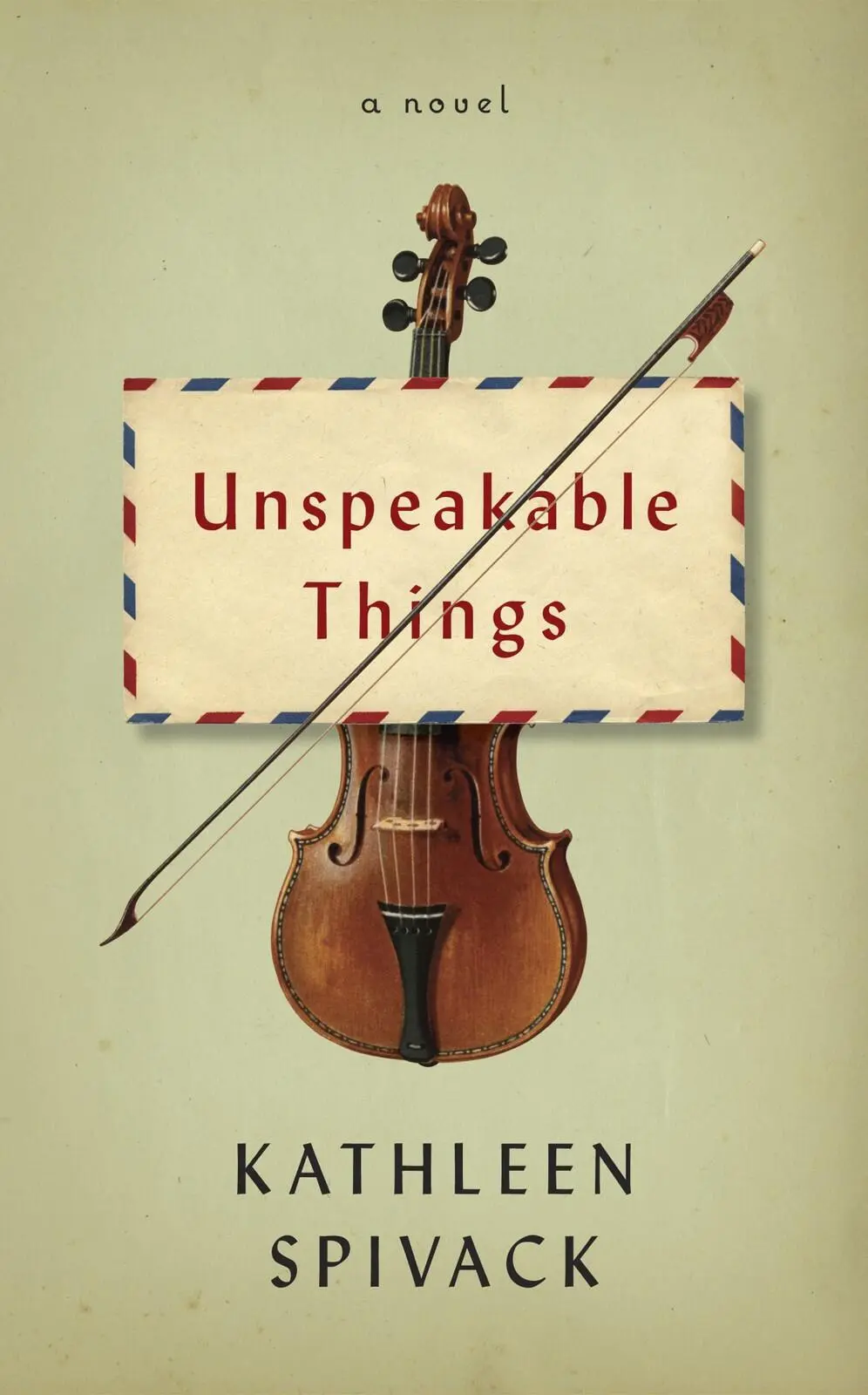
Kathleen Spivack - Unspeakable Things
Здесь есть возможность читать онлайн «Kathleen Spivack - Unspeakable Things» весь текст электронной книги совершенно бесплатно (целиком полную версию без сокращений). В некоторых случаях можно слушать аудио, скачать через торрент в формате fb2 и присутствует краткое содержание. Год выпуска: 2016, Издательство: Knopf, Жанр: Современная проза, на английском языке. Описание произведения, (предисловие) а так же отзывы посетителей доступны на портале библиотеки ЛибКат.
- Название:Unspeakable Things
- Автор:
- Издательство:Knopf
- Жанр:
- Год:2016
- ISBN:нет данных
- Рейтинг книги:4 / 5. Голосов: 1
-
Избранное:Добавить в избранное
- Отзывы:
-
Ваша оценка:
Unspeakable Things: краткое содержание, описание и аннотация
Предлагаем к чтению аннотацию, описание, краткое содержание или предисловие (зависит от того, что написал сам автор книги «Unspeakable Things»). Если вы не нашли необходимую информацию о книге — напишите в комментариях, мы постараемся отыскать её.
and
. A strange, haunting novel about survival and love in all its forms; about sexual awakenings and dark secrets; about European refugee intellectuals who have fled Hitler’s armies with their dreams intact and who have come to an elusive new (American) “can do, will do” world they cannot seem to find. A novel steeped in surreal storytelling and beautiful music that transports its half-broken souls — and us — to another realm of the senses.
The setting: the early 1940s, New York — city of refuge, city of hope, with the specter of a red-hot Europe at war.
At the novel’s center: Anna (known as the Rat), an exotic Hungarian countess with the face of an angel, beautiful eyes, and a seraphic smile, with a passionate intelligence, an exquisite ugliness, and the power to enchant. . Her second cousin Herbert, a former minor Austrian civil servant who believes in Esperanto and the international rights of man, wheeling and dealing in New York, powerful in the social sphere yet under the thumb of his wife, Adeline. . Michael, their missing homosexual son. . Felix, a German pediatrician who dabbles in genetic engineering, practicing from his Upper East Side office with his little dachshund, Schatzie, by his side. . The Tolstoi String Quartet, four men and their instruments, who for twenty years lived as one, playing the great concert halls of Europe, escaping to New York with their money sewn into the silk linings of their instrument cases. .
And watching them all: Herbert’s eight-year-old granddaughter, Maria, who understands from the furtive fear of her mother, and the huddled penury of their lives, and the sense of being in hiding, even in New York, that life is a test of courage and silence, Maria witnessing the family’s strange comings and goings, being regaled at night, when most are asleep, with the intoxicating, thrilling stories of their secret pasts. . of lives lived in Saint Petersburg. . of husbands being sent to the front and large, dangerous debts owed to the Tsar of imperial Russia, of late-night visits by coach to the palace of the Romanovs to beg for mercy and avoid execution. . and at the heart of the stories, told through the long nights with no dawn in sight, the strange, electrifying tale of a pact made in desperation with the private adviser to the Tsar and Tsarina — the mystic faith healer Grigory Rasputin (Russian for “debauched one”), a pact of “companionship” between Anna (the Rat) and the scheming Siberian peasant — turned — holy man, called the Devil by some, the self-proclaimed “only true Christ,” meeting night after night in Rasputin’s apartments, and the spellbinding, unspeakable things done there in the name of penance and pleasure. .
Unspeakable Things — читать онлайн бесплатно полную книгу (весь текст) целиком
Ниже представлен текст книги, разбитый по страницам. Система сохранения места последней прочитанной страницы, позволяет с удобством читать онлайн бесплатно книгу «Unspeakable Things», без необходимости каждый раз заново искать на чём Вы остановились. Поставьте закладку, и сможете в любой момент перейти на страницу, на которой закончили чтение.
Интервал:
Закладка:
Voraciously, each severed finger leaped onto its place on the hand of its rightful owner as if to strangle it. They attached themselves and started sucking greedily.
The shock was so secret and so immediate that no one could speak. It had happened so suddenly. Without a further word, the men pushed back their chairs and left the Automat.
David sat there wondering what to do with the jar and where to pour the remaining liquid. He dumped his leftover cup of coffee into the jar, and quickly, before anyone could notice, he, too, ran out of the Automat. The jar waited on the stained table. That evening, it would be added to the huge ever-steaming pot of unusually strengthening pea soup. There would be a number of street fights in the city the next day among the temporarily insane warriors who had ordered soup for lunch.
The Quartet walked through the city grimly without speaking. Their left hands were tightly curled around their newfound brothers. A green cloud surrounded them. “Welcome back,” crooned the restored hands from every cell as they caressed their prodigals. Holding their precious left hands carefully, the musicians entered the subway and took the long trip back to their underground living quarters. Their shabby basement room was home to them now. And all of New York City was their city now. They walked the last blocks. The great-spired city, its dusk like conflagration, reverberated with magnificence. The organ notes of sunset were calling to one another, orange-purples and a corolla of reds. Sound ricocheted from the gleaming towers. A hundred thousand little lights went on. “We’ve been here all along,” they blinked. “Did you just notice us?”
“And where have you been, my darlings?” asked the fingers of the restored missing ones. “We have been waiting so long for you.”
“Wait and find out,” thought the pinkies impatiently to themselves. They couldn’t bear to be touched, for they were different now. But the hands could not keep from caressing the soft pads, the fingertips no longer calloused, of the newfound fifth fingers.
“We have been so lost without you. Now we are complete.” They stroked each other in the safe snail of the closed hands. The pinkies shook off the grasp of thumbs and loving palms. Being fingered by others irritated them.
Once back in their room, the Quartet could not wait to try their beautiful new hands. The instruments bucked in their cases, ready to be let out. “Easy, boys,” the musicians soothed as they carefully released their instruments and began the ritual of wiping them down. They were gentle and loving, and the left hands lay compliant.
“Bach,” the first violinist declared. “It must be Bach. For thou shalt have no other God before Bach. The hushed harmonies of God.” He stopped, and the musicians hesitated. “No,” he said, correcting himself, “Mozart. Mozart is more joyful.”
“Yes!” cried the fingers in finger language, unwinding themselves from one another and stretching. The lost brothers twitched in the presence of their newly attached siblings and tried to free themselves from this quintuplet group behavior.
As the first strains of the Mozart Quartet No. 1 in G Major began, it was evident that something was wrong. Discordancy and squeaking erupted along the fingerboards. Since the musicians were rusty, they tried to ignore the involuntary misbehavior of their left hands. They pressed closer to their instruments, urging the music forward with their bowing arms. But the hands cramped and the fingers squabbled against one another.
For the newcomers, these regenerated fingers, were not “normal.” They had become superfingers. They were no longer team players. After being nourished for so many months by Felix’s brew of liverwurst and other life-enhancing substances, they had evolved into a master race of little fingers. They stretched in strange ways, made sexually suggestive motions, and clambered all over the strings of their instruments in lewd postures. They threatened to break the others’ knuckles. Angrily, they shoved and scratched. “Move out of the way!” They reached out and hammered the notes of all the parts.
But the other fingers and thumbs would have none of this. Calloused, with strongly developed muscles, they also fought back. “Keep off, this is my note,” they insisted, shoving just as hard. Nevertheless, the old fingers were being pushed out of their way by the superpinkies, and they could no longer hit the true notes. Those new digits were dominant, prehensile. They could do anything, reach any note at any moment, and hit the top harmonics, too. They were aggressive and warlike. “We’re the boss now!”
While the fingers quarreled about who would be boss, the musicians stopped playing. “What is it?” asked the second violinist. “What are they doing?” He looked at his twisted fingers, excitedly scratching one another. “Listen.”
“Can it be? I think they were playing Wagner.” The cellist sighed. “It sounds so dark and so horrible. This is not Mozart!” This was the dawn of a new race, a master race with master fingers. It was the sound of triumph and victory.
Outshouting the sweet notes of Mozart, the little fingers tapped the Meistersinger overture, which Hitler had decreed for every rally.
The Tolstoi musicians listened to the music and watched their alien fifth fingers knocking out every note. The new fingers were celebrating the immolation of the old order.
The Quartet realized that the new fingers had to be retrained. The musicians decided to use a system of punishment and reward. Recognizing that only Germanic authority would work at first, they reluctantly began spanking their lost fingers. The new pinkies were strong-willed, but the Quartet simply would not tolerate Wagner. Each time they pushed another finger out of the way, each time they secretly plucked down a Wagnerian note, the musicians whacked the offending fingers with their bows. “This hurts me more than it hurts you!” they grunted. Then the cellist cried, “It hertz!” The four men doubled over in laughter.
Deprived of the elixir that had sustained them, and without Felix’s formula, the fingers slowly shrank. They were no longer special. They missed their liverwurst mixture, pig fat and innards, which the Quartet, on principle, refused to serve. To stave off all noxious Germanic influences, the Quartet switched to Italian salami instead. The little fingers became weaker and more compliant. The men worked hard to accustom them again to the familiar classical tuning, to move them down on the strings, to get over the habit of pressing the strings slightly higher and sharper, when the rest of the fingers were peacefully obeying their traditional tuning.
For tuning had changed. In the middle of the nineteenth century, some composers and players had started adding additional stretch to their instrumental tuning, But in 1939, Goebbels, then Minister of Propaganda, made it official. He decided to change the tuning of all musical instruments. The note A was cranked from 432 hertz to 440. The old classical tuning of A, as it stood, was too calming, too inward. Goebbels wanted something that would incite the crowds. Though not discernible to the human ear, this change moved the whole tuning up, one whole tone sharper and more insistent. The director of music, Furtwängler, supported this edict. It was known that Verdi, Italian and individualist, had refused to alter all his tuning, while Richard Wagner, his nineteenth-century contemporary, had complied. The operas of Wagner, Teutonic, nationalistic, now with an entire industry devoted to them at Bayreuth, inspired the passions of the Führer. That was enough reason for Goebbels’s decision. He did a few experiments in support of the edict. And the music of Wagner was on the last program given by the Berlin Philharmonic Orchestra before it was forced to close its doors at the end of the War.
Читать дальшеИнтервал:
Закладка:
Похожие книги на «Unspeakable Things»
Представляем Вашему вниманию похожие книги на «Unspeakable Things» списком для выбора. Мы отобрали схожую по названию и смыслу литературу в надежде предоставить читателям больше вариантов отыскать новые, интересные, ещё непрочитанные произведения.









Обсуждение, отзывы о книге «Unspeakable Things» и просто собственные мнения читателей. Оставьте ваши комментарии, напишите, что Вы думаете о произведении, его смысле или главных героях. Укажите что конкретно понравилось, а что нет, и почему Вы так считаете.