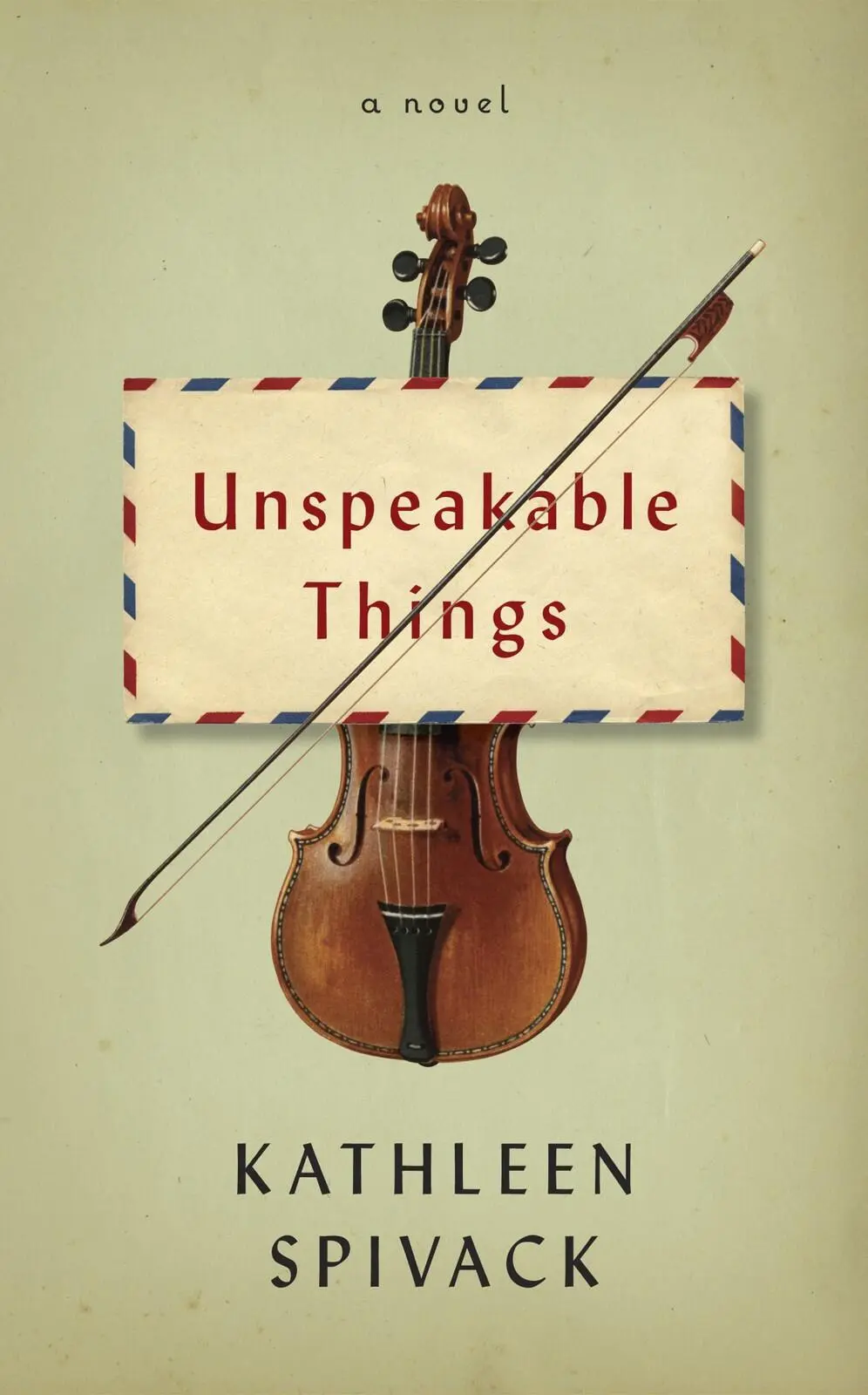
Kathleen Spivack - Unspeakable Things
Здесь есть возможность читать онлайн «Kathleen Spivack - Unspeakable Things» весь текст электронной книги совершенно бесплатно (целиком полную версию без сокращений). В некоторых случаях можно слушать аудио, скачать через торрент в формате fb2 и присутствует краткое содержание. Год выпуска: 2016, Издательство: Knopf, Жанр: Современная проза, на английском языке. Описание произведения, (предисловие) а так же отзывы посетителей доступны на портале библиотеки ЛибКат.
- Название:Unspeakable Things
- Автор:
- Издательство:Knopf
- Жанр:
- Год:2016
- ISBN:нет данных
- Рейтинг книги:4 / 5. Голосов: 1
-
Избранное:Добавить в избранное
- Отзывы:
-
Ваша оценка:
Unspeakable Things: краткое содержание, описание и аннотация
Предлагаем к чтению аннотацию, описание, краткое содержание или предисловие (зависит от того, что написал сам автор книги «Unspeakable Things»). Если вы не нашли необходимую информацию о книге — напишите в комментариях, мы постараемся отыскать её.
and
. A strange, haunting novel about survival and love in all its forms; about sexual awakenings and dark secrets; about European refugee intellectuals who have fled Hitler’s armies with their dreams intact and who have come to an elusive new (American) “can do, will do” world they cannot seem to find. A novel steeped in surreal storytelling and beautiful music that transports its half-broken souls — and us — to another realm of the senses.
The setting: the early 1940s, New York — city of refuge, city of hope, with the specter of a red-hot Europe at war.
At the novel’s center: Anna (known as the Rat), an exotic Hungarian countess with the face of an angel, beautiful eyes, and a seraphic smile, with a passionate intelligence, an exquisite ugliness, and the power to enchant. . Her second cousin Herbert, a former minor Austrian civil servant who believes in Esperanto and the international rights of man, wheeling and dealing in New York, powerful in the social sphere yet under the thumb of his wife, Adeline. . Michael, their missing homosexual son. . Felix, a German pediatrician who dabbles in genetic engineering, practicing from his Upper East Side office with his little dachshund, Schatzie, by his side. . The Tolstoi String Quartet, four men and their instruments, who for twenty years lived as one, playing the great concert halls of Europe, escaping to New York with their money sewn into the silk linings of their instrument cases. .
And watching them all: Herbert’s eight-year-old granddaughter, Maria, who understands from the furtive fear of her mother, and the huddled penury of their lives, and the sense of being in hiding, even in New York, that life is a test of courage and silence, Maria witnessing the family’s strange comings and goings, being regaled at night, when most are asleep, with the intoxicating, thrilling stories of their secret pasts. . of lives lived in Saint Petersburg. . of husbands being sent to the front and large, dangerous debts owed to the Tsar of imperial Russia, of late-night visits by coach to the palace of the Romanovs to beg for mercy and avoid execution. . and at the heart of the stories, told through the long nights with no dawn in sight, the strange, electrifying tale of a pact made in desperation with the private adviser to the Tsar and Tsarina — the mystic faith healer Grigory Rasputin (Russian for “debauched one”), a pact of “companionship” between Anna (the Rat) and the scheming Siberian peasant — turned — holy man, called the Devil by some, the self-proclaimed “only true Christ,” meeting night after night in Rasputin’s apartments, and the spellbinding, unspeakable things done there in the name of penance and pleasure. .
Unspeakable Things — читать онлайн бесплатно полную книгу (весь текст) целиком
Ниже представлен текст книги, разбитый по страницам. Система сохранения места последней прочитанной страницы, позволяет с удобством читать онлайн бесплатно книгу «Unspeakable Things», без необходимости каждый раз заново искать на чём Вы остановились. Поставьте закладку, и сможете в любой момент перейти на страницу, на которой закончили чтение.
Интервал:
Закладка:
Herbert could not envision a time when he would not frequent the Automat, making deals for human lives. He could not imagine a day not spent at the New York Public Library, where, out of the gloom of the great hushed hall, small figures broke from the general dimness to fling themselves at his feet, presenting their appeals. He felt each life, each loss, as if it had been his own. But in another way, like a giant rock in the water, he felt nothing. He was implacable-seeming, even while he was being imperceptibly worn down.
“Bless you, Herr Hofrat.” He allowed his ring to be kissed. His eyes closed for a moment in remembered pain. But there was no time for his own feelings, really. “Bless you.”
“I am of service,” he replied humbly. “I am at your service. What can I do for you?” He waited, he listened, his large ears backlit, his head like an aureole.
Tonight, shoulders bent, as always, under the shabby overcoat, Herbert waited beside the outstretched arm of the usher, before the ranks of seats in the front row of Carnegie Hall. He stood aside to allow Adeline to enter.
Adeline was wearing her best finery today: the silk dress, low cut over the shrunken bosom, the fine pearly stockings, the shoes, the kid gloves, alabaster to the elbow, with little pearl buttons all the way up. She wore her good fur jacket with the silk lining, into which was woven, over and over, the coat of arms of the Emperor Franz Joseph, delicately embossed. Most important, she wore slung about her neck a stole made of little dead foxes, two of them, their sharp teeth still yapping in protest, their small dark eyes open, veiled and glassy, as in the moment of death. Their entwined tails dangled over her left shoulder. And Adeline wore her hat, black and smart.
The rest of the family followed. Maria was enthralled by the foxes, their sharp glassy eyes and black-button noses. She, too, wore her best dress. She and Philip, solemn in their importance, had promised to sit quietly throughout the entire concert.
As Herbert stood aside to allow his wife to enter the front row, a ripple of whispers swept the hall. “Herr Hofrat,” the voices rustled, like many little leaves, leaves of the weeping willow, shaken out of weeping into a moment of recognition. “With his family.”
The rustling of the audience gathered force, swept from the first rows to the last and up into the first and second balconies. “Herr Hofrat!” Leaning forward, the audience was composed almost entirely of refugees, all of whom had turned out to hear their own, their finest musicians in this city of strangers.
Herbert, embarrassed, sank into his seat. But Adeline stood up immediately, poking him with her elbow. Applause ricocheted off the chandeliers, the royal red velvet curtains, the gilded moldings. Herbert became smaller. Graciously, Adeline turned and faced the audience. She inclined her head regally while she adjusted the little foxes, their bared, snarling teeth, around her neck with one delicate gloved hand. She bowed, her nostrils flaring with the exhilaration of being once again center stage. There had been times when she had been applauded like this in the past. She smiled, self-satisfied.
But the audience would not be quiet, would not sit down. On their feet, they continued to applaud. Their cries rose to the ceiling. “Herr Hofrat!”
Herbert hunched modestly in his seat. But finally, when it was clear that the audience would not stop until he did something, he raised one hand and gave a little wave. “Thank you, my friends. Now, please, sit down.”
The great animal of the audience swelled. There was the noise of many people creaking, the rustling of old coats, the smell of wet wool, the readjusting of bodies into seats, and a few coughs.
Herbert hated displays of any kind. “I am so tired,” he thought.
A hush in the hall, and a single spotlight on the rich velvet curtains. The chandeliers were dimmed, their luster fading slowly. Maria leaned forward in her seat. Her chest would almost burst with the beauty of anticipation, royal red excitement of the just-before.
The Tolstoi Quartet entered onto the stage in Germanic precision, stopping in front of Herbert, aligned, to bow once, briskly, before taking their seats. Instruments gleamed in their gloved hands. The first violinist nodded. And then the music began.
Mozart, of course. The music poured, con brio, out of the musicians’ instruments. They swayed, obedient to their masters, bridled, then lifted and galloped. The chariot of the music took hold of Carnegie Hall, and as in the chariot of Phoebus Apollo, the audience was borne upward, up toward the sun itself. Life, the giver of life: Mozart, a golden god, like rays of the sun, showered notes upon the listeners.
The music lifted the listeners to the rafters of the great hall and then opened the roof so that they were dispersed into the starry sky. And through this music, they were vouchsafed another glimpse of the Europe they had left.
Not the Europe of sighs, of darkness. Not the Europe of prejudice disguised as new intellectual thought. Not the Europe of bigotry and jealousy. For hadn’t insatiable jealousy been the innate cause of this diaspora? The Jews knew it, much as they tried to hide their scorn for the stupidity of “the blond, blue-eyed ones.” The jealousy. How they feared it. It started among children way before the school yard. But in Europe, nothing stopped it. The Continent ran on jealousy. Territorial expansion, covetousness. A small, mean series of countries where everyone knew everybody else’s business.
As the music lifted in Carnegie Hall, another Europe, the “real Europe,” or perhaps the “best of Europe,” was to be heard, reminding the audience of its presence. The unreal, romantic Europe of storybooks. The Europe of beauty, of delicate music and flowers and wine and flirtatious glances. Beautiful meals served beautifully. A Europe of gracious people who wished only to enjoy themselves and think about the meaning of life at the same time. A Europe that valued education. And culture. And beauty, carefully cultivated. The cafés open along the boulevard Unter den Linden. The Tiergarten, with its many flowers just waiting to bloom in neat gardens along the paths. The churches. The Platzes and squares. The crystal, the china, the pastry gleaming with sugar and butter in the elegant rooms of the Hotel Sacher. Love affairs. Perfume. Music. Baroque architecture.
The naked Klimt girls, with their jeweled long hair and jeweled eyes, swirling above eye level. The grapes and cupids and goddesses on the stone windowsills of buildings. The ornamentation of life. Everywhere, what was man-made was made to delight the senses. Nothing was simply what it seemed.
Listening to the concert, the refugees strolled once more along the Ring. They sat in the park and let the sun warm their tired bodies. They drank Kaffee mit Schlag. They talked, talked endlessly. About everything and nothing. Once more, they felt the hopefulness of their philosophies. Philosophy that would soon blow to nothing in the light of history. But for now, a belief in education and in culture. Rational man. Some kind of hope.
As if that could somehow veil the underlying barbarism that they had up until now believed was to be found only in America and in some regions of Siberia. Places where the natives were not civilized enough to appreciate Mozart.
When the concert was over, the Mozart, the Haydn, and the Beethoven, the audience would not be quieted. Encore after encore. Finally, the first violinist held up a white-gloved hand. And the Tolstoi Quartet sat down again and played one Strauss waltz after another until the sun came up on a new day in New York.
Only then did the audience agree to go home, picking up their old coats from their chairs, folding the programs and carefully putting them away and taking themselves and their sleeping children out into the streets of New York. Day was beginning in this icy new world, sharp and beautiful and bright. The first rays of the frosty morning sun touched the first skyscrapers. The Quartet packed up their instruments. They were getting ready for their tour now. Mozart and the old masters were in their guardianship.
Читать дальшеИнтервал:
Закладка:
Похожие книги на «Unspeakable Things»
Представляем Вашему вниманию похожие книги на «Unspeakable Things» списком для выбора. Мы отобрали схожую по названию и смыслу литературу в надежде предоставить читателям больше вариантов отыскать новые, интересные, ещё непрочитанные произведения.








Обсуждение, отзывы о книге «Unspeakable Things» и просто собственные мнения читателей. Оставьте ваши комментарии, напишите, что Вы думаете о произведении, его смысле или главных героях. Укажите что конкретно понравилось, а что нет, и почему Вы так считаете.